Carles Corbella , Asim Aijaz , Tomas Kubart , Li Lin , Sabine Portal , Michael Keidar
{"title":"Pulsed plasma vapour deposition of carbon materials: Advantages and challenges","authors":"Carles Corbella , Asim Aijaz , Tomas Kubart , Li Lin , Sabine Portal , Michael Keidar","doi":"10.1016/j.carbon.2024.119772","DOIUrl":null,"url":null,"abstract":"<div><div>Here, we review the benefits of low-temperature pulsed plasma technology on the synthesis of amorphous and diamond-like carbon (DLC) films, nanocrystalline diamond (NCD) films, and carbon nanomaterials, such as graphene and carbon nanotubes. Physical and chemical vapour depositions of strong carbon materials are dominated in industry by magnetron sputtering and vacuum arc. At research stage, carbon deposition can be accomplished by many techniques involving pulsed discharges in vacuum or atmospheric pressure. Either by pulsed-DC glow discharge, high-power impulse magnetron sputtering (HiPIMS), filtered cathodic vacuum arc (FCVA), or anodic arc discharge, the structural and mechanical properties of carbon-based samples can be tailored by adequately adjusting “plasma knobs”, namely peak power, pulse duration, and duty cycle. Milestones such as tuning surface properties via ion bombardment, enhancing plasma ionisation through energetic pulses, and stabilization of plasma processes for industrial implementation, are discussed. Also, pulsed plasma technology arises as an excellent laboratory to train machine learning algorithms thanks to the large variety of material properties. In conclusion, nonequilibrium plasmas operated with pulsed power provide exciting opportunities for (1) fabrication of new carbon architectures with desired functional properties for many applications, and (2) advancing our knowledge on carbon plasma chemistry via artificial intelligence resources.</div></div>","PeriodicalId":262,"journal":{"name":"Carbon","volume":"232 ","pages":"Article 119772"},"PeriodicalIF":11.6000,"publicationDate":"2024-11-02","publicationTypes":"Journal Article","fieldsOfStudy":null,"isOpenAccess":false,"openAccessPdf":"","citationCount":"0","resultStr":null,"platform":"Semanticscholar","paperid":null,"PeriodicalName":"Carbon","FirstCategoryId":"88","ListUrlMain":"https://www.sciencedirect.com/science/article/pii/S0008622324009916","RegionNum":2,"RegionCategory":"材料科学","ArticlePicture":[],"TitleCN":null,"AbstractTextCN":null,"PMCID":null,"EPubDate":"","PubModel":"","JCR":"Q1","JCRName":"CHEMISTRY, PHYSICAL","Score":null,"Total":0}
引用次数: 0
Abstract
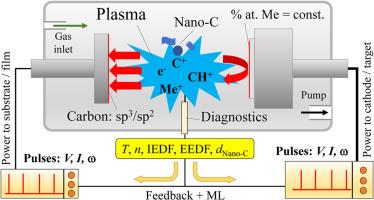
Here, we review the benefits of low-temperature pulsed plasma technology on the synthesis of amorphous and diamond-like carbon (DLC) films, nanocrystalline diamond (NCD) films, and carbon nanomaterials, such as graphene and carbon nanotubes. Physical and chemical vapour depositions of strong carbon materials are dominated in industry by magnetron sputtering and vacuum arc. At research stage, carbon deposition can be accomplished by many techniques involving pulsed discharges in vacuum or atmospheric pressure. Either by pulsed-DC glow discharge, high-power impulse magnetron sputtering (HiPIMS), filtered cathodic vacuum arc (FCVA), or anodic arc discharge, the structural and mechanical properties of carbon-based samples can be tailored by adequately adjusting “plasma knobs”, namely peak power, pulse duration, and duty cycle. Milestones such as tuning surface properties via ion bombardment, enhancing plasma ionisation through energetic pulses, and stabilization of plasma processes for industrial implementation, are discussed. Also, pulsed plasma technology arises as an excellent laboratory to train machine learning algorithms thanks to the large variety of material properties. In conclusion, nonequilibrium plasmas operated with pulsed power provide exciting opportunities for (1) fabrication of new carbon architectures with desired functional properties for many applications, and (2) advancing our knowledge on carbon plasma chemistry via artificial intelligence resources.
期刊介绍:
The journal Carbon is an international multidisciplinary forum for communicating scientific advances in the field of carbon materials. It reports new findings related to the formation, structure, properties, behaviors, and technological applications of carbons. Carbons are a broad class of ordered or disordered solid phases composed primarily of elemental carbon, including but not limited to carbon black, carbon fibers and filaments, carbon nanotubes, diamond and diamond-like carbon, fullerenes, glassy carbon, graphite, graphene, graphene-oxide, porous carbons, pyrolytic carbon, and other sp2 and non-sp2 hybridized carbon systems. Carbon is the companion title to the open access journal Carbon Trends. Relevant application areas for carbon materials include biology and medicine, catalysis, electronic, optoelectronic, spintronic, high-frequency, and photonic devices, energy storage and conversion systems, environmental applications and water treatment, smart materials and systems, and structural and thermal applications.



 京公网安备 11010802042870号
京ICP备2023020795号-1
京公网安备 11010802042870号
京ICP备2023020795号-1

 分享
分享
 求助内容:
求助内容: 应助结果提醒方式:
 扫码关注我们
