Yi Yang , Mingzhi Yuan , Chao Qian , Chengyu Li , Yanping Yang , Xueyan Du , Hongliang Dong , Bin Chen
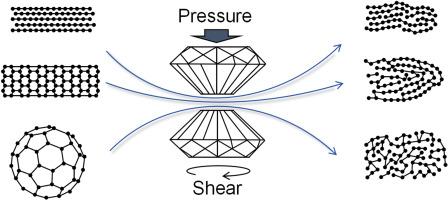
{"title":"Disordering of graphene nanoplatelet, carbon nanotube and C60 fullerene under shear stress","authors":"Yi Yang , Mingzhi Yuan , Chao Qian , Chengyu Li , Yanping Yang , Xueyan Du , Hongliang Dong , Bin Chen","doi":"10.1016/j.carbon.2024.119802","DOIUrl":null,"url":null,"abstract":"<div><div>Carbon nanomaterials typically possess excellent mechanical properties, enabling them to withstand extreme physical environments. However, the response of different nanostructures under shear stress has not yet been experimentally investigated. In this study, we employ the rotational diamond anvil cell to apply pressure and shear to three carbon nanomaterials–graphene nanoplatelet, multi-wall carbon nanotube and C<sub>60</sub> fullerene–and investigate their structure evolution using Raman spectroscopy and electron microscopy. Detailed analysis revealed that the materials exhibit distinct changes in their intrinsic structure. Specifically, defects and lattice distortion were introduced into graphene nanoplatelet, carbon nanotube broke down into curly graphene fragments, and C<sub>60</sub> completely transformed into amorphous carbon. The most compelling discovery is the remarkably high degree of amorphization process in C<sub>60</sub> at room temperature, accompanied by an sp<sup>3</sup> hybridization fraction reaching 20.84 %. Our results underscore the profound impact of shear stress on the stability of carbon-based nanomaterials, provide new insights into their mechanical behavior and potential limitation in practical application, and offer a strategy for regulating these materials which have the strongest covalent bonds.</div></div>","PeriodicalId":262,"journal":{"name":"Carbon","volume":"232 ","pages":"Article 119802"},"PeriodicalIF":11.6000,"publicationDate":"2025-01-15","publicationTypes":"Journal Article","fieldsOfStudy":null,"isOpenAccess":false,"openAccessPdf":"","citationCount":"0","resultStr":null,"platform":"Semanticscholar","paperid":null,"PeriodicalName":"Carbon","FirstCategoryId":"88","ListUrlMain":"https://www.sciencedirect.com/science/article/pii/S0008622324010212","RegionNum":2,"RegionCategory":"材料科学","ArticlePicture":[],"TitleCN":null,"AbstractTextCN":null,"PMCID":null,"EPubDate":"2024/11/5 0:00:00","PubModel":"Epub","JCR":"Q1","JCRName":"CHEMISTRY, PHYSICAL","Score":null,"Total":0}
引用次数: 0
Abstract
Carbon nanomaterials typically possess excellent mechanical properties, enabling them to withstand extreme physical environments. However, the response of different nanostructures under shear stress has not yet been experimentally investigated. In this study, we employ the rotational diamond anvil cell to apply pressure and shear to three carbon nanomaterials–graphene nanoplatelet, multi-wall carbon nanotube and C60 fullerene–and investigate their structure evolution using Raman spectroscopy and electron microscopy. Detailed analysis revealed that the materials exhibit distinct changes in their intrinsic structure. Specifically, defects and lattice distortion were introduced into graphene nanoplatelet, carbon nanotube broke down into curly graphene fragments, and C60 completely transformed into amorphous carbon. The most compelling discovery is the remarkably high degree of amorphization process in C60 at room temperature, accompanied by an sp3 hybridization fraction reaching 20.84 %. Our results underscore the profound impact of shear stress on the stability of carbon-based nanomaterials, provide new insights into their mechanical behavior and potential limitation in practical application, and offer a strategy for regulating these materials which have the strongest covalent bonds.
期刊介绍:
The journal Carbon is an international multidisciplinary forum for communicating scientific advances in the field of carbon materials. It reports new findings related to the formation, structure, properties, behaviors, and technological applications of carbons. Carbons are a broad class of ordered or disordered solid phases composed primarily of elemental carbon, including but not limited to carbon black, carbon fibers and filaments, carbon nanotubes, diamond and diamond-like carbon, fullerenes, glassy carbon, graphite, graphene, graphene-oxide, porous carbons, pyrolytic carbon, and other sp2 and non-sp2 hybridized carbon systems. Carbon is the companion title to the open access journal Carbon Trends. Relevant application areas for carbon materials include biology and medicine, catalysis, electronic, optoelectronic, spintronic, high-frequency, and photonic devices, energy storage and conversion systems, environmental applications and water treatment, smart materials and systems, and structural and thermal applications.



 京公网安备 11010802042870号
京ICP备2023020795号-1
京公网安备 11010802042870号
京ICP备2023020795号-1

 分享
分享
 求助内容:
求助内容: 应助结果提醒方式:
 扫码关注我们
