Thamyres F.M. Moreira, Edgar F. Pinzón, Adriano dos Santos, Laís C. Lopes, Paulo R. Bueno
{"title":"The quantum mechanical origin of the supercapacitance phenomenon in reduced graphene oxide structures","authors":"Thamyres F.M. Moreira, Edgar F. Pinzón, Adriano dos Santos, Laís C. Lopes, Paulo R. Bueno","doi":"10.1016/j.carbon.2024.119736","DOIUrl":null,"url":null,"abstract":"<div><div>We investigated supercapacitance phenomena observed in reduced graphene oxide structures from a quantum mechanical rate viewpoint. The supercapacitance phenomenon in carbonaceous materials has been majorly attributed to electrostatic capacitance contributions, in which the magnitude of this capacitance is correlated with the amount of surface area available to be charged under the presence of electric potential perturbations. Nonetheless, the quantum rate theory predicts a superposition between electrostatic <span><math><msub><mrow><mi>C</mi></mrow><mrow><mi>e</mi></mrow></msub></math></span> and chemical <span><math><msub><mrow><mi>C</mi></mrow><mrow><mi>q</mi></mrow></msub></math></span> (also called quantum) capacitance energetic levels. The superposition of these capacitive states implies that the electric potential perturbation not only drives the separation of charges in space (thus correlating with the geometry of the capacitor and consequently with the surface area) but also governs the occupancy of the electric-field screened electronic structure of reduced graphene oxide embedded in the electrolyte environment. This leads to an energy degeneracy between electrostatic <span><math><mrow><msup><mrow><mi>e</mi></mrow><mrow><mn>2</mn></mrow></msup><mo>/</mo><msub><mrow><mi>C</mi></mrow><mrow><mi>q</mi></mrow></msub></mrow></math></span> and quantum <span><math><mrow><msup><mrow><mi>e</mi></mrow><mrow><mn>2</mn></mrow></msup><mo>/</mo><msub><mrow><mi>C</mi></mrow><mrow><mi>q</mi></mrow></msub></mrow></math></span> capacitive energy states, as confirmed in this work for reduced graphene oxide carbonaceous structures. Accordingly, the analysis proves that the charge dynamics associated with the resistance for charging the pseudo-capacitive <span><math><mrow><mi>E</mi><mo>=</mo><msup><mrow><mi>e</mi></mrow><mrow><mn>2</mn></mrow></msup><mo>/</mo><msub><mrow><mi>C</mi></mrow><mrow><mi>q</mi></mrow></msub></mrow></math></span> states of reduced graphene oxide structure follows a quantum resistance limit <span><math><mrow><msub><mrow><mi>R</mi></mrow><mrow><mi>K</mi></mrow></msub><mo>=</mo><mi>h</mi><mo>/</mo><msup><mrow><mi>e</mi></mrow><mrow><mn>2</mn></mrow></msup><mo>∼</mo><mn>25</mn><mo>.</mo><mn>8</mn></mrow></math></span> k<span><math><mi>Ω</mi></math></span> within a charging frequency of <span><math><mrow><mi>ν</mi><mo>=</mo><mn>1</mn><mo>/</mo><msub><mrow><mi>R</mi></mrow><mrow><mi>K</mi></mrow></msub><msub><mrow><mi>C</mi></mrow><mrow><mi>q</mi></mrow></msub><mo>=</mo><mi>E</mi><mo>/</mo><mi>h</mi><mo>=</mo><msup><mrow><mi>e</mi></mrow><mrow><mn>2</mn></mrow></msup><mo>/</mo><mi>h</mi><msub><mrow><mi>C</mi></mrow><mrow><mi>q</mi></mrow></msub></mrow></math></span> that obeys quantum electrodynamics principles, in agreement with the premises of the quantum rate theory. Two energy levels associated with the occupancy of the electronic states upon the reduction of graphene oxide were identified.</div></div>","PeriodicalId":262,"journal":{"name":"Carbon","volume":"232 ","pages":"Article 119736"},"PeriodicalIF":11.6000,"publicationDate":"2025-01-15","publicationTypes":"Journal Article","fieldsOfStudy":null,"isOpenAccess":false,"openAccessPdf":"","citationCount":"0","resultStr":null,"platform":"Semanticscholar","paperid":null,"PeriodicalName":"Carbon","FirstCategoryId":"88","ListUrlMain":"https://www.sciencedirect.com/science/article/pii/S0008622324009552","RegionNum":2,"RegionCategory":"材料科学","ArticlePicture":[],"TitleCN":null,"AbstractTextCN":null,"PMCID":null,"EPubDate":"2024/11/7 0:00:00","PubModel":"Epub","JCR":"Q1","JCRName":"CHEMISTRY, PHYSICAL","Score":null,"Total":0}
引用次数: 0
Abstract
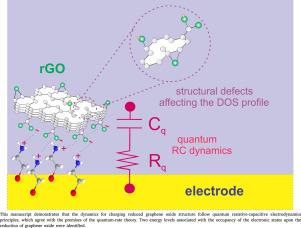
We investigated supercapacitance phenomena observed in reduced graphene oxide structures from a quantum mechanical rate viewpoint. The supercapacitance phenomenon in carbonaceous materials has been majorly attributed to electrostatic capacitance contributions, in which the magnitude of this capacitance is correlated with the amount of surface area available to be charged under the presence of electric potential perturbations. Nonetheless, the quantum rate theory predicts a superposition between electrostatic and chemical (also called quantum) capacitance energetic levels. The superposition of these capacitive states implies that the electric potential perturbation not only drives the separation of charges in space (thus correlating with the geometry of the capacitor and consequently with the surface area) but also governs the occupancy of the electric-field screened electronic structure of reduced graphene oxide embedded in the electrolyte environment. This leads to an energy degeneracy between electrostatic and quantum capacitive energy states, as confirmed in this work for reduced graphene oxide carbonaceous structures. Accordingly, the analysis proves that the charge dynamics associated with the resistance for charging the pseudo-capacitive states of reduced graphene oxide structure follows a quantum resistance limit k within a charging frequency of that obeys quantum electrodynamics principles, in agreement with the premises of the quantum rate theory. Two energy levels associated with the occupancy of the electronic states upon the reduction of graphene oxide were identified.
期刊介绍:
The journal Carbon is an international multidisciplinary forum for communicating scientific advances in the field of carbon materials. It reports new findings related to the formation, structure, properties, behaviors, and technological applications of carbons. Carbons are a broad class of ordered or disordered solid phases composed primarily of elemental carbon, including but not limited to carbon black, carbon fibers and filaments, carbon nanotubes, diamond and diamond-like carbon, fullerenes, glassy carbon, graphite, graphene, graphene-oxide, porous carbons, pyrolytic carbon, and other sp2 and non-sp2 hybridized carbon systems. Carbon is the companion title to the open access journal Carbon Trends. Relevant application areas for carbon materials include biology and medicine, catalysis, electronic, optoelectronic, spintronic, high-frequency, and photonic devices, energy storage and conversion systems, environmental applications and water treatment, smart materials and systems, and structural and thermal applications.



 京公网安备 11010802042870号
京ICP备2023020795号-1
京公网安备 11010802042870号
京ICP备2023020795号-1

 分享
分享
 求助内容:
求助内容: 应助结果提醒方式:
 扫码关注我们
