Xintong Li, Min Gao, Shenglong Li, Zhichuan Yang, Xin Zhao, Yu Liu
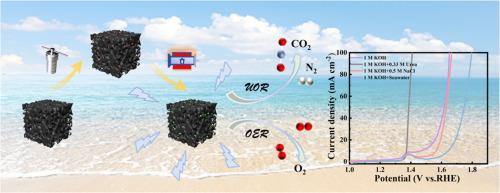
{"title":"Bio-based mesoporous carbon-modified Co3O4 quantum dots as efficient electrocatalyst for freshwater, seawater and urea oxidation reaction","authors":"Xintong Li, Min Gao, Shenglong Li, Zhichuan Yang, Xin Zhao, Yu Liu","doi":"10.1016/j.mcat.2024.114678","DOIUrl":null,"url":null,"abstract":"<div><div>The combination of quantum dots (QDs) with carbon materials has garnered significant attention as electrocatalysts owing to their exceptional catalytic activity and robust thermodynamic stabilities. The present study utilizes bio-based mesoporous carbon as a carbon source to synthesize QDs carbon nanostructures (Co<sub>3</sub>O<sub>4</sub>/BMC<em><sub>-400</sub></em>) through hydrothermal and carbonization methods. Due to the abundance of active sites and limited availability of Co, the size of Co particles is confined to the QDs level, ranging from 2 to 3 nm. The anodic oxidation reaction of the Co<sub>3</sub>O<sub>4</sub>/BMC<em><sub>-400</sub></em> was investigated in freshwater, seawater, and urea. The prepared Co<sub>3</sub>O<sub>4</sub>/BMC<em><sub>-400</sub></em> exhibits an oxygen evolution reaction overpotential of 235 mV at 10 mA cm<sup>−2</sup> in 1.0 M KOH. The catalytic activity is reduced as a result of the competitive oxidation and corrosion caused by chloride ions in seawater. For the urea oxidation reaction, Co<sub>3</sub>O<sub>4</sub>/BMC<em><sub>-400</sub></em> exhibits superior catalytic performance, requiring only a potential of 1.371 V at 10 mA cm<sup>−2</sup>, while exhibiting remarkable long-term stability for up to 30 h. More significantly, in comparison to Co<sub>3</sub>O<sub>4</sub> nanosheets and nanoparticles, QDs can effectively reduce the transport pathways of alkali metal ions, thereby affording an increased number of catalytic active sites while simultaneously enhancing stability and prolonging service life. These findings may facilitate further exploration of metal-QDs/carbon materials in a wide range of electrocatalytic application.</div></div>","PeriodicalId":393,"journal":{"name":"Molecular Catalysis","volume":"570 ","pages":"Article 114678"},"PeriodicalIF":4.9000,"publicationDate":"2025-01-01","publicationTypes":"Journal Article","fieldsOfStudy":null,"isOpenAccess":false,"openAccessPdf":"","citationCount":"0","resultStr":null,"platform":"Semanticscholar","paperid":null,"PeriodicalName":"Molecular Catalysis","FirstCategoryId":"92","ListUrlMain":"https://www.sciencedirect.com/science/article/pii/S2468823124008605","RegionNum":2,"RegionCategory":"化学","ArticlePicture":[],"TitleCN":null,"AbstractTextCN":null,"PMCID":null,"EPubDate":"2024/11/13 0:00:00","PubModel":"Epub","JCR":"Q2","JCRName":"CHEMISTRY, PHYSICAL","Score":null,"Total":0}
引用次数: 0
Abstract
The combination of quantum dots (QDs) with carbon materials has garnered significant attention as electrocatalysts owing to their exceptional catalytic activity and robust thermodynamic stabilities. The present study utilizes bio-based mesoporous carbon as a carbon source to synthesize QDs carbon nanostructures (Co3O4/BMC-400) through hydrothermal and carbonization methods. Due to the abundance of active sites and limited availability of Co, the size of Co particles is confined to the QDs level, ranging from 2 to 3 nm. The anodic oxidation reaction of the Co3O4/BMC-400 was investigated in freshwater, seawater, and urea. The prepared Co3O4/BMC-400 exhibits an oxygen evolution reaction overpotential of 235 mV at 10 mA cm−2 in 1.0 M KOH. The catalytic activity is reduced as a result of the competitive oxidation and corrosion caused by chloride ions in seawater. For the urea oxidation reaction, Co3O4/BMC-400 exhibits superior catalytic performance, requiring only a potential of 1.371 V at 10 mA cm−2, while exhibiting remarkable long-term stability for up to 30 h. More significantly, in comparison to Co3O4 nanosheets and nanoparticles, QDs can effectively reduce the transport pathways of alkali metal ions, thereby affording an increased number of catalytic active sites while simultaneously enhancing stability and prolonging service life. These findings may facilitate further exploration of metal-QDs/carbon materials in a wide range of electrocatalytic application.
期刊介绍:
Molecular Catalysis publishes full papers that are original, rigorous, and scholarly contributions examining the molecular and atomic aspects of catalytic activation and reaction mechanisms. The fields covered are:
Heterogeneous catalysis including immobilized molecular catalysts
Homogeneous catalysis including organocatalysis, organometallic catalysis and biocatalysis
Photo- and electrochemistry
Theoretical aspects of catalysis analyzed by computational methods



 京公网安备 11010802042870号
京ICP备2023020795号-1
京公网安备 11010802042870号
京ICP备2023020795号-1

 分享
分享
 求助内容:
求助内容: 应助结果提醒方式:
 扫码关注我们
