C. Kimberly Tsui, Nicholas Twells, Jenni Durieux, Emma Doan, Jacqueline Woo, Noosha Khosrojerdi, Janiya Brooks, Ayodeji Kulepa, Brant Webster, Lara K. Mahal, Andrew Dillin
{"title":"CRISPR screens and lectin microarrays identify high mannose N-glycan regulators","authors":"C. Kimberly Tsui, Nicholas Twells, Jenni Durieux, Emma Doan, Jacqueline Woo, Noosha Khosrojerdi, Janiya Brooks, Ayodeji Kulepa, Brant Webster, Lara K. Mahal, Andrew Dillin","doi":"10.1038/s41467-024-53225-1","DOIUrl":null,"url":null,"abstract":"<p>Glycans play critical roles in cellular signaling and function. Unlike proteins, glycan structures are not templated from genetic sequences but synthesized by the concerted activity of many genes, making them historically challenging to study. Here, we present a strategy that utilizes CRISPR screens and lectin microarrays to uncover and characterize regulators of glycosylation. We applied this approach to study the regulation of high mannose glycans – the starting structure of all asparagine(N)-linked-glycans. We used CRISPR screens to uncover the expanded network of genes controlling high mannose levels, followed by lectin microarrays to fully measure the complex effect of select regulators on glycosylation globally. Through this, we elucidated how two high mannose regulators – TM9SF3 and the CCC complex – control complex N-glycosylation via regulating Golgi morphology and function. Notably, this allows us to interrogate Golgi function in-depth and reveals that similar disruption to Golgi morphology can lead to drastically different glycosylation outcomes. Collectively, this work demonstrates a generalizable approach for systematically dissecting the regulatory network underlying glycosylation.</p>","PeriodicalId":19066,"journal":{"name":"Nature Communications","volume":"17 1","pages":""},"PeriodicalIF":15.7000,"publicationDate":"2024-11-18","publicationTypes":"Journal Article","fieldsOfStudy":null,"isOpenAccess":false,"openAccessPdf":"","citationCount":"0","resultStr":null,"platform":"Semanticscholar","paperid":null,"PeriodicalName":"Nature Communications","FirstCategoryId":"103","ListUrlMain":"https://doi.org/10.1038/s41467-024-53225-1","RegionNum":1,"RegionCategory":"综合性期刊","ArticlePicture":[],"TitleCN":null,"AbstractTextCN":null,"PMCID":null,"EPubDate":"","PubModel":"","JCR":"Q1","JCRName":"MULTIDISCIPLINARY SCIENCES","Score":null,"Total":0}
引用次数: 0
Abstract
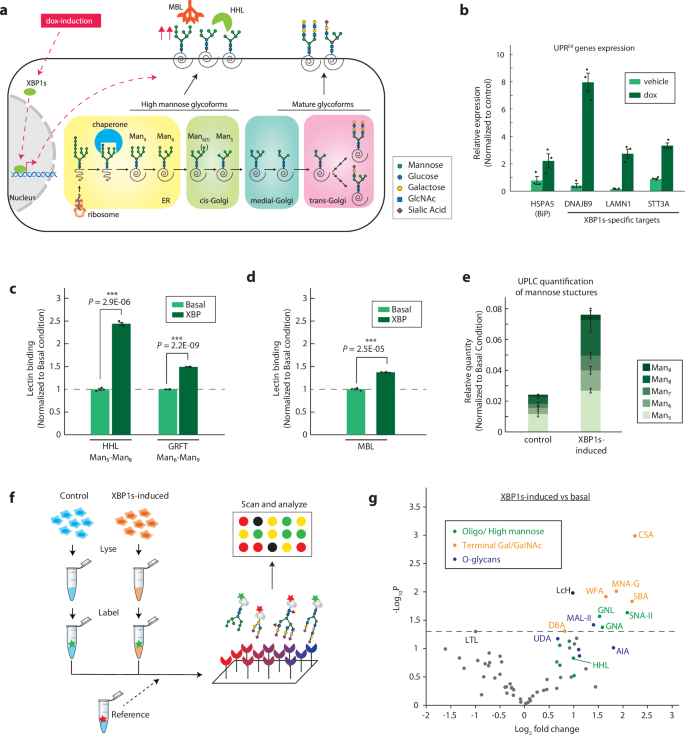
Glycans play critical roles in cellular signaling and function. Unlike proteins, glycan structures are not templated from genetic sequences but synthesized by the concerted activity of many genes, making them historically challenging to study. Here, we present a strategy that utilizes CRISPR screens and lectin microarrays to uncover and characterize regulators of glycosylation. We applied this approach to study the regulation of high mannose glycans – the starting structure of all asparagine(N)-linked-glycans. We used CRISPR screens to uncover the expanded network of genes controlling high mannose levels, followed by lectin microarrays to fully measure the complex effect of select regulators on glycosylation globally. Through this, we elucidated how two high mannose regulators – TM9SF3 and the CCC complex – control complex N-glycosylation via regulating Golgi morphology and function. Notably, this allows us to interrogate Golgi function in-depth and reveals that similar disruption to Golgi morphology can lead to drastically different glycosylation outcomes. Collectively, this work demonstrates a generalizable approach for systematically dissecting the regulatory network underlying glycosylation.
期刊介绍:
Nature Communications, an open-access journal, publishes high-quality research spanning all areas of the natural sciences. Papers featured in the journal showcase significant advances relevant to specialists in each respective field. With a 2-year impact factor of 16.6 (2022) and a median time of 8 days from submission to the first editorial decision, Nature Communications is committed to rapid dissemination of research findings. As a multidisciplinary journal, it welcomes contributions from biological, health, physical, chemical, Earth, social, mathematical, applied, and engineering sciences, aiming to highlight important breakthroughs within each domain.



 京公网安备 11010802042870号
京ICP备2023020795号-1
京公网安备 11010802042870号
京ICP备2023020795号-1

 分享
分享
 求助内容:
求助内容: 应助结果提醒方式:
 扫码关注我们
