{"title":"Total videoscopic tracheal intubation: a technical modification to reduce the risk of unrecognised oesophageal intubation","authors":"James Wright, Sandeep Sudan","doi":"10.1111/anae.16481","DOIUrl":null,"url":null,"abstract":"<p>The guidelines from the Project for Universal Management of Airways for preventing unrecognised oesophageal intubation is a comprehensive and vital piece of work [<span>1</span>]. There is an important emphasis on shared communication regarding tracheal tube placement and a simple, sequential, process to follow in the absence of sustained exhaled carbon dioxide. However, we believe there are additional simple steps that should be included in the process and these guidelines, that can help further reduce the risk of unrecognised oesophageal intubation.</p><p>With the advent of videolaryngoscopy, there is scope for an altered sequence to tracheal intubation. Historically, with direct laryngoscopy when the tracheal tube is advanced through the vocal cords, the laryngoscope is removed from the patient's mouth, followed by cuff inflation, circuit connection and verification of correct placement. This practice of immediate removal of the laryngoscope originates from the possible obscurement of the larynx once the tracheal tube has been introduced. It is likely due to muscle memory that most anaesthetists also perform and teach videolaryngoscopic tracheal intubations in this manner. However, the use of videolaryngoscopy can result in an improved view of the glottis [<span>2, 3</span>] and therefore lends itself to a modified technique. The whole process of tracheal intubation through to confirmation of correct placement by demonstration of sustained exhaled carbon dioxide, can be performed with continuous laryngeal visualisation.</p><p>Observing cuff inflation under video guidance enables immediate identification of cuff herniation and the potential dislodgement and oesophageal migration that could occur. Furthermore, as the view of the larynx can be maintained even once the tracheal tube is passed through the vocal cords with a videolaryngoscope, it makes sense that this is visualised continually until sustained exhaled carbon dioxide is shown. Only at this point should the laryngoscope be removed and the process of tracheal intubation considered complete.</p><p>If sustained exhaled carbon dioxide is not observed, the view of the tracheal tube can be immediately verified by a two-person check, without the need to reinsert the scope and obtain the view of the larynx, all of which is time-consuming in a patient with evolving hypoxia.</p><p>This technique may result in a reduced need to remove the tracheal tube, as advised by the guidance [<span>1</span>]. It may also identify oesophageal intubation earlier, as it allows more time for the anaesthetist and assistant to examine and confirm correct placement on the video screen. The technique does not eliminate the issue of glottic impersonation, but with a prolonged videoscopic view it may increase the chance of abnormal or unusual anatomy being recognised. Reducing the hurriedness of this phase may also allow time to enable those with less training to feel empowered to verbalise their concerns.</p><p>The ergonomics of this technique of ‘total videoscopic tracheal intubation’ are slightly different to the traditional approach but can still be performed easily with two people. Following placement of the tracheal tube through the vocal cords and cuff inflation, the circuit can be connected by the assistant, who can then hold the tracheal tube while the anaesthetist continues to hold the laryngoscope in one hand and ventilates the patient's lungs with the other. This is then followed by a two-person check of sustained exhaled carbon dioxide under continuous videoscopic guidance. The technique can be more challenging when the assistant is applying cricoid force, or in the absence of an airway assistant. However, the ergonomics of the tracheal intubation process may be significantly altered, and we recommend practising this in a simulation scenario first.</p><p>Although this is a small and subtle modification to the standard technique, we believe it is a sensible way of increasing safety. The technique facilitates a process of deliberate practice and could be considered as the standard method of teaching trainees.</p>","PeriodicalId":7742,"journal":{"name":"Anaesthesia","volume":"80 4","pages":"457-458"},"PeriodicalIF":6.9000,"publicationDate":"2024-11-18","publicationTypes":"Journal Article","fieldsOfStudy":null,"isOpenAccess":false,"openAccessPdf":"https://onlinelibrary.wiley.com/doi/epdf/10.1111/anae.16481","citationCount":"0","resultStr":null,"platform":"Semanticscholar","paperid":null,"PeriodicalName":"Anaesthesia","FirstCategoryId":"3","ListUrlMain":"https://associationofanaesthetists-publications.onlinelibrary.wiley.com/doi/10.1111/anae.16481","RegionNum":1,"RegionCategory":"医学","ArticlePicture":[],"TitleCN":null,"AbstractTextCN":null,"PMCID":null,"EPubDate":"","PubModel":"","JCR":"Q1","JCRName":"ANESTHESIOLOGY","Score":null,"Total":0}
引用次数: 0
Abstract
The guidelines from the Project for Universal Management of Airways for preventing unrecognised oesophageal intubation is a comprehensive and vital piece of work [1]. There is an important emphasis on shared communication regarding tracheal tube placement and a simple, sequential, process to follow in the absence of sustained exhaled carbon dioxide. However, we believe there are additional simple steps that should be included in the process and these guidelines, that can help further reduce the risk of unrecognised oesophageal intubation.
With the advent of videolaryngoscopy, there is scope for an altered sequence to tracheal intubation. Historically, with direct laryngoscopy when the tracheal tube is advanced through the vocal cords, the laryngoscope is removed from the patient's mouth, followed by cuff inflation, circuit connection and verification of correct placement. This practice of immediate removal of the laryngoscope originates from the possible obscurement of the larynx once the tracheal tube has been introduced. It is likely due to muscle memory that most anaesthetists also perform and teach videolaryngoscopic tracheal intubations in this manner. However, the use of videolaryngoscopy can result in an improved view of the glottis [2, 3] and therefore lends itself to a modified technique. The whole process of tracheal intubation through to confirmation of correct placement by demonstration of sustained exhaled carbon dioxide, can be performed with continuous laryngeal visualisation.
Observing cuff inflation under video guidance enables immediate identification of cuff herniation and the potential dislodgement and oesophageal migration that could occur. Furthermore, as the view of the larynx can be maintained even once the tracheal tube is passed through the vocal cords with a videolaryngoscope, it makes sense that this is visualised continually until sustained exhaled carbon dioxide is shown. Only at this point should the laryngoscope be removed and the process of tracheal intubation considered complete.
If sustained exhaled carbon dioxide is not observed, the view of the tracheal tube can be immediately verified by a two-person check, without the need to reinsert the scope and obtain the view of the larynx, all of which is time-consuming in a patient with evolving hypoxia.
This technique may result in a reduced need to remove the tracheal tube, as advised by the guidance [1]. It may also identify oesophageal intubation earlier, as it allows more time for the anaesthetist and assistant to examine and confirm correct placement on the video screen. The technique does not eliminate the issue of glottic impersonation, but with a prolonged videoscopic view it may increase the chance of abnormal or unusual anatomy being recognised. Reducing the hurriedness of this phase may also allow time to enable those with less training to feel empowered to verbalise their concerns.
The ergonomics of this technique of ‘total videoscopic tracheal intubation’ are slightly different to the traditional approach but can still be performed easily with two people. Following placement of the tracheal tube through the vocal cords and cuff inflation, the circuit can be connected by the assistant, who can then hold the tracheal tube while the anaesthetist continues to hold the laryngoscope in one hand and ventilates the patient's lungs with the other. This is then followed by a two-person check of sustained exhaled carbon dioxide under continuous videoscopic guidance. The technique can be more challenging when the assistant is applying cricoid force, or in the absence of an airway assistant. However, the ergonomics of the tracheal intubation process may be significantly altered, and we recommend practising this in a simulation scenario first.
Although this is a small and subtle modification to the standard technique, we believe it is a sensible way of increasing safety. The technique facilitates a process of deliberate practice and could be considered as the standard method of teaching trainees.
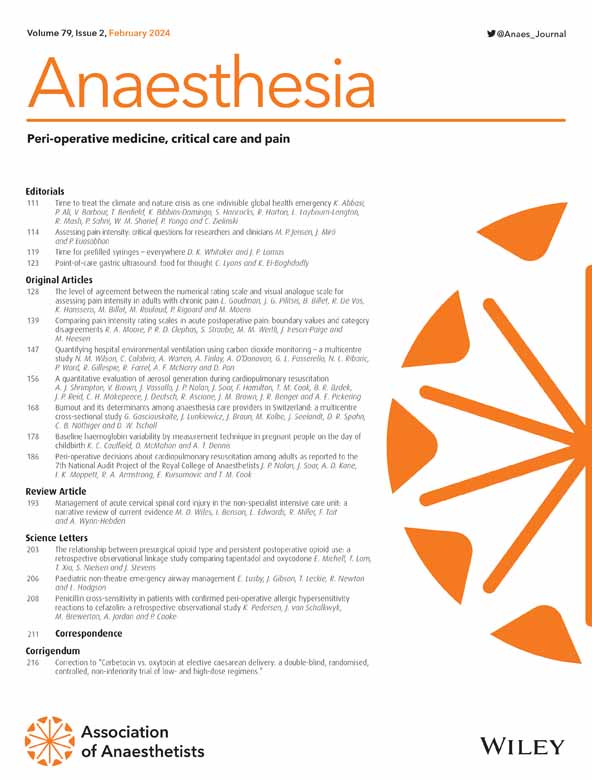
期刊介绍:
The official journal of the Association of Anaesthetists is Anaesthesia. It is a comprehensive international publication that covers a wide range of topics. The journal focuses on general and regional anaesthesia, as well as intensive care and pain therapy. It includes original articles that have undergone peer review, covering all aspects of these fields, including research on equipment.




 京公网安备 11010802042870号
京ICP备2023020795号-1
京公网安备 11010802042870号
京ICP备2023020795号-1

 分享
分享
 求助内容:
求助内容: 应助结果提醒方式:
 扫码关注我们
