Kotb B. Tawfiq;Hatem Zeineldin;Ahmed Al-Durra;Ehab F. El-Saadany
{"title":"Mitigation of Leakage Current and Current Harmonics in PV Grid-Connected Systems Using a New H10 Three-Phase Inverter","authors":"Kotb B. Tawfiq;Hatem Zeineldin;Ahmed Al-Durra;Ehab F. El-Saadany","doi":"10.1109/JESTPE.2024.3500071","DOIUrl":null,"url":null,"abstract":"This article proposes a new 10-switch (H10) inverter to alleviate the leakage current and grid current harmonics in grid-connected photovoltaic (PV) systems. A space vector pulsewidth modulation (SVPWM) control approach has been developed for this inverter to maintain an overall fluctuation of the common mode voltage (CMV) between <inline-formula> <tex-math>${V}_{\\text {dc}}/{3}$ </tex-math></inline-formula> and <inline-formula> <tex-math>${2V}_{\\text {dc}} / {3}$ </tex-math></inline-formula> with a <inline-formula> <tex-math>${dv} /{dt }$ </tex-math></inline-formula> of <inline-formula> <tex-math>$V_{\\text {dc}}/{6}$ </tex-math></inline-formula>, which is similar to the three-level inverters with smaller number of switches. Furthermore, the proposed SVPWM for this new inverter isolates the PV from grid during the zero voltage vectors. Additionally, the number of CMV transitions will be reduced, resulting in a lower leakage current and less harmonics in output currents. Moreover, the self-balancing neutral point voltage (NPV) of the proposed system will be mathematically and experimentally proved. The performance of the PV grid-connected system with the proposed H10 inverter will be compared to other topologies in the literature, e.g., H8 and H10 inverters. Numerous MATLAB simulations and experimental results indicate the effectiveness of CMV and leakage current reductions of the proposed inverter.","PeriodicalId":13093,"journal":{"name":"IEEE Journal of Emerging and Selected Topics in Power Electronics","volume":"13 1","pages":"214-229"},"PeriodicalIF":4.9000,"publicationDate":"2024-11-18","publicationTypes":"Journal Article","fieldsOfStudy":null,"isOpenAccess":false,"openAccessPdf":"","citationCount":"0","resultStr":null,"platform":"Semanticscholar","paperid":null,"PeriodicalName":"IEEE Journal of Emerging and Selected Topics in Power Electronics","FirstCategoryId":"5","ListUrlMain":"https://ieeexplore.ieee.org/document/10755041/","RegionNum":2,"RegionCategory":"工程技术","ArticlePicture":[],"TitleCN":null,"AbstractTextCN":null,"PMCID":null,"EPubDate":"","PubModel":"","JCR":"Q1","JCRName":"ENGINEERING, ELECTRICAL & ELECTRONIC","Score":null,"Total":0}
引用次数: 0
Abstract
This article proposes a new 10-switch (H10) inverter to alleviate the leakage current and grid current harmonics in grid-connected photovoltaic (PV) systems. A space vector pulsewidth modulation (SVPWM) control approach has been developed for this inverter to maintain an overall fluctuation of the common mode voltage (CMV) between ${V}_{\text {dc}}/{3}$ and ${2V}_{\text {dc}} / {3}$ with a ${dv} /{dt }$ of $V_{\text {dc}}/{6}$ , which is similar to the three-level inverters with smaller number of switches. Furthermore, the proposed SVPWM for this new inverter isolates the PV from grid during the zero voltage vectors. Additionally, the number of CMV transitions will be reduced, resulting in a lower leakage current and less harmonics in output currents. Moreover, the self-balancing neutral point voltage (NPV) of the proposed system will be mathematically and experimentally proved. The performance of the PV grid-connected system with the proposed H10 inverter will be compared to other topologies in the literature, e.g., H8 and H10 inverters. Numerous MATLAB simulations and experimental results indicate the effectiveness of CMV and leakage current reductions of the proposed inverter.
期刊介绍:
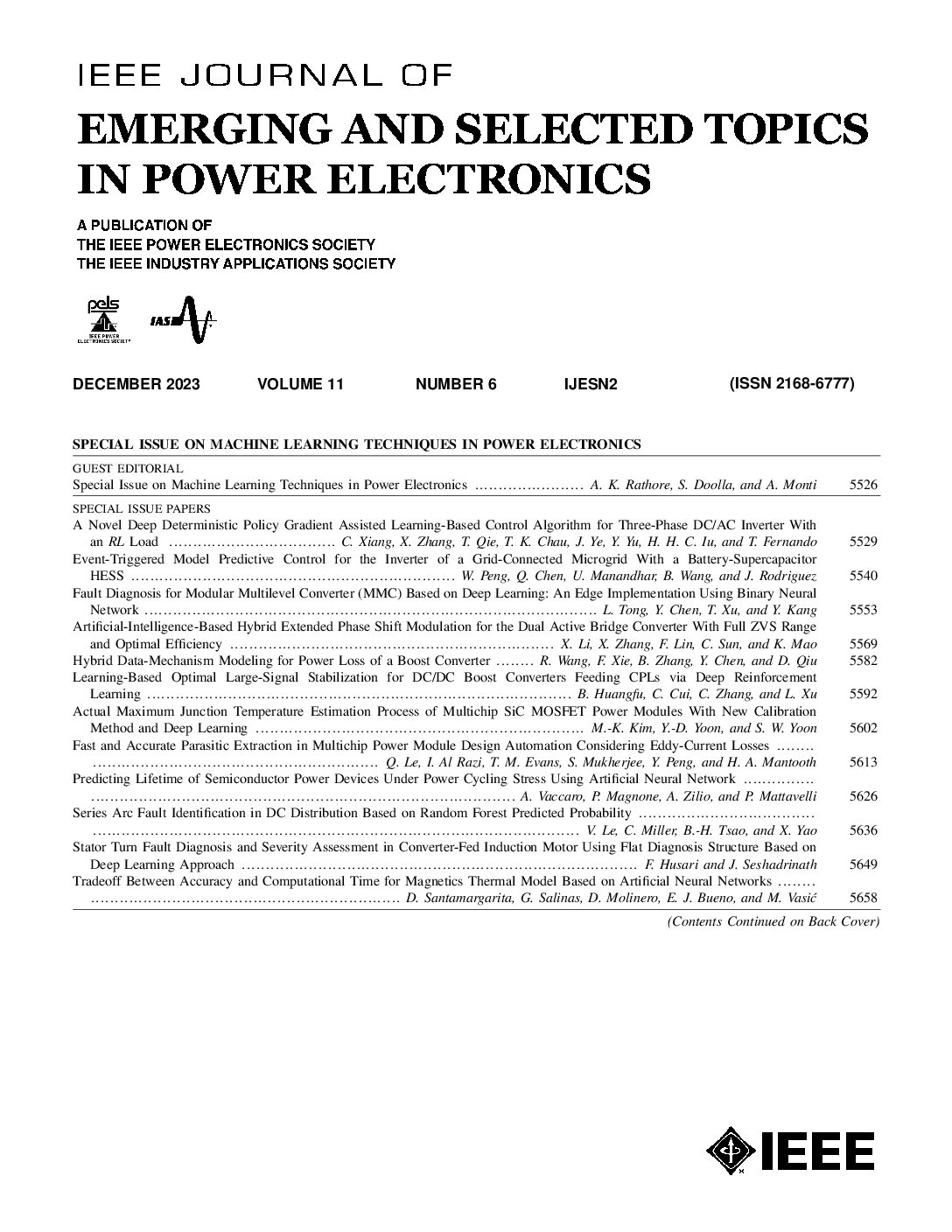
The aim of the journal is to enable the power electronics community to address the emerging and selected topics in power electronics in an agile fashion. It is a forum where multidisciplinary and discriminating technologies and applications are discussed by and for both practitioners and researchers on timely topics in power electronics from components to systems.



 京公网安备 11010802042870号
京ICP备2023020795号-1
京公网安备 11010802042870号
京ICP备2023020795号-1

 分享
分享
 求助内容:
求助内容: 应助结果提醒方式:
 扫码关注我们
