{"title":"Secret Innovation","authors":"Michael F. Joseph, Michael Poznansky","doi":"10.1017/s0020818324000250","DOIUrl":null,"url":null,"abstract":"<p>Conventional wisdom holds that open, collaborative, and transparent organizations are innovative. But some of the most radical innovations—satellites, lithium-iodine batteries, the internet—were conceived by small, secretive teams in national security agencies. Are these organizations more innovative because of their secrecy, or in spite of it? We study a principal–agent model of public-sector innovation. We give research teams a secret option and a public option during the initial testing and prototyping phase. Secrecy helps advance high-risk, high-reward projects through the early phase via a cost-passing mechanism. In open institutions, managers will not approve pilot research into high-risk, high-reward ideas for fear of political costs. Researchers exploit secrecy to conduct pilot research at a higher personal cost to generate evidence that their project is viable and win their manager's approval. Contrary to standard principal–agent findings, we show that researchers may exploit secrecy even if their preferences are perfectly aligned with their manager's, and that managers do not monitor researchers even if monitoring is costless and perfect. We illustrate our theory with two cases from the early Cold War: the CIA's attempt to master mind control (MKULTRA) and the origins of the reconnaissance satellite (CORONA). We contribute to the political application of principal–agent theory and studies of national security innovation, emerging technologies, democratic oversight, the Sino–American technology debate, and great power competition.</p>","PeriodicalId":48388,"journal":{"name":"International Organization","volume":"11 1","pages":""},"PeriodicalIF":4.5000,"publicationDate":"2024-11-19","publicationTypes":"Journal Article","fieldsOfStudy":null,"isOpenAccess":false,"openAccessPdf":"","citationCount":"0","resultStr":null,"platform":"Semanticscholar","paperid":null,"PeriodicalName":"International Organization","FirstCategoryId":"90","ListUrlMain":"https://doi.org/10.1017/s0020818324000250","RegionNum":1,"RegionCategory":"社会学","ArticlePicture":[],"TitleCN":null,"AbstractTextCN":null,"PMCID":null,"EPubDate":"","PubModel":"","JCR":"Q1","JCRName":"INTERNATIONAL RELATIONS","Score":null,"Total":0}
引用次数: 0
Abstract
Conventional wisdom holds that open, collaborative, and transparent organizations are innovative. But some of the most radical innovations—satellites, lithium-iodine batteries, the internet—were conceived by small, secretive teams in national security agencies. Are these organizations more innovative because of their secrecy, or in spite of it? We study a principal–agent model of public-sector innovation. We give research teams a secret option and a public option during the initial testing and prototyping phase. Secrecy helps advance high-risk, high-reward projects through the early phase via a cost-passing mechanism. In open institutions, managers will not approve pilot research into high-risk, high-reward ideas for fear of political costs. Researchers exploit secrecy to conduct pilot research at a higher personal cost to generate evidence that their project is viable and win their manager's approval. Contrary to standard principal–agent findings, we show that researchers may exploit secrecy even if their preferences are perfectly aligned with their manager's, and that managers do not monitor researchers even if monitoring is costless and perfect. We illustrate our theory with two cases from the early Cold War: the CIA's attempt to master mind control (MKULTRA) and the origins of the reconnaissance satellite (CORONA). We contribute to the political application of principal–agent theory and studies of national security innovation, emerging technologies, democratic oversight, the Sino–American technology debate, and great power competition.
期刊介绍:
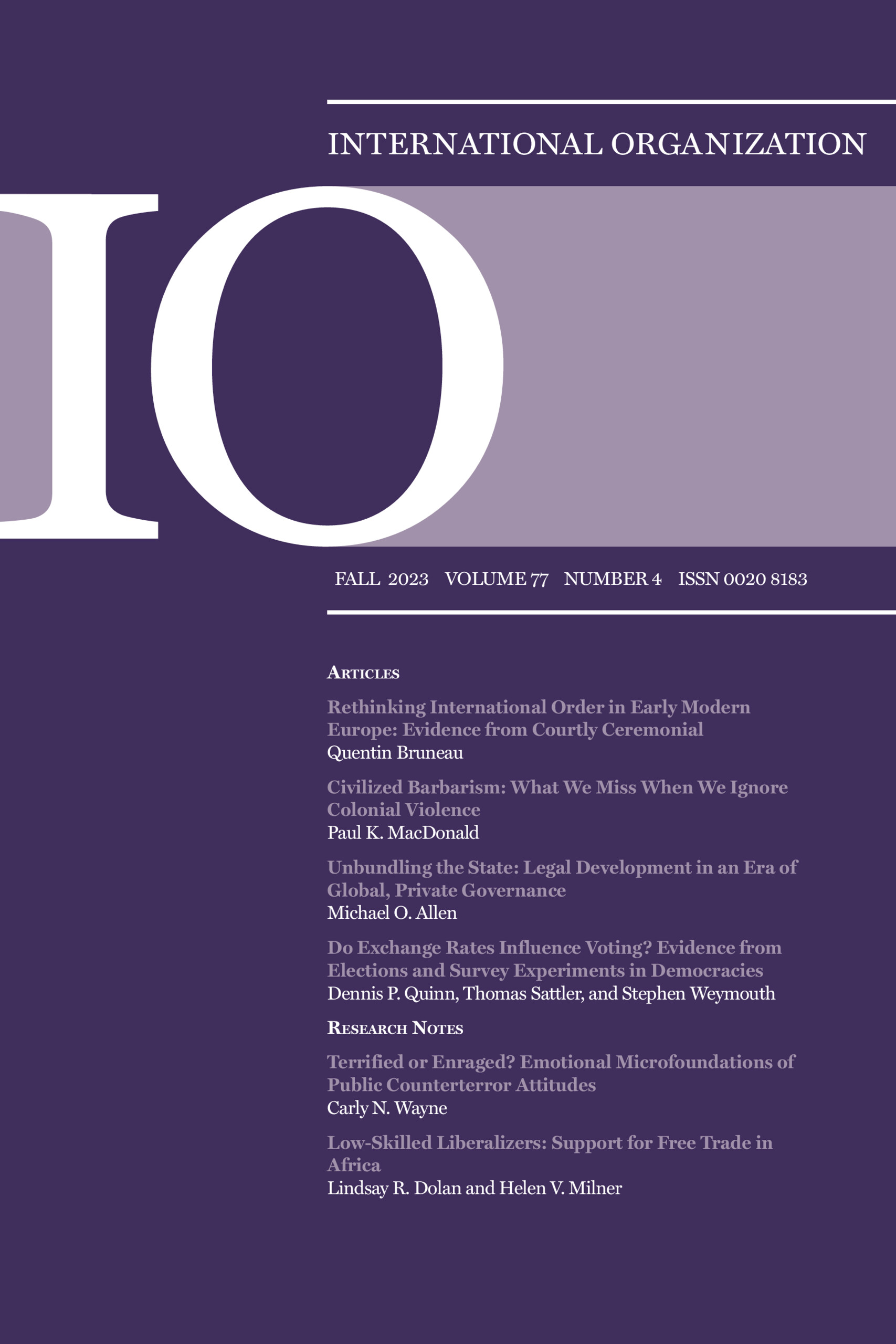
International Organization (IO) is a prominent peer-reviewed journal that comprehensively covers the field of international affairs. Its subject areas encompass foreign policies, international relations, political economy, security policies, environmental disputes, regional integration, alliance patterns, conflict resolution, economic development, and international capital movements. Continuously ranked among the top journals in the field, IO does not publish book reviews but instead features high-quality review essays that survey new developments, synthesize important ideas, and address key issues for future scholarship.



 京公网安备 11010802042870号
京ICP备2023020795号-1
京公网安备 11010802042870号
京ICP备2023020795号-1

 分享
分享
 求助内容:
求助内容: 应助结果提醒方式:
 扫码关注我们
