Bruno Schmelz, Kazem Zhour, Susanna Krämer, Mariano Grünebaum, Diddo Diddens, Björn Braunschweig, Hadrián Montes-Campos, Masoud Baghernejad
{"title":"Interfacial Potentiodynamics of “Water-in-Salt” Electrolytes in Aqueous Lithium-Ion Batteries Using Nonlinear Spectroscopy and Molecular Simulations","authors":"Bruno Schmelz, Kazem Zhour, Susanna Krämer, Mariano Grünebaum, Diddo Diddens, Björn Braunschweig, Hadrián Montes-Campos, Masoud Baghernejad","doi":"10.1021/acs.jpcc.4c04982","DOIUrl":null,"url":null,"abstract":"The molecular arrangement of the electrode/electrolyte interface is crucial for enlarging the electrochemical stability of “water-in-salt” electrolytes in aqueous lithium-ion batteries. Using <i>in situ</i> vibrational sum-frequency generation (SFG) spectroscopy and molecular dynamics (MD) simulations, we investigated the interfacial structure and molecular orientation of water molecules and anions of a LiTFSI-based “water-in-salt” electrolyte as a function of electrode potential. Shifting the electrode potential from positive to negative values induces significant interfacial changes in the structure of the electrolyte species, transitioning from anion surface excess to a water-rich interface. Furthermore, TFSI anions undergo a conformational change from <i>cis</i> to <i>trans</i> at the interface at positive electrode potentials. The results of comprehensive MD simulations support the experimental observations, demonstrating a potentiodynamic change in the number densities of water molecules, TFSI anions, and Li-ions at the interface accompanied by increasing dihedral angles of TFSI anions at higher positive electrode potentials.","PeriodicalId":61,"journal":{"name":"The Journal of Physical Chemistry C","volume":"18 1","pages":""},"PeriodicalIF":3.2000,"publicationDate":"2024-11-19","publicationTypes":"Journal Article","fieldsOfStudy":null,"isOpenAccess":false,"openAccessPdf":"","citationCount":"0","resultStr":null,"platform":"Semanticscholar","paperid":null,"PeriodicalName":"The Journal of Physical Chemistry C","FirstCategoryId":"1","ListUrlMain":"https://doi.org/10.1021/acs.jpcc.4c04982","RegionNum":3,"RegionCategory":"化学","ArticlePicture":[],"TitleCN":null,"AbstractTextCN":null,"PMCID":null,"EPubDate":"","PubModel":"","JCR":"Q2","JCRName":"CHEMISTRY, PHYSICAL","Score":null,"Total":0}
引用次数: 0
Abstract
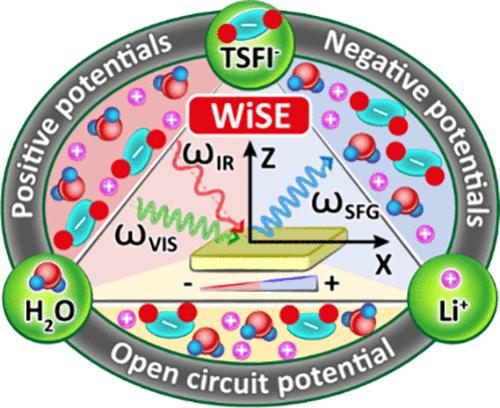
The molecular arrangement of the electrode/electrolyte interface is crucial for enlarging the electrochemical stability of “water-in-salt” electrolytes in aqueous lithium-ion batteries. Using in situ vibrational sum-frequency generation (SFG) spectroscopy and molecular dynamics (MD) simulations, we investigated the interfacial structure and molecular orientation of water molecules and anions of a LiTFSI-based “water-in-salt” electrolyte as a function of electrode potential. Shifting the electrode potential from positive to negative values induces significant interfacial changes in the structure of the electrolyte species, transitioning from anion surface excess to a water-rich interface. Furthermore, TFSI anions undergo a conformational change from cis to trans at the interface at positive electrode potentials. The results of comprehensive MD simulations support the experimental observations, demonstrating a potentiodynamic change in the number densities of water molecules, TFSI anions, and Li-ions at the interface accompanied by increasing dihedral angles of TFSI anions at higher positive electrode potentials.
期刊介绍:
The Journal of Physical Chemistry A/B/C is devoted to reporting new and original experimental and theoretical basic research of interest to physical chemists, biophysical chemists, and chemical physicists.



 京公网安备 11010802042870号
京ICP备2023020795号-1
京公网安备 11010802042870号
京ICP备2023020795号-1

 分享
分享
 求助内容:
求助内容: 应助结果提醒方式:
 扫码关注我们
