F. Elfatouaki, R. Takassa, M. Alla, O. Farkad, Abdelkarim EL Mouncharih, S. Hassine, S. Giusepponi, E. A. Ibnouelghazi, A. Outzourhit, D. Abouelaoualim
{"title":"Enhancing Perovskite Solar Cells Performance Through Investigation of Ruddlesden–Popper (2D) Cs2GeI2Br2 and (3D) CsGeI2Br Absorbers","authors":"F. Elfatouaki, R. Takassa, M. Alla, O. Farkad, Abdelkarim EL Mouncharih, S. Hassine, S. Giusepponi, E. A. Ibnouelghazi, A. Outzourhit, D. Abouelaoualim","doi":"10.1021/acs.jpcc.4c04167","DOIUrl":null,"url":null,"abstract":"Ruddlesden–Popper (RP) perovskite materials are gaining traction in optoelectronic applications due to their unique structure and adjustable properties. This study investigates the potential of RP (2D) Cs<sub>2</sub>GeI<sub>2</sub>Br<sub>2</sub> and (3D) CsGeI<sub>2</sub>Br absorbers in enhancing perovskite solar cell (PSC) performance. Through rigorous analysis, we find that integrating RP phases improves charge transport and reduces defects, leading to superior device performance. The results showed a direct bandgap (1.45 eV for 2D), high optical absorption (above 50 × 10<sup>4</sup> cm<sup>–1</sup> for 3D), low reflectivity, and energy loss, indicating solar cell suitability. The calculated effective mass values (<i>m</i><sub>e</sub><sup>*</sup>, <i>m</i><sub>h</sub><sup>*</sup>) (0.245, 0.423 eV) for Cs<sub>2</sub>GeI<sub>2</sub>Br<sub>2</sub> closely resemble those reported for Cs<sub>2</sub>PbI<sub>2</sub>Br<sub>2</sub> and Cs<sub>2</sub>PbI<sub>2</sub>Cl<sub>2</sub>, indicating similar charge carrier behavior in these materials. Our research provides valuable insights for optimizing PSCs with alternative structures. Additionally, simulations explore various hole transport layers and temperature effects on key electrical parameters under standard AM 1.5 G solar radiation using the SCAPS-1D software, achieving a maximum efficiency of approximately 29.59% for the PSC prototype at an ambient temperature of 25 °C.","PeriodicalId":61,"journal":{"name":"The Journal of Physical Chemistry C","volume":"22 1","pages":""},"PeriodicalIF":3.2000,"publicationDate":"2024-11-18","publicationTypes":"Journal Article","fieldsOfStudy":null,"isOpenAccess":false,"openAccessPdf":"","citationCount":"0","resultStr":null,"platform":"Semanticscholar","paperid":null,"PeriodicalName":"The Journal of Physical Chemistry C","FirstCategoryId":"1","ListUrlMain":"https://doi.org/10.1021/acs.jpcc.4c04167","RegionNum":3,"RegionCategory":"化学","ArticlePicture":[],"TitleCN":null,"AbstractTextCN":null,"PMCID":null,"EPubDate":"","PubModel":"","JCR":"Q2","JCRName":"CHEMISTRY, PHYSICAL","Score":null,"Total":0}
引用次数: 0
Abstract
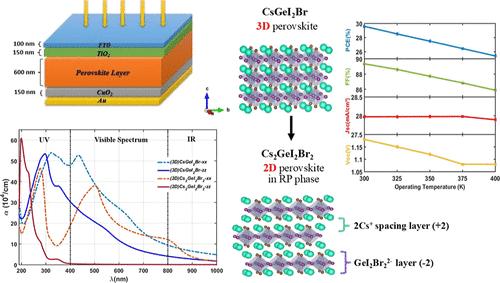
Ruddlesden–Popper (RP) perovskite materials are gaining traction in optoelectronic applications due to their unique structure and adjustable properties. This study investigates the potential of RP (2D) Cs2GeI2Br2 and (3D) CsGeI2Br absorbers in enhancing perovskite solar cell (PSC) performance. Through rigorous analysis, we find that integrating RP phases improves charge transport and reduces defects, leading to superior device performance. The results showed a direct bandgap (1.45 eV for 2D), high optical absorption (above 50 × 104 cm–1 for 3D), low reflectivity, and energy loss, indicating solar cell suitability. The calculated effective mass values (me*, mh*) (0.245, 0.423 eV) for Cs2GeI2Br2 closely resemble those reported for Cs2PbI2Br2 and Cs2PbI2Cl2, indicating similar charge carrier behavior in these materials. Our research provides valuable insights for optimizing PSCs with alternative structures. Additionally, simulations explore various hole transport layers and temperature effects on key electrical parameters under standard AM 1.5 G solar radiation using the SCAPS-1D software, achieving a maximum efficiency of approximately 29.59% for the PSC prototype at an ambient temperature of 25 °C.
期刊介绍:
The Journal of Physical Chemistry A/B/C is devoted to reporting new and original experimental and theoretical basic research of interest to physical chemists, biophysical chemists, and chemical physicists.




 京公网安备 11010802042870号
京ICP备2023020795号-1
京公网安备 11010802042870号
京ICP备2023020795号-1

 分享
分享
 求助内容:
求助内容: 应助结果提醒方式:
 扫码关注我们
