Riki Nakatani, Jin Sakai, Aishik Saha, Ayumu Kondo, Rina Tomioka, Tokuhisa Kawawaki, Saikat Das and Yuichi Negishi
{"title":"Designed construction of two new atom-precise three-dimensional and two-dimensional Ag12 cluster-assembled materials†","authors":"Riki Nakatani, Jin Sakai, Aishik Saha, Ayumu Kondo, Rina Tomioka, Tokuhisa Kawawaki, Saikat Das and Yuichi Negishi","doi":"10.1039/D4NR03992K","DOIUrl":null,"url":null,"abstract":"<p >Silver cluster-assembled materials (SCAMs) are well-defined crystalline extended materials hallmarked by their unique geometric structures, atomically precise designability and functional modularity. In this study, we report for the first time the synthesis of a (3,6)-connected three-dimensional (3D) SCAM, [Ag<small><sub>12</sub></small>(S<small><sup><em>t</em></sup></small>Bu)<small><sub>6</sub></small>(CF<small><sub>3</sub></small>COO)<small><sub>6</sub></small>(TPMA)<small><sub>6</sub></small>]<small><sub><em>n</em></sub></small> (designated as <strong>TUS 6</strong>), TPMA = tris(pyridine-4-ylmethyl)amine, by assembling Ag<small><sub>12</sub></small> cluster nodes with the help of a tritopic linker TPMA. Besides, we also prepared a two-dimensional (2D) SCAM, [Ag<small><sub>12</sub></small>(S<small><sup><em>t</em></sup></small>Bu)<small><sub>6</sub></small>(CF<small><sub>3</sub></small>COO)<small><sub>6</sub></small>(TPEB)<small><sub>6</sub></small>]<small><sub><em>n</em></sub></small> (described as <strong>TUS 7</strong>), TPEB = 1,3,5-tris(pyridine-4-ylethynyl)benzene, by reticulating Ag<small><sub>12</sub></small> nodes with a tritopic linker TPEB. Characterized by microscopic and diffraction analyses, the SCAMs revealed distinct morphologies, structural robustness, and phase purity. This paper elucidates how the binding with the organic linkers alters the symmetry of the silver nanoclusters (NCs). Changes in the symmetry of discrete NCs to assembled structures have not been reported yet. This study provides an atomic-level explanation of the transformation of symmetry from NCs to extended structures.</p>","PeriodicalId":92,"journal":{"name":"Nanoscale","volume":" 2","pages":" 813-822"},"PeriodicalIF":5.1000,"publicationDate":"2024-11-19","publicationTypes":"Journal Article","fieldsOfStudy":null,"isOpenAccess":false,"openAccessPdf":"","citationCount":"0","resultStr":null,"platform":"Semanticscholar","paperid":null,"PeriodicalName":"Nanoscale","FirstCategoryId":"88","ListUrlMain":"https://pubs.rsc.org/en/content/articlelanding/2025/nr/d4nr03992k","RegionNum":3,"RegionCategory":"材料科学","ArticlePicture":[],"TitleCN":null,"AbstractTextCN":null,"PMCID":null,"EPubDate":"","PubModel":"","JCR":"Q1","JCRName":"CHEMISTRY, MULTIDISCIPLINARY","Score":null,"Total":0}
引用次数: 0
Abstract
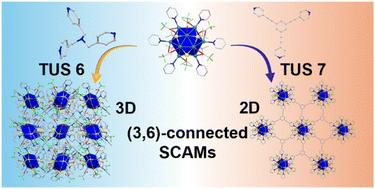
Silver cluster-assembled materials (SCAMs) are well-defined crystalline extended materials hallmarked by their unique geometric structures, atomically precise designability and functional modularity. In this study, we report for the first time the synthesis of a (3,6)-connected three-dimensional (3D) SCAM, [Ag12(StBu)6(CF3COO)6(TPMA)6]n (designated as TUS 6), TPMA = tris(pyridine-4-ylmethyl)amine, by assembling Ag12 cluster nodes with the help of a tritopic linker TPMA. Besides, we also prepared a two-dimensional (2D) SCAM, [Ag12(StBu)6(CF3COO)6(TPEB)6]n (described as TUS 7), TPEB = 1,3,5-tris(pyridine-4-ylethynyl)benzene, by reticulating Ag12 nodes with a tritopic linker TPEB. Characterized by microscopic and diffraction analyses, the SCAMs revealed distinct morphologies, structural robustness, and phase purity. This paper elucidates how the binding with the organic linkers alters the symmetry of the silver nanoclusters (NCs). Changes in the symmetry of discrete NCs to assembled structures have not been reported yet. This study provides an atomic-level explanation of the transformation of symmetry from NCs to extended structures.
期刊介绍:
Nanoscale is a high-impact international journal, publishing high-quality research across nanoscience and nanotechnology. Nanoscale publishes a full mix of research articles on experimental and theoretical work, including reviews, communications, and full papers.Highly interdisciplinary, this journal appeals to scientists, researchers and professionals interested in nanoscience and nanotechnology, quantum materials and quantum technology, including the areas of physics, chemistry, biology, medicine, materials, energy/environment, information technology, detection science, healthcare and drug discovery, and electronics.



 京公网安备 11010802042870号
京ICP备2023020795号-1
京公网安备 11010802042870号
京ICP备2023020795号-1

 分享
分享
 求助内容:
求助内容: 应助结果提醒方式:
 扫码关注我们
