Qiyao Peng;Yinghui Wang;Pengfei Jiao;Huaming Wu;Lin Pan
{"title":"Alleviate the Impact of Heterogeneity in Network Alignment From Community View","authors":"Qiyao Peng;Yinghui Wang;Pengfei Jiao;Huaming Wu;Lin Pan","doi":"10.1109/TNNLS.2024.3491892","DOIUrl":null,"url":null,"abstract":"Network alignment is a fundamental problem in various domains since it can establish bridges for the same entity (i.e., anchor nodes) between different networks. Most existing network alignment methods are based on consistency assumption, i.e., anchor nodes exhibit similar local structures or neighbors across different networks. However, many anchor nodes have different local structures or neighbors across different networks, which could be regarded as anchor nodes’ heterogeneity. It poses a challenge to methods based on the assumption of consistency, as they lack abundant shared information, such as common neighbors. Fortunately, network communities provide the comprehension of node relationships and group structures within networks, which could alleviate the information insufficient. In this article, we propose to address the challenge of inadequate shared information triggered by nodes’ heterogeneity from a community perspective. Our model is based on joint optimization of node representation learning and community discovery, including: 1) a node-level constraint is employed to bring nodes with more anchor pairs as neighbors closer together and 2) a community-level constraint is utilized to bring nodes with higher order similarity closer together. We model the cross-network community alignment relations as asymmetric to mitigate the interference caused by anchor node heterogeneity when measuring community alignment relations. Furthermore, we leverage the learned cross-network community alignment relations to supplement node alignment, which could narrow down the search range of potential anchor nodes by focusing solely on aligning nodes within aligned cross-network communities. We conducted extensive experiments on real-world datasets, and the results show the effectiveness and efficiency of our proposed model on network alignment.","PeriodicalId":13303,"journal":{"name":"IEEE transactions on neural networks and learning systems","volume":"36 6","pages":"11313-11326"},"PeriodicalIF":8.9000,"publicationDate":"2024-11-19","publicationTypes":"Journal Article","fieldsOfStudy":null,"isOpenAccess":false,"openAccessPdf":"","citationCount":"0","resultStr":null,"platform":"Semanticscholar","paperid":null,"PeriodicalName":"IEEE transactions on neural networks and learning systems","FirstCategoryId":"94","ListUrlMain":"https://ieeexplore.ieee.org/document/10757314/","RegionNum":1,"RegionCategory":"计算机科学","ArticlePicture":[],"TitleCN":null,"AbstractTextCN":null,"PMCID":null,"EPubDate":"","PubModel":"","JCR":"Q1","JCRName":"COMPUTER SCIENCE, ARTIFICIAL INTELLIGENCE","Score":null,"Total":0}
引用次数: 0
Abstract
Network alignment is a fundamental problem in various domains since it can establish bridges for the same entity (i.e., anchor nodes) between different networks. Most existing network alignment methods are based on consistency assumption, i.e., anchor nodes exhibit similar local structures or neighbors across different networks. However, many anchor nodes have different local structures or neighbors across different networks, which could be regarded as anchor nodes’ heterogeneity. It poses a challenge to methods based on the assumption of consistency, as they lack abundant shared information, such as common neighbors. Fortunately, network communities provide the comprehension of node relationships and group structures within networks, which could alleviate the information insufficient. In this article, we propose to address the challenge of inadequate shared information triggered by nodes’ heterogeneity from a community perspective. Our model is based on joint optimization of node representation learning and community discovery, including: 1) a node-level constraint is employed to bring nodes with more anchor pairs as neighbors closer together and 2) a community-level constraint is utilized to bring nodes with higher order similarity closer together. We model the cross-network community alignment relations as asymmetric to mitigate the interference caused by anchor node heterogeneity when measuring community alignment relations. Furthermore, we leverage the learned cross-network community alignment relations to supplement node alignment, which could narrow down the search range of potential anchor nodes by focusing solely on aligning nodes within aligned cross-network communities. We conducted extensive experiments on real-world datasets, and the results show the effectiveness and efficiency of our proposed model on network alignment.
期刊介绍:
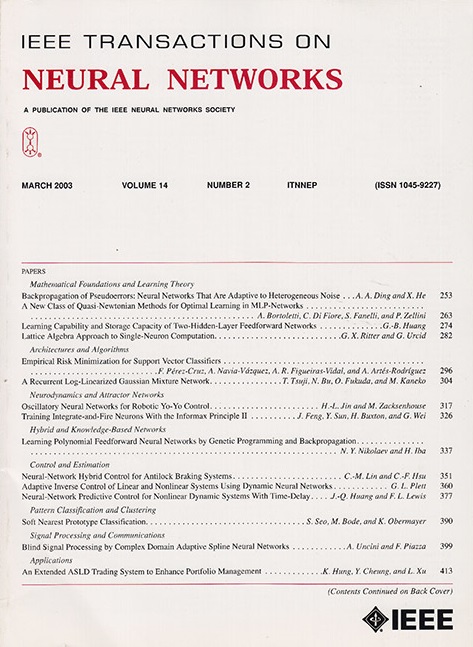
The focus of IEEE Transactions on Neural Networks and Learning Systems is to present scholarly articles discussing the theory, design, and applications of neural networks as well as other learning systems. The journal primarily highlights technical and scientific research in this domain.



 京公网安备 11010802042870号
京ICP备2023020795号-1
京公网安备 11010802042870号
京ICP备2023020795号-1

 分享
分享
 求助内容:
求助内容: 应助结果提醒方式:
 扫码关注我们
