Cheng Liu;Rui Li;Hangjun Che;Man-Fai Leung;Si Wu;Zhiwen Yu;Hau-San Wong
{"title":"Beyond Euclidean Structures: Collaborative Topological Graph Learning for Multiview Clustering","authors":"Cheng Liu;Rui Li;Hangjun Che;Man-Fai Leung;Si Wu;Zhiwen Yu;Hau-San Wong","doi":"10.1109/TNNLS.2024.3489585","DOIUrl":null,"url":null,"abstract":"Graph-based multiview clustering (MVC) approaches have demonstrated impressive performance by leveraging the consistency properties of multiview data in an unsupervised manner. However, existing methods for graph learning heavily rely on either Euclidean structures or the manifold topological structures derived from fixed view-specific graphs. Unfortunately, these approaches may not accurately reflect the consensus topological structure in a multiview setting. To address this limitation and enhance the intrinsic graph learning process, an adaptive exploration of a more appropriate consistency topological structure is required. Toward this end, we propose a novel approach called collaborative topological graph learning (CTGL) for MVC. The key idea is to adaptively discover the consistent topological structure to guide intrinsic graph learning. We achieve this by introducing an auxiliary consistency graph that formulates the topological relevance learning function. However, estimating the auxiliary consistency graph is not straightforward, as it is based on the learned view-specific graphs and requires prior availability. To overcome this challenge, we develop a collaborative learning strategy that simultaneously learns both the auxiliary consistency graph and view-specific graphs using tensor learning techniques. This strategy enables the adaptive exploration of the consistency topological structure during graph learning, resulting in more accurate clustering outcomes. Extensive experiments are provided to show the effectiveness of the proposed method. The source code can be found at <uri>https://github.com/CLiu272/CTGL</uri>.","PeriodicalId":13303,"journal":{"name":"IEEE transactions on neural networks and learning systems","volume":"36 6","pages":"10606-10618"},"PeriodicalIF":8.9000,"publicationDate":"2024-11-19","publicationTypes":"Journal Article","fieldsOfStudy":null,"isOpenAccess":false,"openAccessPdf":"","citationCount":"0","resultStr":null,"platform":"Semanticscholar","paperid":null,"PeriodicalName":"IEEE transactions on neural networks and learning systems","FirstCategoryId":"94","ListUrlMain":"https://ieeexplore.ieee.org/document/10758336/","RegionNum":1,"RegionCategory":"计算机科学","ArticlePicture":[],"TitleCN":null,"AbstractTextCN":null,"PMCID":null,"EPubDate":"","PubModel":"","JCR":"Q1","JCRName":"COMPUTER SCIENCE, ARTIFICIAL INTELLIGENCE","Score":null,"Total":0}
引用次数: 0
Abstract
Graph-based multiview clustering (MVC) approaches have demonstrated impressive performance by leveraging the consistency properties of multiview data in an unsupervised manner. However, existing methods for graph learning heavily rely on either Euclidean structures or the manifold topological structures derived from fixed view-specific graphs. Unfortunately, these approaches may not accurately reflect the consensus topological structure in a multiview setting. To address this limitation and enhance the intrinsic graph learning process, an adaptive exploration of a more appropriate consistency topological structure is required. Toward this end, we propose a novel approach called collaborative topological graph learning (CTGL) for MVC. The key idea is to adaptively discover the consistent topological structure to guide intrinsic graph learning. We achieve this by introducing an auxiliary consistency graph that formulates the topological relevance learning function. However, estimating the auxiliary consistency graph is not straightforward, as it is based on the learned view-specific graphs and requires prior availability. To overcome this challenge, we develop a collaborative learning strategy that simultaneously learns both the auxiliary consistency graph and view-specific graphs using tensor learning techniques. This strategy enables the adaptive exploration of the consistency topological structure during graph learning, resulting in more accurate clustering outcomes. Extensive experiments are provided to show the effectiveness of the proposed method. The source code can be found at https://github.com/CLiu272/CTGL.
期刊介绍:
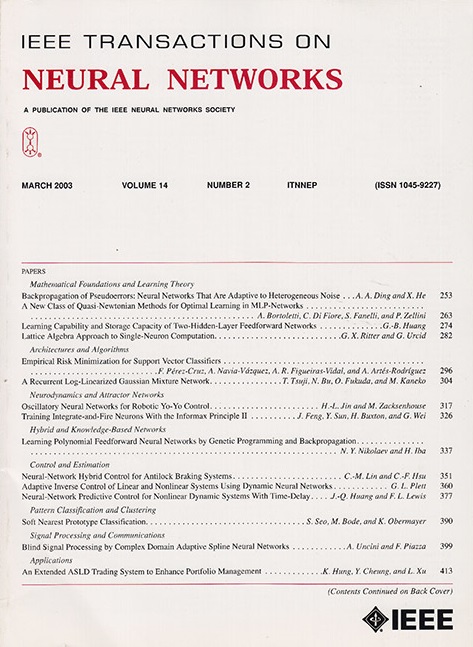
The focus of IEEE Transactions on Neural Networks and Learning Systems is to present scholarly articles discussing the theory, design, and applications of neural networks as well as other learning systems. The journal primarily highlights technical and scientific research in this domain.



 京公网安备 11010802042870号
京ICP备2023020795号-1
京公网安备 11010802042870号
京ICP备2023020795号-1

 分享
分享
 求助内容:
求助内容: 应助结果提醒方式:
 扫码关注我们
