
Entomopathogenic nematodes (EPNs) are recognized as effective biocontrol agents against various soil-dwelling pests. However, their efficacy in managing leaf pests is often constrained by factors such as ultraviolet (UV) radiation and desiccation.
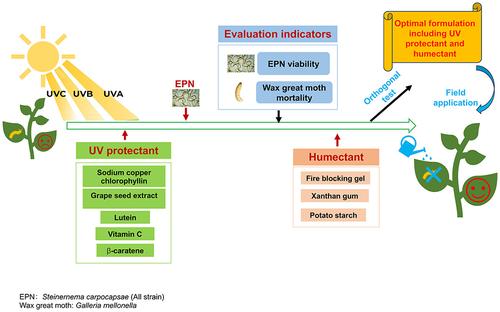
We evaluated the protective effects of five plant-derived substances, including grape seed extract, sodium copper chlorophyllin, vitamin C, β-carotene and lutein, on Steinernema carpocapsae upon exposure to three wavelengths of artificial ultraviolet radiation (UVA, UVB, UVC). The five protectants showed efficient protective effects. Notably, grape seed extract, sodium copper chlorophyllin and vitamin C exhibited significant protective effects on infective juveniles (IJs) even after exposure to UVC for 4, 8 and 12 h. Under natural sunlight conditions, we combined these UV protectants with three humectants and evaluated their effects on IJ viability. Orthogonal experiments revealed that the combination treatment of 0.2% grape seed extract and 0.1% fire blocking gel yielded the highest IJ survival rate. This foliar formulation was tested in the field, leading to significantly higher mortality of Tuta absoluta compared with EPNs only.
Our findings suggest that the formulation containing UV protectants and humectants effectively overcome the limitations encountered in the foliar application of EPNs, thereby enhancing their potential for pest management in agricultural contexts. © 2024 Society of Chemical Industry.







 京公网安备 11010802042870号
京ICP备2023020795号-1
京公网安备 11010802042870号
京ICP备2023020795号-1

 分享
分享
 求助内容:
求助内容: 应助结果提醒方式:
 扫码关注我们
