Lihong Pei;Yang Cao;Yu Kang;Zhenyi Xu;Qianming Liu
{"title":"Spatiotemporal Imputation of Traffic Emissions With Self-Supervised Diffusion Model","authors":"Lihong Pei;Yang Cao;Yu Kang;Zhenyi Xu;Qianming Liu","doi":"10.1109/TNNLS.2024.3495990","DOIUrl":null,"url":null,"abstract":"The comprehensive regulatory oversight of traffic emissions frequently encounters the missing not-at-random (MNAR) pattern, characterized by the long-term block missing in adjacent road segments, arising from insufficient monitoring points and nonuniform spatiotemporal distribution. The spatiotemporal block missing simultaneously disrupts the spatiotemporal correlation, introducing significant biases in spatiotemporal modeling for incomplete data. The emerging diffusion model recovers the information of the missing regions in a self-supervised manner and focuses on the generation process of the missing regions to address biases. However, the dynamics and spatiotemporal heterogeneity of traffic emissions limit its applicability in unknown spatiotemporal missing. To address this issue, this article proposes a novel progressive Diffusion Model-based framework for SpatioTemporal Imputation of traffic emissions (STI-dm). Specifically, a self-supervised masked training strategy is first devised to construct the nonlocal similarity prior of traffic emission data, explicitly introducing the MNAR missing mechanism for the diffusion process. Furthermore, an enhanced approach of noise injection and supervised denoising is adopted to rectify misconceptions of nonlocal alignment, decreasing modeling biases associated with incomplete data in the generation process. The imputation and prior modeling processes are progressively performed until obtaining stable results, and each of the preceding modeling processes benefits from the gradual improvement results in the other. Experimental evidence indicates that STI-dm surpasses the current state-of-the-art algorithms in scenarios with intricate spatiotemporal patterns and varying rates of missing data.","PeriodicalId":13303,"journal":{"name":"IEEE transactions on neural networks and learning systems","volume":"36 6","pages":"10928-10942"},"PeriodicalIF":8.9000,"publicationDate":"2024-11-19","publicationTypes":"Journal Article","fieldsOfStudy":null,"isOpenAccess":false,"openAccessPdf":"","citationCount":"0","resultStr":null,"platform":"Semanticscholar","paperid":null,"PeriodicalName":"IEEE transactions on neural networks and learning systems","FirstCategoryId":"94","ListUrlMain":"https://ieeexplore.ieee.org/document/10758344/","RegionNum":1,"RegionCategory":"计算机科学","ArticlePicture":[],"TitleCN":null,"AbstractTextCN":null,"PMCID":null,"EPubDate":"","PubModel":"","JCR":"Q1","JCRName":"COMPUTER SCIENCE, ARTIFICIAL INTELLIGENCE","Score":null,"Total":0}
引用次数: 0
Abstract
The comprehensive regulatory oversight of traffic emissions frequently encounters the missing not-at-random (MNAR) pattern, characterized by the long-term block missing in adjacent road segments, arising from insufficient monitoring points and nonuniform spatiotemporal distribution. The spatiotemporal block missing simultaneously disrupts the spatiotemporal correlation, introducing significant biases in spatiotemporal modeling for incomplete data. The emerging diffusion model recovers the information of the missing regions in a self-supervised manner and focuses on the generation process of the missing regions to address biases. However, the dynamics and spatiotemporal heterogeneity of traffic emissions limit its applicability in unknown spatiotemporal missing. To address this issue, this article proposes a novel progressive Diffusion Model-based framework for SpatioTemporal Imputation of traffic emissions (STI-dm). Specifically, a self-supervised masked training strategy is first devised to construct the nonlocal similarity prior of traffic emission data, explicitly introducing the MNAR missing mechanism for the diffusion process. Furthermore, an enhanced approach of noise injection and supervised denoising is adopted to rectify misconceptions of nonlocal alignment, decreasing modeling biases associated with incomplete data in the generation process. The imputation and prior modeling processes are progressively performed until obtaining stable results, and each of the preceding modeling processes benefits from the gradual improvement results in the other. Experimental evidence indicates that STI-dm surpasses the current state-of-the-art algorithms in scenarios with intricate spatiotemporal patterns and varying rates of missing data.
期刊介绍:
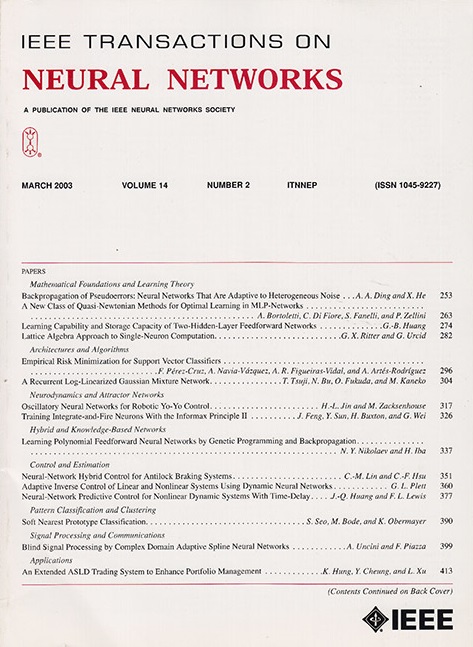
The focus of IEEE Transactions on Neural Networks and Learning Systems is to present scholarly articles discussing the theory, design, and applications of neural networks as well as other learning systems. The journal primarily highlights technical and scientific research in this domain.



 京公网安备 11010802042870号
京ICP备2023020795号-1
京公网安备 11010802042870号
京ICP备2023020795号-1

 分享
分享
 求助内容:
求助内容: 应助结果提醒方式:
 扫码关注我们
