Hexafluorophosphate-Triggered Hydrogen Isotope Exchange (HIE) in Fluorinated Environments: A Platform for the Deuteration of Aromatic Compounds via Strong Bond Activation
Dr. Yang Ni, Jonathan Lebelt, Milena Barp, Florian Kreuter, Hannah Buttkus, Jiaye Jin, Dr. Martin Kretzschmar, Prof. Dr. Ralf Tonner-Zech, Prof. Dr. Knut R. Asmis, Prof. Dr. Tanja Gulder
{"title":"Hexafluorophosphate-Triggered Hydrogen Isotope Exchange (HIE) in Fluorinated Environments: A Platform for the Deuteration of Aromatic Compounds via Strong Bond Activation","authors":"Dr. Yang Ni, Jonathan Lebelt, Milena Barp, Florian Kreuter, Hannah Buttkus, Jiaye Jin, Dr. Martin Kretzschmar, Prof. Dr. Ralf Tonner-Zech, Prof. Dr. Knut R. Asmis, Prof. Dr. Tanja Gulder","doi":"10.1002/anie.202417889","DOIUrl":null,"url":null,"abstract":"<p>There is a perpetual need for efficient and mild methods to integrate deuterium atoms into carbon frameworks through late-stage modifications. We have developed a simple and highly effective synthetic route for hydrogen isotope exchange (HIE) in aromatic compounds under ambient conditions. This method utilizes catalytic amounts of hexafluorophosphate (PF<sub>6</sub><sup>−</sup>) in deuterated 1,1,1,3,3,3-hexafluoroisopropanol (HFIP-<i>d<sub>1</sub></i>) and D<sub>2</sub>O. Phenols, anilines, anisoles, and heterocyclic compounds were converted with high yields and excellent deuterium incorporations, which allows for the synthesis of a wide range of deuterated aromatic compounds. Spectroscopic and theoretical studies show that an interactive H-bonding network triggered by HFIP-<i>d<sub>1</sub></i> activates the typically inert P−F bond in PF<sub>6</sub><sup>−</sup> for D<sub>2</sub>O addition. The thus in situ formed DPO<sub>2</sub>F<sub>2</sub> then triggers HIE, offering a new way to deuterated building blocks, drugs, and natural-product derivatives with high deuterium incorporation via the activation of strong bonds.</p>","PeriodicalId":125,"journal":{"name":"Angewandte Chemie International Edition","volume":"64 6","pages":""},"PeriodicalIF":16.9000,"publicationDate":"2024-11-20","publicationTypes":"Journal Article","fieldsOfStudy":null,"isOpenAccess":false,"openAccessPdf":"https://onlinelibrary.wiley.com/doi/epdf/10.1002/anie.202417889","citationCount":"0","resultStr":null,"platform":"Semanticscholar","paperid":null,"PeriodicalName":"Angewandte Chemie International Edition","FirstCategoryId":"92","ListUrlMain":"https://onlinelibrary.wiley.com/doi/10.1002/anie.202417889","RegionNum":1,"RegionCategory":"化学","ArticlePicture":[],"TitleCN":null,"AbstractTextCN":null,"PMCID":null,"EPubDate":"","PubModel":"","JCR":"Q1","JCRName":"CHEMISTRY, MULTIDISCIPLINARY","Score":null,"Total":0}
引用次数: 0
Abstract
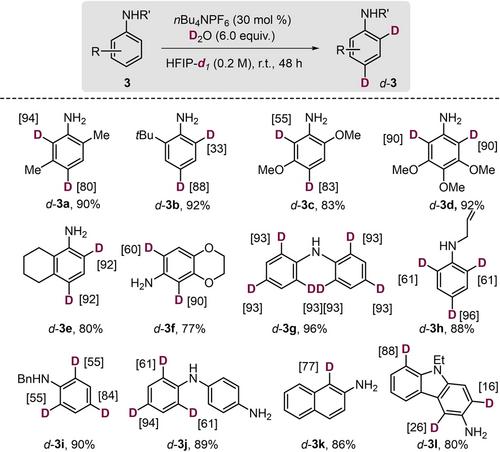
There is a perpetual need for efficient and mild methods to integrate deuterium atoms into carbon frameworks through late-stage modifications. We have developed a simple and highly effective synthetic route for hydrogen isotope exchange (HIE) in aromatic compounds under ambient conditions. This method utilizes catalytic amounts of hexafluorophosphate (PF6−) in deuterated 1,1,1,3,3,3-hexafluoroisopropanol (HFIP-d1) and D2O. Phenols, anilines, anisoles, and heterocyclic compounds were converted with high yields and excellent deuterium incorporations, which allows for the synthesis of a wide range of deuterated aromatic compounds. Spectroscopic and theoretical studies show that an interactive H-bonding network triggered by HFIP-d1 activates the typically inert P−F bond in PF6− for D2O addition. The thus in situ formed DPO2F2 then triggers HIE, offering a new way to deuterated building blocks, drugs, and natural-product derivatives with high deuterium incorporation via the activation of strong bonds.
期刊介绍:
Angewandte Chemie, a journal of the German Chemical Society (GDCh), maintains a leading position among scholarly journals in general chemistry with an impressive Impact Factor of 16.6 (2022 Journal Citation Reports, Clarivate, 2023). Published weekly in a reader-friendly format, it features new articles almost every day. Established in 1887, Angewandte Chemie is a prominent chemistry journal, offering a dynamic blend of Review-type articles, Highlights, Communications, and Research Articles on a weekly basis, making it unique in the field.




 京公网安备 11010802042870号
京ICP备2023020795号-1
京公网安备 11010802042870号
京ICP备2023020795号-1

 分享
分享
 求助内容:
求助内容: 应助结果提醒方式:
 扫码关注我们
