Giovanni Antonio Silverii MD, Laura Pala PhD, Barbara Cresci MD, Edoardo Mannucci MD
{"title":"Glucagon-like peptide 1 (GLP1) receptor agonists and risk for ischemic optic neuropathy: A meta-analysis of randomised controlled trials","authors":"Giovanni Antonio Silverii MD, Laura Pala PhD, Barbara Cresci MD, Edoardo Mannucci MD","doi":"10.1111/dom.16076","DOIUrl":null,"url":null,"abstract":"<p>Glucagon-like peptide-1 receptor agonists (GLP-1 RA) are an established treatment for type 2 diabetes; due to their weight-reducing effect, some of the molecules of the class are increasingly used as a treatment for obesity.<span><sup>1</sup></span> The use of GLP-1 RA is associated with a reduction of major cardiovascular events,<span><sup>2</sup></span> with possible improvements of heart failure,<span><sup>3, 4</sup></span> and renal function.<span><sup>5</sup></span> An increased risk for worsening pre-existing diabetic retinopathy was also observed in a large trial with semaglutide,<span><sup>6</sup></span> but it may be the consequence of a sudden and wide reduction of hyperglycaemia.<span><sup>7</sup></span></p><p>Recently, a retrospective observational study highlighted the possibility of an association of semaglutide treatment with a more than four-fold increase in risk for nonarteritic anterior ischemic optic neuropathy (NAION), but the results could be affected by selection bias, as the study was performed in a sample referring to a specialist facility.<span><sup>8</sup></span> NAION, a condition potentially leading to blindness, is relatively rare in the general population (2–10/100 000 cases/year),<span><sup>9, 10</sup></span> but more frequent in patients with obesity, diabetes and possibly obstructive sleep apnoea.<span><sup>10, 11</sup></span> Because GLP-1 receptors have been detected in neuronal cells in the human eye,<span><sup>12</sup></span> a possible effect of GLP1-RA on optic neuropathy is not implausible. However, a retrospective study, even when well-designed, cannot provide any demonstration of causal relationships, because the possibility of confounding factors cannot be entirely ruled out. In case of suggestions of safety issues detected in observational studies, the retrieval of specific data from randomised trial can therefore add relevant information.</p><p>The present meta-analysis is a post hoc analysis of a systematic review aimed at the assessment of another potential safety issue, that is the incidence of thyroid malignancies, previously registered on the PROSPERO website (https://www.crd.york.ac.uk/PROSPERO; registration number CRD42023456382). It followed the Preferred Reporting Items for Systematic Reviews and Meta Analyses reporting guidance.<span><sup>13</sup></span></p><p>We included all randomised controlled trials (RCTs) lasting at least 12 months, in which any GLP-1 RA approved by European Medical Agency for any indication (at present, obesity and type 2 diabetes) was compared with either placebo or active comparators in adults, and the complete list of serious adverse events (SAE) was disclosed. The population of interest was therefore composed of people with obesity and/or type 2 diabetes.</p><p>A Medline, Embase, Clinicaltrials.gov, Cochrane CENTRAL Database search was performed up to 20th July 2024. Keywords included all the included GLP1-RA drug names, without any language or date restriction, whereas animal studies were excluded. Detailed information on the search strategy is reported in Table S1 of the supplementary materials.</p><p>The endpoint was the difference in incidence of ischemic optic neuropathy, as reported by investigators as SAE.</p><p>Estimates for the variables of interest were extracted from the principal publication, secondary publications and clinicaltrials.gov registry, in the hierarchical order reported above. Three authors performed data extraction independently (G. A. S., L. P., B. C.), and conflicts were resolved by a fourth investigator (E. M.).</p><p>Mantel–Haenszel Odds Ratio [MH-OR] for categorical variables were calculated and displayed as forest plots, using random effect models if heterogeneity was significant, and fixed-effects models if it was not. Statistical heterogeneity was assessed by <i>I</i><sup>2</sup> test. Subgroup analyses were performed for trials performed with different molecules. The risk of bias in RCTs was assessed using the revised Cochrane recommended tool<span><sup>14</sup></span>; the procedure is detailed in Table S2. All analyses were performed using Review Manager (RevMan), Version 5.4.1 (Copenhagen: The Nordic Cochrane Centre, The Cochrane Collaboration).</p><p>The complete trial research flow summary is reported in Figure S1. Out of 6034 items retrieved after removing duplicates, 101 records were selected to retrieve full text; of those, 69 studies fulfilled the inclusion criteria, overall including 144 226 and 132 922 patient-years in GLP1-RA and placebo arms respectively. Of those, 52 trials included only patients with type 2 diabetes, whereas 17 were performed enrolling obese individuals; liraglutide, semaglutide, exenatide, dulaglutide and lixisenatide were used in 23, 19, 15, 7 and 1 trials respectively. The characteristics of the included trials are reported in Table 1, whereas the list of excluded studies is reported in Table S3. The median duration of the studies was 56 weeks. The median age was 57 years, and the median body mass index was 32 kg/m<sup>2</sup>. The risk of bias table and summary are reported in Figures S2 and S3 respectively.</p><p>Of the 69 trials extensively reporting SAE, 64 did not report any case of NAION. In the remaining five trials, we retrieved eight cases of ischemic optic neuropathy in the GLP1-RA arm and four cases in the comparator arm. When considering different molecules, six cases were observed in patients on semaglutide and one each in patients on liraglutide and dulaglutide. GLP1-RA treatment was not associated with a significant difference in the risk for optic ischemic neuropathy in the fixed-effects analysis (MH-OR 1.53, 95% CI [0.53, 4.44], <i>p</i> = 0.43; Figure 1), with low heterogeneity (<i>I</i><sup>2</sup> = 0%).</p><p>The estimated incidence of optic ischemic neuropathy was 5.6/100 000 patient-years and 3/100 000 patient-years in the GLP1-RA and placebo arms respectively. The estimated absolute increase in risk for ischemic optic neuropathy in patients in GLP1-RA therapy was 2.6/100 000 patient-years, whereas a 570/100 000 patient-years absolute increase in risk would have been required to reach a statistical power of 80%.</p><p>Our meta-analysis failed to detect a significant detrimental effect of GLP1-RA therapy on ischemic optic neuropathy in randomised clinical trials. However, the confidence interval was very wide, showing that the number of observed events could have been insufficient to yield a significant result. In fact, NAION is a rare condition, with an incidence between 2 and 10 cases per 100 000 patient-years.<span><sup>9, 10</sup></span> In the present meta-analysis, an accurate incidence estimate could not be calculated, because the time of occurrence of ischemic optic neuropathy during trials was not available. However, an approximate calculation based on the mean duration of observation for each trial suggests an approximate incidence of ischemic optic neuropathy of 5.6 and 3.0 cases per 100 000 patient-years in patients in GLP1-RA and control arms respectively, which is compatible with current epidemiological data.<span><sup>9, 10</sup></span> The possibility of underreporting should not be excluded, because ischemic optic neuropathy was not an independently adjudicated adverse event. Furthermore, it was not specified, in clinical trials whether ischemic neuropathy was arteritic or not arteritic, which is a challenging differential diagnosis and reporting for many ophthalmologists, as the two diseases share the same ICD-9 coding.<span><sup>8</sup></span></p><p>Considering the rarity of the condition, available clinical trials, although relevant for number and sample size, are not yet sufficient to demonstrate an association nor to establish the safety of GLP-1 RA in this respect, particularly for semaglutide, because the majority of detected cases was treated with this specific agent. The potential impact of such a risk increase, if confirmed, could be amplified by the fact that patients with obesity and diabetes, who are most likely to receive treatment, already have an increased baseline risk of NAION.<span><sup>10</sup></span></p><p>A relevant increase of the relative risk for a very rare, although severe, condition does not modify the overall risk–benefit ratio of effective drugs, at least when appropriately prescribed. In fact, if we assume a difference in incidence between GLP1 RA and placebo of 2.6 cases per 100 000 patient-years, the 1-year number needed to harm would be 38 460—well above the number needed to treat to avoid a major cardiovascular event in cardiovascular outcome trials.<span><sup>2, 15</sup></span> In fact, sight-threatening diabetic retinopathy is much more frequent than NAION.<span><sup>16</sup></span> At the same time, we should be aware that the inappropriate use of drugs for inducing weight loss in moderately overweight patients with low cardiovascular risk could be associated with rare, but severe, adverse effects, possibly including NAION. Owing to the rarity of NAION, results of clinical trials cannot either establish nor rule out an association with GLP1 RA, which needs to be further investigated.</p><p>GAS and EM made the analysis plan, researched data, performed analyses, contributed to the discussion and wrote the first draft of the manuscript. LP and BC contributed to data research and discussion and reviewed and edited the manuscript. All authors approved the final version of the manuscript. All the authors had full access to all the data in the study, and they take responsibility for the integrity of the data and the accuracy of the data analysis.</p><p>This research was performed independently of any funding, as part of the institutional activity of the investigators. The corresponding author had full access to all the data in the study and had final responsibility for the decision to submit for publication.</p><p>GAS, LP and BC have no conflicts of interest to declare. The unit directed by EM has received research grants from Abbott, Eli-Lilly and Novo Nordisk, outside the submitted work. EM has received consultancy fees from Dexcom and Sanofi and speaking fees from Astra Zeneca, Boehringer-Ingelheim, Eli-Lilly and Novo Nordisk, outside the submitted work.</p>","PeriodicalId":158,"journal":{"name":"Diabetes, Obesity & Metabolism","volume":"27 2","pages":"1005-1009"},"PeriodicalIF":5.7000,"publicationDate":"2024-11-20","publicationTypes":"Journal Article","fieldsOfStudy":null,"isOpenAccess":false,"openAccessPdf":"https://onlinelibrary.wiley.com/doi/epdf/10.1111/dom.16076","citationCount":"0","resultStr":null,"platform":"Semanticscholar","paperid":null,"PeriodicalName":"Diabetes, Obesity & Metabolism","FirstCategoryId":"3","ListUrlMain":"https://dom-pubs.onlinelibrary.wiley.com/doi/10.1111/dom.16076","RegionNum":2,"RegionCategory":"医学","ArticlePicture":[],"TitleCN":null,"AbstractTextCN":null,"PMCID":null,"EPubDate":"","PubModel":"","JCR":"Q1","JCRName":"ENDOCRINOLOGY & METABOLISM","Score":null,"Total":0}
引用次数: 0
Abstract
Glucagon-like peptide-1 receptor agonists (GLP-1 RA) are an established treatment for type 2 diabetes; due to their weight-reducing effect, some of the molecules of the class are increasingly used as a treatment for obesity.1 The use of GLP-1 RA is associated with a reduction of major cardiovascular events,2 with possible improvements of heart failure,3, 4 and renal function.5 An increased risk for worsening pre-existing diabetic retinopathy was also observed in a large trial with semaglutide,6 but it may be the consequence of a sudden and wide reduction of hyperglycaemia.7
Recently, a retrospective observational study highlighted the possibility of an association of semaglutide treatment with a more than four-fold increase in risk for nonarteritic anterior ischemic optic neuropathy (NAION), but the results could be affected by selection bias, as the study was performed in a sample referring to a specialist facility.8 NAION, a condition potentially leading to blindness, is relatively rare in the general population (2–10/100 000 cases/year),9, 10 but more frequent in patients with obesity, diabetes and possibly obstructive sleep apnoea.10, 11 Because GLP-1 receptors have been detected in neuronal cells in the human eye,12 a possible effect of GLP1-RA on optic neuropathy is not implausible. However, a retrospective study, even when well-designed, cannot provide any demonstration of causal relationships, because the possibility of confounding factors cannot be entirely ruled out. In case of suggestions of safety issues detected in observational studies, the retrieval of specific data from randomised trial can therefore add relevant information.
The present meta-analysis is a post hoc analysis of a systematic review aimed at the assessment of another potential safety issue, that is the incidence of thyroid malignancies, previously registered on the PROSPERO website (https://www.crd.york.ac.uk/PROSPERO; registration number CRD42023456382). It followed the Preferred Reporting Items for Systematic Reviews and Meta Analyses reporting guidance.13
We included all randomised controlled trials (RCTs) lasting at least 12 months, in which any GLP-1 RA approved by European Medical Agency for any indication (at present, obesity and type 2 diabetes) was compared with either placebo or active comparators in adults, and the complete list of serious adverse events (SAE) was disclosed. The population of interest was therefore composed of people with obesity and/or type 2 diabetes.
A Medline, Embase, Clinicaltrials.gov, Cochrane CENTRAL Database search was performed up to 20th July 2024. Keywords included all the included GLP1-RA drug names, without any language or date restriction, whereas animal studies were excluded. Detailed information on the search strategy is reported in Table S1 of the supplementary materials.
The endpoint was the difference in incidence of ischemic optic neuropathy, as reported by investigators as SAE.
Estimates for the variables of interest were extracted from the principal publication, secondary publications and clinicaltrials.gov registry, in the hierarchical order reported above. Three authors performed data extraction independently (G. A. S., L. P., B. C.), and conflicts were resolved by a fourth investigator (E. M.).
Mantel–Haenszel Odds Ratio [MH-OR] for categorical variables were calculated and displayed as forest plots, using random effect models if heterogeneity was significant, and fixed-effects models if it was not. Statistical heterogeneity was assessed by I2 test. Subgroup analyses were performed for trials performed with different molecules. The risk of bias in RCTs was assessed using the revised Cochrane recommended tool14; the procedure is detailed in Table S2. All analyses were performed using Review Manager (RevMan), Version 5.4.1 (Copenhagen: The Nordic Cochrane Centre, The Cochrane Collaboration).
The complete trial research flow summary is reported in Figure S1. Out of 6034 items retrieved after removing duplicates, 101 records were selected to retrieve full text; of those, 69 studies fulfilled the inclusion criteria, overall including 144 226 and 132 922 patient-years in GLP1-RA and placebo arms respectively. Of those, 52 trials included only patients with type 2 diabetes, whereas 17 were performed enrolling obese individuals; liraglutide, semaglutide, exenatide, dulaglutide and lixisenatide were used in 23, 19, 15, 7 and 1 trials respectively. The characteristics of the included trials are reported in Table 1, whereas the list of excluded studies is reported in Table S3. The median duration of the studies was 56 weeks. The median age was 57 years, and the median body mass index was 32 kg/m2. The risk of bias table and summary are reported in Figures S2 and S3 respectively.
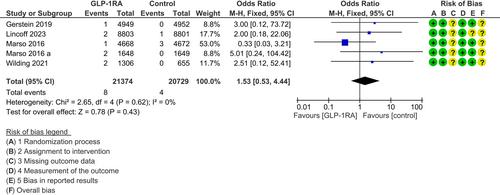
Of the 69 trials extensively reporting SAE, 64 did not report any case of NAION. In the remaining five trials, we retrieved eight cases of ischemic optic neuropathy in the GLP1-RA arm and four cases in the comparator arm. When considering different molecules, six cases were observed in patients on semaglutide and one each in patients on liraglutide and dulaglutide. GLP1-RA treatment was not associated with a significant difference in the risk for optic ischemic neuropathy in the fixed-effects analysis (MH-OR 1.53, 95% CI [0.53, 4.44], p = 0.43; Figure 1), with low heterogeneity (I2 = 0%).
The estimated incidence of optic ischemic neuropathy was 5.6/100 000 patient-years and 3/100 000 patient-years in the GLP1-RA and placebo arms respectively. The estimated absolute increase in risk for ischemic optic neuropathy in patients in GLP1-RA therapy was 2.6/100 000 patient-years, whereas a 570/100 000 patient-years absolute increase in risk would have been required to reach a statistical power of 80%.
Our meta-analysis failed to detect a significant detrimental effect of GLP1-RA therapy on ischemic optic neuropathy in randomised clinical trials. However, the confidence interval was very wide, showing that the number of observed events could have been insufficient to yield a significant result. In fact, NAION is a rare condition, with an incidence between 2 and 10 cases per 100 000 patient-years.9, 10 In the present meta-analysis, an accurate incidence estimate could not be calculated, because the time of occurrence of ischemic optic neuropathy during trials was not available. However, an approximate calculation based on the mean duration of observation for each trial suggests an approximate incidence of ischemic optic neuropathy of 5.6 and 3.0 cases per 100 000 patient-years in patients in GLP1-RA and control arms respectively, which is compatible with current epidemiological data.9, 10 The possibility of underreporting should not be excluded, because ischemic optic neuropathy was not an independently adjudicated adverse event. Furthermore, it was not specified, in clinical trials whether ischemic neuropathy was arteritic or not arteritic, which is a challenging differential diagnosis and reporting for many ophthalmologists, as the two diseases share the same ICD-9 coding.8
Considering the rarity of the condition, available clinical trials, although relevant for number and sample size, are not yet sufficient to demonstrate an association nor to establish the safety of GLP-1 RA in this respect, particularly for semaglutide, because the majority of detected cases was treated with this specific agent. The potential impact of such a risk increase, if confirmed, could be amplified by the fact that patients with obesity and diabetes, who are most likely to receive treatment, already have an increased baseline risk of NAION.10
A relevant increase of the relative risk for a very rare, although severe, condition does not modify the overall risk–benefit ratio of effective drugs, at least when appropriately prescribed. In fact, if we assume a difference in incidence between GLP1 RA and placebo of 2.6 cases per 100 000 patient-years, the 1-year number needed to harm would be 38 460—well above the number needed to treat to avoid a major cardiovascular event in cardiovascular outcome trials.2, 15 In fact, sight-threatening diabetic retinopathy is much more frequent than NAION.16 At the same time, we should be aware that the inappropriate use of drugs for inducing weight loss in moderately overweight patients with low cardiovascular risk could be associated with rare, but severe, adverse effects, possibly including NAION. Owing to the rarity of NAION, results of clinical trials cannot either establish nor rule out an association with GLP1 RA, which needs to be further investigated.
GAS and EM made the analysis plan, researched data, performed analyses, contributed to the discussion and wrote the first draft of the manuscript. LP and BC contributed to data research and discussion and reviewed and edited the manuscript. All authors approved the final version of the manuscript. All the authors had full access to all the data in the study, and they take responsibility for the integrity of the data and the accuracy of the data analysis.
This research was performed independently of any funding, as part of the institutional activity of the investigators. The corresponding author had full access to all the data in the study and had final responsibility for the decision to submit for publication.
GAS, LP and BC have no conflicts of interest to declare. The unit directed by EM has received research grants from Abbott, Eli-Lilly and Novo Nordisk, outside the submitted work. EM has received consultancy fees from Dexcom and Sanofi and speaking fees from Astra Zeneca, Boehringer-Ingelheim, Eli-Lilly and Novo Nordisk, outside the submitted work.
期刊介绍:
Diabetes, Obesity and Metabolism is primarily a journal of clinical and experimental pharmacology and therapeutics covering the interrelated areas of diabetes, obesity and metabolism. The journal prioritises high-quality original research that reports on the effects of new or existing therapies, including dietary, exercise and lifestyle (non-pharmacological) interventions, in any aspect of metabolic and endocrine disease, either in humans or animal and cellular systems. ‘Metabolism’ may relate to lipids, bone and drug metabolism, or broader aspects of endocrine dysfunction. Preclinical pharmacology, pharmacokinetic studies, meta-analyses and those addressing drug safety and tolerability are also highly suitable for publication in this journal. Original research may be published as a main paper or as a research letter.





 京公网安备 11010802042870号
京ICP备2023020795号-1
京公网安备 11010802042870号
京ICP备2023020795号-1

 分享
分享
 求助内容:
求助内容: 应助结果提醒方式:
 扫码关注我们
