Kerstin Geißelsöder, Maren Weiss, Klara Boksán, Michael Dechant, Johann Endres, Maike Breuer, Mark Stemmler, Norbert Wodarz
{"title":"Opioid substitution treatment, relapse and addiction-related outcomes in prison setting and after release: A longitudinal study.","authors":"Kerstin Geißelsöder, Maren Weiss, Klara Boksán, Michael Dechant, Johann Endres, Maike Breuer, Mark Stemmler, Norbert Wodarz","doi":"10.1177/14550725241276309","DOIUrl":null,"url":null,"abstract":"<p><p><b>Aims:</b> Opioid addiction is a common problem among prisoners. The aim of this study was to examine differences between people who are incarcerated receiving opioid substitution treatment (OST) and those not receiving OST on addiction-related outcome variables during incarceration and after release from prison. Variables covered illicit use of opioids, non-prescribed substitution medication and other substances, opioid withdrawal symptoms, opioid craving, non-fatal overdoses and post-release substitution treatment. <b>Design:</b> Interviews (European Addiction Severity Index, EuropASI) were conducted with 247 participants in German prisons before release. Participants were interviewed again 1 month and 3-6 months after release from prison. <b>Results:</b> During incarceration, participants who received OST used less illicit opioids and non-prescribed substitution medication than those who did not receive OST. After release from prison, participants in the OST group reported less illicit opioid use and less non-prescribed substitution medication use, as well as less opioid craving. Participants who received OST in prison were more likely to be in OST at post-release follow-up than those who had not received in-prison OST. <b>Conclusion:</b> OST appears to have a positive effect on illicit opioid use and craving both in prison and after release, as well as on treatment at follow-up, which can be considered a protective factor.</p>","PeriodicalId":46180,"journal":{"name":"Nordic Studies on Alcohol and Drugs","volume":" ","pages":"640-655"},"PeriodicalIF":2.2000,"publicationDate":"2024-12-01","publicationTypes":"Journal Article","fieldsOfStudy":null,"isOpenAccess":false,"openAccessPdf":"https://www.ncbi.nlm.nih.gov/pmc/articles/PMC11572460/pdf/","citationCount":"0","resultStr":null,"platform":"Semanticscholar","paperid":null,"PeriodicalName":"Nordic Studies on Alcohol and Drugs","FirstCategoryId":"90","ListUrlMain":"https://doi.org/10.1177/14550725241276309","RegionNum":3,"RegionCategory":"社会学","ArticlePicture":[],"TitleCN":null,"AbstractTextCN":null,"PMCID":null,"EPubDate":"2024/10/16 0:00:00","PubModel":"Epub","JCR":"Q3","JCRName":"SUBSTANCE ABUSE","Score":null,"Total":0}
引用次数: 0
Abstract
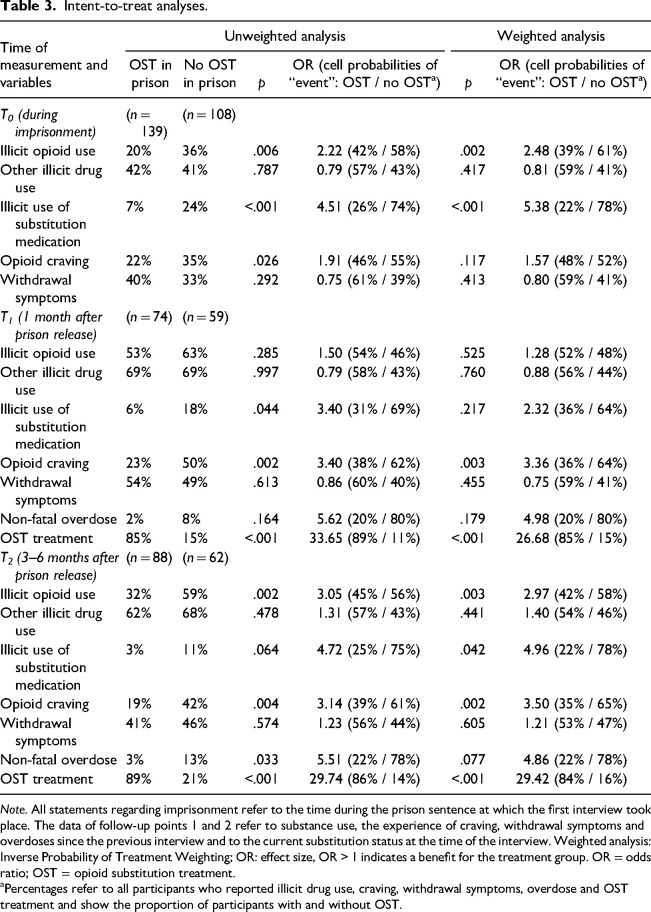
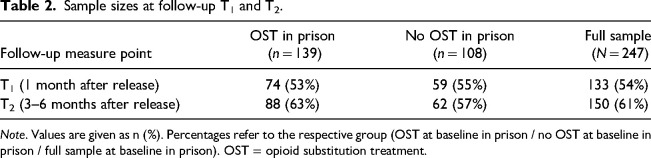
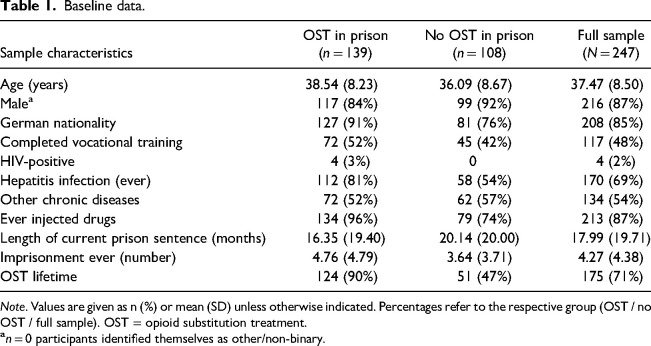
Aims: Opioid addiction is a common problem among prisoners. The aim of this study was to examine differences between people who are incarcerated receiving opioid substitution treatment (OST) and those not receiving OST on addiction-related outcome variables during incarceration and after release from prison. Variables covered illicit use of opioids, non-prescribed substitution medication and other substances, opioid withdrawal symptoms, opioid craving, non-fatal overdoses and post-release substitution treatment. Design: Interviews (European Addiction Severity Index, EuropASI) were conducted with 247 participants in German prisons before release. Participants were interviewed again 1 month and 3-6 months after release from prison. Results: During incarceration, participants who received OST used less illicit opioids and non-prescribed substitution medication than those who did not receive OST. After release from prison, participants in the OST group reported less illicit opioid use and less non-prescribed substitution medication use, as well as less opioid craving. Participants who received OST in prison were more likely to be in OST at post-release follow-up than those who had not received in-prison OST. Conclusion: OST appears to have a positive effect on illicit opioid use and craving both in prison and after release, as well as on treatment at follow-up, which can be considered a protective factor.




 京公网安备 11010802042870号
京ICP备2023020795号-1
京公网安备 11010802042870号
京ICP备2023020795号-1

 分享
分享
 求助内容:
求助内容: 应助结果提醒方式:
 扫码关注我们
