Yeon Heo, Seok Oh, Kyung Hoon Cho, Min Chul Kim, Doo Sun Sim, Young Joon Hong, Ju Han Kim, Youngkeun Ahn, Myung Ho Jeong
{"title":"Coronary vasospasm and cardiovascular outcomes in patients with isolated myocardial bridging: A retrospective study.","authors":"Yeon Heo, Seok Oh, Kyung Hoon Cho, Min Chul Kim, Doo Sun Sim, Young Joon Hong, Ju Han Kim, Youngkeun Ahn, Myung Ho Jeong","doi":"10.5603/cj.99129","DOIUrl":null,"url":null,"abstract":"<p><strong>Background: </strong>Mounting evidence suggests an associated between myocardial bridging (MB) and coronary vasospasm (CVS); however, no consensus has been established on whether CVS worsens clinical outcomes in patients with MB. Therefore, this retrospective study aimed to compare the long-term clinical outcomes in patients with MB based on CVS presence.</p><p><strong>Methods: </strong>This retrospective study enrolled 254 consecutive patients with MB undergoing provocative testing for coronary reactivity between January 1, 2009 and December 30, 2015, and stratified them into 2 groups: (a) group A (with CVS, n = 168); and (b) group B (without CVS, n = 86). The primary endpoints were major adverse cardiovascular events (MACEs), a composite of cardiac death, cardiac arrest, non-fatal myocardial infarction, ischemia-driven revascularization, ischemia-driven coronary angiography, and ischemia-related hospitalization. Diverse Cox models were used to determine whether CVS independently influenced MACE.</p><p><strong>Results: </strong>The mean age of study participants was 50.8 years, and 60.2% of them were male. The median follow-up period was 8.15 years. The rate of MACE was 35.1% and 26.7% in groups A and B, respectively. Group A had a significantly higher risk of MACE than group B (the reference group) in model 3 (hazard ratio [HR]:1.92; 95% confidence interval [CI]:1.12-3.29) and model 4 (adjusted HR: 1.94; 95% CI: 1.04-3.59).</p><p><strong>Conclusions: </strong>The presence of CVS adversely affects clinical outcomes in patients with MB. Further prospective clinical studies are required to confirm this association.</p>","PeriodicalId":93923,"journal":{"name":"Cardiology journal","volume":" ","pages":"814-822"},"PeriodicalIF":0.0000,"publicationDate":"2024-01-01","publicationTypes":"Journal Article","fieldsOfStudy":null,"isOpenAccess":false,"openAccessPdf":"https://www.ncbi.nlm.nih.gov/pmc/articles/PMC11706257/pdf/","citationCount":"0","resultStr":null,"platform":"Semanticscholar","paperid":null,"PeriodicalName":"Cardiology journal","FirstCategoryId":"1085","ListUrlMain":"https://doi.org/10.5603/cj.99129","RegionNum":0,"RegionCategory":null,"ArticlePicture":[],"TitleCN":null,"AbstractTextCN":null,"PMCID":null,"EPubDate":"2024/11/20 0:00:00","PubModel":"Epub","JCR":"","JCRName":"","Score":null,"Total":0}
引用次数: 0
Abstract
Background: Mounting evidence suggests an associated between myocardial bridging (MB) and coronary vasospasm (CVS); however, no consensus has been established on whether CVS worsens clinical outcomes in patients with MB. Therefore, this retrospective study aimed to compare the long-term clinical outcomes in patients with MB based on CVS presence.
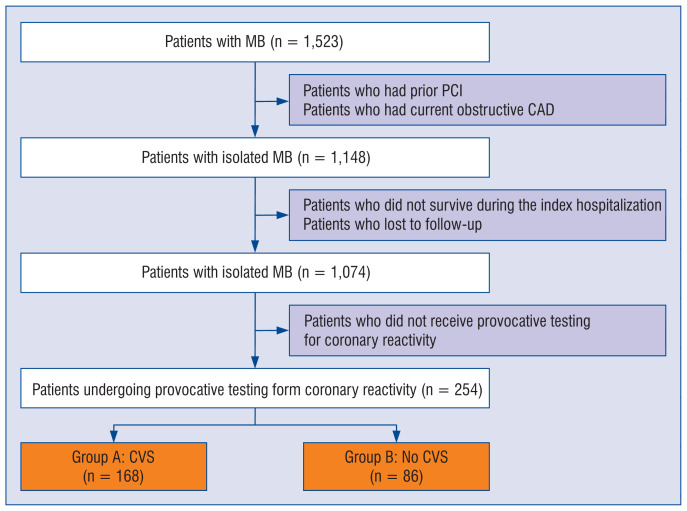
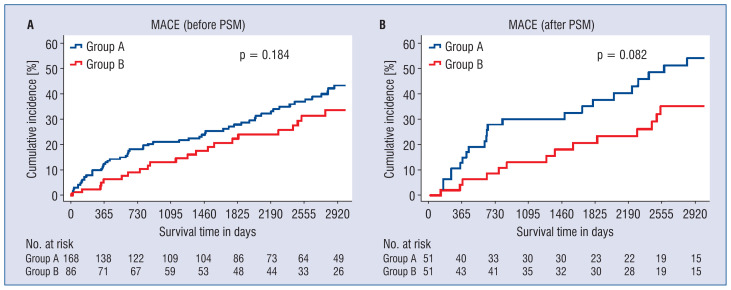
Methods: This retrospective study enrolled 254 consecutive patients with MB undergoing provocative testing for coronary reactivity between January 1, 2009 and December 30, 2015, and stratified them into 2 groups: (a) group A (with CVS, n = 168); and (b) group B (without CVS, n = 86). The primary endpoints were major adverse cardiovascular events (MACEs), a composite of cardiac death, cardiac arrest, non-fatal myocardial infarction, ischemia-driven revascularization, ischemia-driven coronary angiography, and ischemia-related hospitalization. Diverse Cox models were used to determine whether CVS independently influenced MACE.
Results: The mean age of study participants was 50.8 years, and 60.2% of them were male. The median follow-up period was 8.15 years. The rate of MACE was 35.1% and 26.7% in groups A and B, respectively. Group A had a significantly higher risk of MACE than group B (the reference group) in model 3 (hazard ratio [HR]:1.92; 95% confidence interval [CI]:1.12-3.29) and model 4 (adjusted HR: 1.94; 95% CI: 1.04-3.59).
Conclusions: The presence of CVS adversely affects clinical outcomes in patients with MB. Further prospective clinical studies are required to confirm this association.



 京公网安备 11010802042870号
京ICP备2023020795号-1
京公网安备 11010802042870号
京ICP备2023020795号-1

 分享
分享

 求助内容:
求助内容: 应助结果提醒方式:
 扫码关注我们
