Ultra-wide band near-infrared (NIR) optical thermometry (12–673 K) performance enhanced by Stark sublevel splitting in Er3+ ions near the first biological window in the PbZr0.53Ti0.47O3:Er3+/Yb3+ phosphor†
Prasenjit Prasad Sukul, Yadvendra Singh and Hendrik Swart
{"title":"Ultra-wide band near-infrared (NIR) optical thermometry (12–673 K) performance enhanced by Stark sublevel splitting in Er3+ ions near the first biological window in the PbZr0.53Ti0.47O3:Er3+/Yb3+ phosphor†","authors":"Prasenjit Prasad Sukul, Yadvendra Singh and Hendrik Swart","doi":"10.1039/D4CP03125C","DOIUrl":null,"url":null,"abstract":"<p >The fluorescence intensity ratio (FIR) approach, which relies on thermally coupled levels (TCLs), is significantly important for optical thermometry at room temperature and above, but was found to be impractical for low temperature sensing due to limited population density (thermal) or lack of spectrum at extremely low temperatures. Herein, we report a wide temperature range (12–673 K) sensing capability of the PbZr<small><sub>0.53</sub></small>Ti<small><sub>0.47</sub></small>O<small><sub>3</sub></small>:Er<small><sup>3+</sup></small>/Yb<small><sup>3+</sup></small> (C1:PZT) phosphor utilising the bandwidth of Stark sublevel split near-infrared (NIR) emission bands as one sensing parameter and FIR as another. Motivated by our previous studies on upconversion (UC) and the promising thermometry performance of the C1:PZT phosphor for real time nanothermometer monitoring (using visible TCLs), this work extends to the same thermometry application using UC-NIR emission as TCLs. The temperature-dependent UC spectra were measured across the ranges of 12–313 K and 313–673 K under 980 nm excitation, and their sensing capabilities were thoroughly evaluated. An enveloped single emission band, comprising multiple peaks in the NIR region, was observed and subsequently deconvoluted using Gaussian fitting. These individual peaks were analyzed in relation to Stark sublevel splitting, which was particularly evident at 12 K, and the variations in their full width at half maximum (FWHM) were compared across temperatures up to 313 K. Based on the temperature-dependent bandwidth, two prominent peaks ∼11 655 cm<small><sup>−1</sup></small> (858 nm) and 11 454 cm<small><sup>−1</sup></small> (873 nm), were identified as TCL levels, and a sensitivity (<em>S</em><small><sub>r</sub></small>) of 0.68 ± 0.01% K<small><sup>−1</sup></small> at 673 K was observed, making it a suitable thermometer for reading low temperatures using NIR bands.</p>","PeriodicalId":99,"journal":{"name":"Physical Chemistry Chemical Physics","volume":" 1","pages":" 270-282"},"PeriodicalIF":2.9000,"publicationDate":"2024-11-21","publicationTypes":"Journal Article","fieldsOfStudy":null,"isOpenAccess":false,"openAccessPdf":"https://pubs.rsc.org/en/content/articlepdf/2025/cp/d4cp03125c?page=search","citationCount":"0","resultStr":null,"platform":"Semanticscholar","paperid":null,"PeriodicalName":"Physical Chemistry Chemical Physics","FirstCategoryId":"92","ListUrlMain":"https://pubs.rsc.org/en/content/articlelanding/2025/cp/d4cp03125c","RegionNum":3,"RegionCategory":"化学","ArticlePicture":[],"TitleCN":null,"AbstractTextCN":null,"PMCID":null,"EPubDate":"","PubModel":"","JCR":"Q3","JCRName":"CHEMISTRY, PHYSICAL","Score":null,"Total":0}
引用次数: 0
Abstract
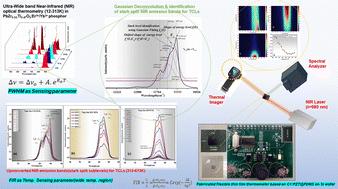
The fluorescence intensity ratio (FIR) approach, which relies on thermally coupled levels (TCLs), is significantly important for optical thermometry at room temperature and above, but was found to be impractical for low temperature sensing due to limited population density (thermal) or lack of spectrum at extremely low temperatures. Herein, we report a wide temperature range (12–673 K) sensing capability of the PbZr0.53Ti0.47O3:Er3+/Yb3+ (C1:PZT) phosphor utilising the bandwidth of Stark sublevel split near-infrared (NIR) emission bands as one sensing parameter and FIR as another. Motivated by our previous studies on upconversion (UC) and the promising thermometry performance of the C1:PZT phosphor for real time nanothermometer monitoring (using visible TCLs), this work extends to the same thermometry application using UC-NIR emission as TCLs. The temperature-dependent UC spectra were measured across the ranges of 12–313 K and 313–673 K under 980 nm excitation, and their sensing capabilities were thoroughly evaluated. An enveloped single emission band, comprising multiple peaks in the NIR region, was observed and subsequently deconvoluted using Gaussian fitting. These individual peaks were analyzed in relation to Stark sublevel splitting, which was particularly evident at 12 K, and the variations in their full width at half maximum (FWHM) were compared across temperatures up to 313 K. Based on the temperature-dependent bandwidth, two prominent peaks ∼11 655 cm−1 (858 nm) and 11 454 cm−1 (873 nm), were identified as TCL levels, and a sensitivity (Sr) of 0.68 ± 0.01% K−1 at 673 K was observed, making it a suitable thermometer for reading low temperatures using NIR bands.
期刊介绍:
Physical Chemistry Chemical Physics (PCCP) is an international journal co-owned by 19 physical chemistry and physics societies from around the world. This journal publishes original, cutting-edge research in physical chemistry, chemical physics and biophysical chemistry. To be suitable for publication in PCCP, articles must include significant innovation and/or insight into physical chemistry; this is the most important criterion that reviewers and Editors will judge against when evaluating submissions.
The journal has a broad scope and welcomes contributions spanning experiment, theory, computation and data science. Topical coverage includes spectroscopy, dynamics, kinetics, statistical mechanics, thermodynamics, electrochemistry, catalysis, surface science, quantum mechanics, quantum computing and machine learning. Interdisciplinary research areas such as polymers and soft matter, materials, nanoscience, energy, surfaces/interfaces, and biophysical chemistry are welcomed if they demonstrate significant innovation and/or insight into physical chemistry. Joined experimental/theoretical studies are particularly appreciated when complementary and based on up-to-date approaches.





 京公网安备 11010802042870号
京ICP备2023020795号-1
京公网安备 11010802042870号
京ICP备2023020795号-1

 分享
分享
 求助内容:
求助内容: 应助结果提醒方式:
 扫码关注我们
