{"title":"Palladium-catalyzed NHC ligand-controlled regiodivergent allyl-fluoroallyl cross-couplings†","authors":"Yangyang Ma , Boxia Xu , Hua Zhang , Zhiping Li","doi":"10.1039/d4qo01800a","DOIUrl":null,"url":null,"abstract":"<div><div>The palladium-catalyzed cross-coupling of (<em>E</em>)-2-fluoroallyl carbonates and allylboronates is reported. The regioselectivity is susceptive to the steric requirements of the NHC ligand, with small IMes favoring linear fluorinated 1,5-dienes, while IPr<sup>BIDEA</sup> featuring sterically-congested character benefits branched products. Control experiments revealed that either 2-fluoroallyl carbonates or <em>gem</em>-F<sub>2</sub>CPs could undergo allylation with excellent regioselectivity, yet the former showed somewhat lower branched reactivity.</div></div>","PeriodicalId":94379,"journal":{"name":"Organic chemistry frontiers : an international journal of organic chemistry","volume":"12 3","pages":"Pages 760-765"},"PeriodicalIF":0.0000,"publicationDate":"2024-11-05","publicationTypes":"Journal Article","fieldsOfStudy":null,"isOpenAccess":false,"openAccessPdf":"","citationCount":"0","resultStr":null,"platform":"Semanticscholar","paperid":null,"PeriodicalName":"Organic chemistry frontiers : an international journal of organic chemistry","FirstCategoryId":"1085","ListUrlMain":"https://www.sciencedirect.com/org/science/article/pii/S205241292400826X","RegionNum":0,"RegionCategory":null,"ArticlePicture":[],"TitleCN":null,"AbstractTextCN":null,"PMCID":null,"EPubDate":"2024/11/21 0:00:00","PubModel":"Epub","JCR":"","JCRName":"","Score":null,"Total":0}
引用次数: 0
Abstract
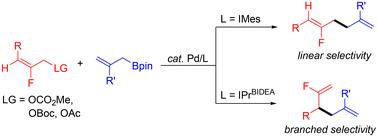
The palladium-catalyzed cross-coupling of (E)-2-fluoroallyl carbonates and allylboronates is reported. The regioselectivity is susceptive to the steric requirements of the NHC ligand, with small IMes favoring linear fluorinated 1,5-dienes, while IPrBIDEA featuring sterically-congested character benefits branched products. Control experiments revealed that either 2-fluoroallyl carbonates or gem-F2CPs could undergo allylation with excellent regioselectivity, yet the former showed somewhat lower branched reactivity.




 京公网安备 11010802042870号
京ICP备2023020795号-1
京公网安备 11010802042870号
京ICP备2023020795号-1

 分享
分享

 求助内容:
求助内容: 应助结果提醒方式:
 扫码关注我们
