Liyu Dai, Xiaomin Wu, Yiqing Guo, Huimin Hou, Zhifeng Hu, Yukai Lin and Zhiping Yuan
{"title":"An enhanced heat transfer method based on the electrocapillary effect of gallium-based liquid metal†","authors":"Liyu Dai, Xiaomin Wu, Yiqing Guo, Huimin Hou, Zhifeng Hu, Yukai Lin and Zhiping Yuan","doi":"10.1039/D4LC00791C","DOIUrl":null,"url":null,"abstract":"<p >As electronic products become smaller and more powerful, there is an increasing need for effective heat dissipation. An effective heat exchange method is necessary for the equipment to function reliably in a compact space. To tackle the limitations of current microfluidic cooling technology, including difficulty in manufacturing, maintenance, and cost reduction, a heat exchange method with a simple system is proposed in this work. This method is based on the electrocapillary effect, using eutectic gallium–indium alloy droplets with high thermal conductivity, surface tension, and controllability as the basic unit. An electric field is applied to generate unevenly distributed charges in the electric double layer on the droplet surface, thereby creating a surface tension gradient that can drive the surrounding solution to flow. Simultaneously, the oscillation of the droplet can also intensify the disturbance of the solution. The violent disturbance of the solution causes the heat transfer mode to change from conduction to convective heat transfer and greatly reduces the thermal resistance, resulting in a substantial increase in heat flux. For this heat transfer method, the temperature distribution and flow characteristics of the solution in low-frequency oscillating and direct-current-biased alternating current electric fields are studied, and the effect of voltage, frequency, and the number of droplets on heat transfer enhancement is clarified. Compared with conduction without internal disturbance, the heat flux can be increased by up to 110% based on the combined effect of two droplets. This work provides a solution for enhancing the heat transfer of microfluidics.</p>","PeriodicalId":85,"journal":{"name":"Lab on a Chip","volume":" 24","pages":" 5318-5327"},"PeriodicalIF":5.4000,"publicationDate":"2024-11-21","publicationTypes":"Journal Article","fieldsOfStudy":null,"isOpenAccess":false,"openAccessPdf":"","citationCount":"0","resultStr":null,"platform":"Semanticscholar","paperid":null,"PeriodicalName":"Lab on a Chip","FirstCategoryId":"5","ListUrlMain":"https://pubs.rsc.org/en/content/articlelanding/2024/lc/d4lc00791c","RegionNum":2,"RegionCategory":"工程技术","ArticlePicture":[],"TitleCN":null,"AbstractTextCN":null,"PMCID":null,"EPubDate":"","PubModel":"","JCR":"Q1","JCRName":"BIOCHEMICAL RESEARCH METHODS","Score":null,"Total":0}
引用次数: 0
Abstract
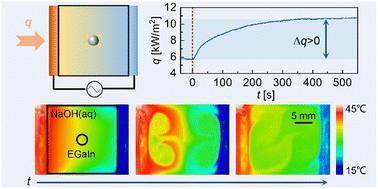
As electronic products become smaller and more powerful, there is an increasing need for effective heat dissipation. An effective heat exchange method is necessary for the equipment to function reliably in a compact space. To tackle the limitations of current microfluidic cooling technology, including difficulty in manufacturing, maintenance, and cost reduction, a heat exchange method with a simple system is proposed in this work. This method is based on the electrocapillary effect, using eutectic gallium–indium alloy droplets with high thermal conductivity, surface tension, and controllability as the basic unit. An electric field is applied to generate unevenly distributed charges in the electric double layer on the droplet surface, thereby creating a surface tension gradient that can drive the surrounding solution to flow. Simultaneously, the oscillation of the droplet can also intensify the disturbance of the solution. The violent disturbance of the solution causes the heat transfer mode to change from conduction to convective heat transfer and greatly reduces the thermal resistance, resulting in a substantial increase in heat flux. For this heat transfer method, the temperature distribution and flow characteristics of the solution in low-frequency oscillating and direct-current-biased alternating current electric fields are studied, and the effect of voltage, frequency, and the number of droplets on heat transfer enhancement is clarified. Compared with conduction without internal disturbance, the heat flux can be increased by up to 110% based on the combined effect of two droplets. This work provides a solution for enhancing the heat transfer of microfluidics.
期刊介绍:
Lab on a Chip is the premiere journal that publishes cutting-edge research in the field of miniaturization. By their very nature, microfluidic/nanofluidic/miniaturized systems are at the intersection of disciplines, spanning fundamental research to high-end application, which is reflected by the broad readership of the journal. Lab on a Chip publishes two types of papers on original research: full-length research papers and communications. Papers should demonstrate innovations, which can come from technical advancements or applications addressing pressing needs in globally important areas. The journal also publishes Comments, Reviews, and Perspectives.



 京公网安备 11010802042870号
京ICP备2023020795号-1
京公网安备 11010802042870号
京ICP备2023020795号-1

 分享
分享
 求助内容:
求助内容: 应助结果提醒方式:
 扫码关注我们
