Tomoki Koyama , Yu Mori , Masayuki Kamimura , Hidetatsu Tanaka , Rui Tome , Ketaro Ito , Masashi Koguchi , Naoko Mori , Toshimi Aizawa
{"title":"TiNbSn alloy plates with low Young's modulus modulates interfragmentary movement and promote osteosynthesis in rat femur","authors":"Tomoki Koyama , Yu Mori , Masayuki Kamimura , Hidetatsu Tanaka , Rui Tome , Ketaro Ito , Masashi Koguchi , Naoko Mori , Toshimi Aizawa","doi":"10.1016/j.jmbbm.2024.106820","DOIUrl":null,"url":null,"abstract":"<div><div>Orthopedic implants such as arthroplasty prostheses, fracture plates, and intramedullary nails often use materials like Ti6Al4V alloy and commercially pure titanium (CP-Ti), which have Young's modulus significantly higher than that of human cortical bone, potentially causing stress shielding and inhibiting effective fracture healing. TiNbSn alloy, a β-type titanium alloy with a lower Young's modulus (40–49 GPa), has shown promise in reducing stress shielding and enhancing bone healing by promoting effective load sharing with bone. This study used 5-hole plates made from TiNbSn alloy and CP-Ti to investigate their effects on bone healing in a rat femoral fracture model. Micro-CT analysis and mechanical testing were performed six weeks postoperatively to assess bone healing. Additionally, Finite element method (FEM) analysis was employed to evaluate stress shielding and interfragmentary movement (IFM) at the fracture site. Micro-CT analysis revealed significantly higher bone volume and mineral density in the TiNbSn group than in the CP-Ti group. Mechanical testing showed increased maximum load and stiffness in the TiNbSn group (77.2 ± 10.0 N for the TiNbSn alloy plate group versus 53.3 ± 8.5 N for the CP-Ti group (p = 0.002)). FEM analysis indicated that TiNbSn plates reduced stress shielding and allowed for greater displacement and strain, promoting IFM conducive to bone healing. The findings suggest that TiNbSn alloy plates are more effective than CP-Ti plates in promoting bone healing by reducing stress shielding and enhancing IFM. The lower Young's modulus of TiNbSn allows better load distribution, facilitating bone regeneration and strengthening at the fracture site.</div></div>","PeriodicalId":380,"journal":{"name":"Journal of the Mechanical Behavior of Biomedical Materials","volume":"161 ","pages":"Article 106820"},"PeriodicalIF":3.5000,"publicationDate":"2025-01-01","publicationTypes":"Journal Article","fieldsOfStudy":null,"isOpenAccess":false,"openAccessPdf":"","citationCount":"0","resultStr":null,"platform":"Semanticscholar","paperid":null,"PeriodicalName":"Journal of the Mechanical Behavior of Biomedical Materials","FirstCategoryId":"5","ListUrlMain":"https://www.sciencedirect.com/science/article/pii/S1751616124004521","RegionNum":2,"RegionCategory":"医学","ArticlePicture":[],"TitleCN":null,"AbstractTextCN":null,"PMCID":null,"EPubDate":"2024/11/16 0:00:00","PubModel":"Epub","JCR":"Q2","JCRName":"ENGINEERING, BIOMEDICAL","Score":null,"Total":0}
引用次数: 0
Abstract
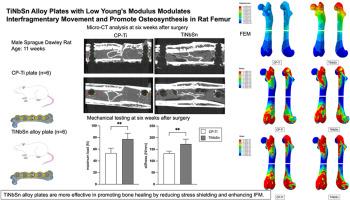
Orthopedic implants such as arthroplasty prostheses, fracture plates, and intramedullary nails often use materials like Ti6Al4V alloy and commercially pure titanium (CP-Ti), which have Young's modulus significantly higher than that of human cortical bone, potentially causing stress shielding and inhibiting effective fracture healing. TiNbSn alloy, a β-type titanium alloy with a lower Young's modulus (40–49 GPa), has shown promise in reducing stress shielding and enhancing bone healing by promoting effective load sharing with bone. This study used 5-hole plates made from TiNbSn alloy and CP-Ti to investigate their effects on bone healing in a rat femoral fracture model. Micro-CT analysis and mechanical testing were performed six weeks postoperatively to assess bone healing. Additionally, Finite element method (FEM) analysis was employed to evaluate stress shielding and interfragmentary movement (IFM) at the fracture site. Micro-CT analysis revealed significantly higher bone volume and mineral density in the TiNbSn group than in the CP-Ti group. Mechanical testing showed increased maximum load and stiffness in the TiNbSn group (77.2 ± 10.0 N for the TiNbSn alloy plate group versus 53.3 ± 8.5 N for the CP-Ti group (p = 0.002)). FEM analysis indicated that TiNbSn plates reduced stress shielding and allowed for greater displacement and strain, promoting IFM conducive to bone healing. The findings suggest that TiNbSn alloy plates are more effective than CP-Ti plates in promoting bone healing by reducing stress shielding and enhancing IFM. The lower Young's modulus of TiNbSn allows better load distribution, facilitating bone regeneration and strengthening at the fracture site.
期刊介绍:
The Journal of the Mechanical Behavior of Biomedical Materials is concerned with the mechanical deformation, damage and failure under applied forces, of biological material (at the tissue, cellular and molecular levels) and of biomaterials, i.e. those materials which are designed to mimic or replace biological materials.
The primary focus of the journal is the synthesis of materials science, biology, and medical and dental science. Reports of fundamental scientific investigations are welcome, as are articles concerned with the practical application of materials in medical devices. Both experimental and theoretical work is of interest; theoretical papers will normally include comparison of predictions with experimental data, though we recognize that this may not always be appropriate. The journal also publishes technical notes concerned with emerging experimental or theoretical techniques, letters to the editor and, by invitation, review articles and papers describing existing techniques for the benefit of an interdisciplinary readership.



 京公网安备 11010802042870号
京ICP备2023020795号-1
京公网安备 11010802042870号
京ICP备2023020795号-1

 分享
分享
 求助内容:
求助内容: 应助结果提醒方式:
 扫码关注我们
