Examination of Gait Characteristics Related to Sarcopenia in Community-Dwelling Older Adults: A Study Focusing on Plantar Pressure

IF 9.1 1区 医学 Q1 GERIATRICS & GERONTOLOGY Journal of Cachexia Sarcopenia and Muscle Pub Date : 2024-11-22 DOI:10.1002/jcsm.13634
Daiki Yamagiwa, Keitaro Makino, Osamu Katayama, Ryo Yamaguchi, von Fingerhut Georg, Yukari Yamashiro, Motoki Sudo, Hiroyuki Shimada
{"title":"Examination of Gait Characteristics Related to Sarcopenia in Community-Dwelling Older Adults: A Study Focusing on Plantar Pressure","authors":"Daiki Yamagiwa,&nbsp;Keitaro Makino,&nbsp;Osamu Katayama,&nbsp;Ryo Yamaguchi,&nbsp;von Fingerhut Georg,&nbsp;Yukari Yamashiro,&nbsp;Motoki Sudo,&nbsp;Hiroyuki Shimada","doi":"10.1002/jcsm.13634","DOIUrl":null,"url":null,"abstract":"<div>\n \n \n <section>\n \n <h3> Background</h3>\n \n <p>Sarcopenia is a condition characterized by a decrease in skeletal muscle mass and strength with age, which results in a lower gait speed. Decreased gait speed in older individuals with sarcopenia can lead to adverse events such as falls and mortality. It is a major health issue; several studies have investigated gait speed in sarcopenia. However, plantar pressure has not been sufficiently evaluated. Plantar pressure facilitates gait analysis, including gait speed, and plays an important role in preventing adverse events such as falls and mortality. Therefore, the current study aimed to validate gait characteristics, including plantar pressure in community-dwelling older adults with sarcopenia.</p>\n </section>\n \n <section>\n \n <h3> Methods</h3>\n \n <p>The current study included community-dwelling Japanese adults aged ≥60 years who participated in health checkups between 2013 and 2018. Sarcopenia was diagnosed by measuring muscle mass and strength based on clinical definition (nonsarcopenia: <i>n</i> = 7662; probable sarcopenia: <i>n</i> = 1208; and sarcopenia: <i>n</i> = 477). Gait parameters (including gait speed, relative plantar pressure, cadence, stride length, step length, step width and foot angle) were measured at a comfortable speed using a computerized electronic walkway. Gait parameters between groups were compared via an analysis of covariance adjusted for age and BMI. In addition, post hoc analyses were performed with Bonferroni correction.</p>\n </section>\n \n <section>\n \n <h3> Results</h3>\n \n <p>The sarcopenia and probable sarcopenia groups had a significantly lower gait speed than the nonsarcopenia group (<i>p</i> &lt; 0.01). Further, the sarcopenia and probable sarcopenia groups had a significantly lower forefoot plantar pressure, stride length and cadence than the nonsarcopenia group (all <i>p</i> &lt; 0.01). When comparing, the sarcopenia group had a greater medial plantar pressure, step length, and foot angle and a lower lateral plantar pressure, cadence, and step width than the probable sarcopenia group (all <i>p</i> &lt; 0.01).</p>\n </section>\n \n <section>\n \n <h3> Conclusion</h3>\n \n <p>The sarcopenia, probable sarcopenia and nonsarcopenia groups differed concerning gait characteristics, including plantar pressure. It is thought that exercise instruction that takes into account walking characteristics is important for probable sarcopenia and sarcopenia.</p>\n </section>\n </div>","PeriodicalId":48911,"journal":{"name":"Journal of Cachexia Sarcopenia and Muscle","volume":"16 1","pages":""},"PeriodicalIF":9.1000,"publicationDate":"2024-11-22","publicationTypes":"Journal Article","fieldsOfStudy":null,"isOpenAccess":false,"openAccessPdf":"https://onlinelibrary.wiley.com/doi/epdf/10.1002/jcsm.13634","citationCount":"0","resultStr":null,"platform":"Semanticscholar","paperid":null,"PeriodicalName":"Journal of Cachexia Sarcopenia and Muscle","FirstCategoryId":"3","ListUrlMain":"https://onlinelibrary.wiley.com/doi/10.1002/jcsm.13634","RegionNum":1,"RegionCategory":"医学","ArticlePicture":[],"TitleCN":null,"AbstractTextCN":null,"PMCID":null,"EPubDate":"","PubModel":"","JCR":"Q1","JCRName":"GERIATRICS & GERONTOLOGY","Score":null,"Total":0}
引用次数: 0

Abstract

Background

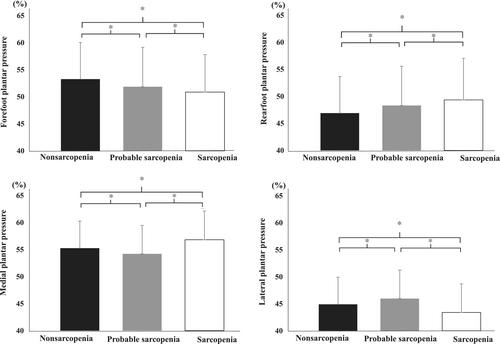
Sarcopenia is a condition characterized by a decrease in skeletal muscle mass and strength with age, which results in a lower gait speed. Decreased gait speed in older individuals with sarcopenia can lead to adverse events such as falls and mortality. It is a major health issue; several studies have investigated gait speed in sarcopenia. However, plantar pressure has not been sufficiently evaluated. Plantar pressure facilitates gait analysis, including gait speed, and plays an important role in preventing adverse events such as falls and mortality. Therefore, the current study aimed to validate gait characteristics, including plantar pressure in community-dwelling older adults with sarcopenia.

Methods

The current study included community-dwelling Japanese adults aged ≥60 years who participated in health checkups between 2013 and 2018. Sarcopenia was diagnosed by measuring muscle mass and strength based on clinical definition (nonsarcopenia: n = 7662; probable sarcopenia: n = 1208; and sarcopenia: n = 477). Gait parameters (including gait speed, relative plantar pressure, cadence, stride length, step length, step width and foot angle) were measured at a comfortable speed using a computerized electronic walkway. Gait parameters between groups were compared via an analysis of covariance adjusted for age and BMI. In addition, post hoc analyses were performed with Bonferroni correction.

Results

The sarcopenia and probable sarcopenia groups had a significantly lower gait speed than the nonsarcopenia group (p < 0.01). Further, the sarcopenia and probable sarcopenia groups had a significantly lower forefoot plantar pressure, stride length and cadence than the nonsarcopenia group (all p < 0.01). When comparing, the sarcopenia group had a greater medial plantar pressure, step length, and foot angle and a lower lateral plantar pressure, cadence, and step width than the probable sarcopenia group (all p < 0.01).

Conclusion

The sarcopenia, probable sarcopenia and nonsarcopenia groups differed concerning gait characteristics, including plantar pressure. It is thought that exercise instruction that takes into account walking characteristics is important for probable sarcopenia and sarcopenia.
Abstract Image

查看原文
分享 分享
微信好友 朋友圈 QQ好友 复制链接
本刊更多论文
研究社区老年人与 "肌肉疏松症 "相关的步态特征:关注足底压力的研究
肌肉疏松症是一种以骨骼肌质量和力量随年龄增长而减少为特征的疾病,会导致步速降低。患有肌肉疏松症的老年人步速降低会导致跌倒和死亡等不良事件。这是一个重大的健康问题;已有多项研究对肌肉疏松症患者的步速进行了调查。然而,对足底压力的评估还不够充分。足底压力有助于步态分析,包括步态速度,并在预防跌倒和死亡等不良事件中发挥重要作用。因此,本研究旨在验证患有肌肉疏松症的社区老年人的步态特征,包括足底压力。
本文章由计算机程序翻译,如有差异,请以英文原文为准。
求助全文
约1分钟内获得全文 去求助
来源期刊
Journal of Cachexia Sarcopenia and Muscle
Journal of Cachexia Sarcopenia and Muscle MEDICINE, GENERAL & INTERNAL-
CiteScore
13.30
自引率
12.40%
发文量
234
审稿时长
16 weeks
期刊介绍: The Journal of Cachexia, Sarcopenia and Muscle is a peer-reviewed international journal dedicated to publishing materials related to cachexia and sarcopenia, as well as body composition and its physiological and pathophysiological changes across the lifespan and in response to various illnesses from all fields of life sciences. The journal aims to provide a reliable resource for professionals interested in related research or involved in the clinical care of affected patients, such as those suffering from AIDS, cancer, chronic heart failure, chronic lung disease, liver cirrhosis, chronic kidney failure, rheumatoid arthritis, or sepsis.
期刊最新文献
Calprotectin Is a Circulating Biomarker and Potential Therapeutic Target for Sarcopenia in Chronic Obstructive Pulmonary Disease Quantitative MRI Findings and Their Relationship to Muscle Histopathology and Ambulatory Clinical Function in Duchenne Muscular Dystrophy The Effects of Soy Protein–Rich Meals on Muscle Health of Older Adults Are Linked to Gut Microbiome Modifications Fibre Type–Specific Proteomics Reveals Shared and Distinct Skeletal Muscle Adaptations to Resistance Training and Beta2-Adrenergic Agonist Blood-Based Lead Biomarkers and Sarcopenia Indicators in Older Adults
×
引用
GB/T 7714-2015
复制
MLA
复制
APA
复制
导出至
BibTeX EndNote RefMan NoteFirst NoteExpress
×
×
提示
您的信息不完整,为了账户安全,请先补充。
现在去补充
×
提示
您因"违规操作"
具体请查看互助需知
我知道了
×
提示
现在去查看 取消
×
提示
确定
0
微信
客服QQ
Book学术公众号 扫码关注我们
反馈
×
意见反馈
请填写您的意见或建议
请填写您的手机或邮箱
已复制链接
已复制链接
快去分享给好友吧!
我知道了
×
扫码分享
扫码分享
Book学术官方微信
Book学术文献互助
Book学术文献互助群
群 号:604180095
Book学术
文献互助 智能选刊 最新文献 互助须知 联系我们:info@booksci.cn
Book学术提供免费学术资源搜索服务,方便国内外学者检索中英文文献。致力于提供最便捷和优质的服务体验。
Copyright © 2023 Book学术 All rights reserved.
ghs 京公网安备 11010802042870号 京ICP备2023020795号-1





