Mingjie Liao , Ziqi Yi , Qingqing You , Chuang Liu , Huangdi Feng , Junhai Huang
{"title":"Efficient synthesis of trisubstituted allenes via palladium-catalysed deaminative coupling of tertiary propargylamines with arylsiloxanes†","authors":"Mingjie Liao , Ziqi Yi , Qingqing You , Chuang Liu , Huangdi Feng , Junhai Huang","doi":"10.1039/d4qo01780c","DOIUrl":null,"url":null,"abstract":"<div><div>A novel and efficient method for the palladium-catalysed and highly regioselective synthesis of trisubstituted allenes <em>via</em> deaminative coupling of tertiary propargylamines with arylsiloxanes is reported. Both unactivated propargylamines and arylsiloxanes were activated <em>in situ</em> using Et<sub>3</sub>N·3HF, followed by cross-coupling to facilitate C–C bond formation through C–N bond cleavage. The method demonstrates exceptional functional group compatibility, high yields, and readily accessible coupling partners.</div></div>","PeriodicalId":94379,"journal":{"name":"Organic chemistry frontiers : an international journal of organic chemistry","volume":"12 2","pages":"Pages 623-628"},"PeriodicalIF":0.0000,"publicationDate":"2024-11-19","publicationTypes":"Journal Article","fieldsOfStudy":null,"isOpenAccess":false,"openAccessPdf":"","citationCount":"0","resultStr":null,"platform":"Semanticscholar","paperid":null,"PeriodicalName":"Organic chemistry frontiers : an international journal of organic chemistry","FirstCategoryId":"1085","ListUrlMain":"https://www.sciencedirect.com/org/science/article/pii/S2052412924007824","RegionNum":0,"RegionCategory":null,"ArticlePicture":[],"TitleCN":null,"AbstractTextCN":null,"PMCID":null,"EPubDate":"2024/11/22 0:00:00","PubModel":"Epub","JCR":"","JCRName":"","Score":null,"Total":0}
引用次数: 0
Abstract
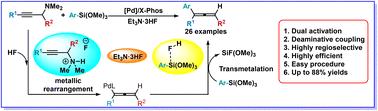
A novel and efficient method for the palladium-catalysed and highly regioselective synthesis of trisubstituted allenes via deaminative coupling of tertiary propargylamines with arylsiloxanes is reported. Both unactivated propargylamines and arylsiloxanes were activated in situ using Et3N·3HF, followed by cross-coupling to facilitate C–C bond formation through C–N bond cleavage. The method demonstrates exceptional functional group compatibility, high yields, and readily accessible coupling partners.





 京公网安备 11010802042870号
京ICP备2023020795号-1
京公网安备 11010802042870号
京ICP备2023020795号-1

 分享
分享

 求助内容:
求助内容: 应助结果提醒方式:
 扫码关注我们
