Transcriptomic and epigenomic profiling reveals altered responses to diesel emissions in Alzheimer's disease both in vitro and in population-based data
Liudmila Saveleva, Tereza Cervena, Claudia Mengoni, Michal Sima, Zdenek Krejcik, Kristyna Vrbova, Jitka Sikorova, Laura Mussalo, Tosca O. E. de Crom, Zuzana Šímová, Mariia Ivanova, Muhammad Ali Shahbaz, Elina Penttilä, Heikki Löppönen, Anne M. Koivisto, M. Arfan Ikram, Pasi I Jalava, Tarja Malm, Sweelin Chew, Michal Vojtisek-Lom, Jan Topinka, Rosalba Giugno, Pavel Rössner, Katja M. Kanninen
{"title":"Transcriptomic and epigenomic profiling reveals altered responses to diesel emissions in Alzheimer's disease both in vitro and in population-based data","authors":"Liudmila Saveleva, Tereza Cervena, Claudia Mengoni, Michal Sima, Zdenek Krejcik, Kristyna Vrbova, Jitka Sikorova, Laura Mussalo, Tosca O. E. de Crom, Zuzana Šímová, Mariia Ivanova, Muhammad Ali Shahbaz, Elina Penttilä, Heikki Löppönen, Anne M. Koivisto, M. Arfan Ikram, Pasi I Jalava, Tarja Malm, Sweelin Chew, Michal Vojtisek-Lom, Jan Topinka, Rosalba Giugno, Pavel Rössner, Katja M. Kanninen","doi":"10.1002/alz.14347","DOIUrl":null,"url":null,"abstract":"<div>\n \n \n <section>\n \n <h3> INTRODUCTION</h3>\n \n <p>Studies have correlated living close to major roads with Alzheimer's disease (AD) risk. However, the mechanisms responsible for this link remain unclear.</p>\n </section>\n \n <section>\n \n <h3> METHODS</h3>\n \n <p>We exposed olfactory mucosa (OM) cells of healthy individuals and AD patients to diesel emissions (DE). Cytotoxicity of exposure was assessed, mRNA, miRNA expression, and DNA methylation analyses were performed. The discovered altered pathways were validated using data from the human population-based Rotterdam Study.</p>\n </section>\n \n <section>\n \n <h3> RESULTS</h3>\n \n <p>DE exposure resulted in an almost four-fold higher response in AD OM cells, indicating increased susceptibility to DE effects. Methylation analysis detected different DNA methylation patterns, revealing new exposure targets. Findings were validated by analyzing data from the Rotterdam Study cohort and demonstrated a key role of nuclear factor erythroid 2–related factor 2 signaling in responses to air pollutants.</p>\n </section>\n \n <section>\n \n <h3> DISCUSSION</h3>\n \n <p>This study identifies air pollution exposure biomarkers and pinpoints key pathways activated by exposure. The data suggest that AD individuals may face heightened risks due to impaired cellular defenses.</p>\n </section>\n \n <section>\n \n <h3> Highlights</h3>\n \n <div>\n <ul>\n \n <li>Healthy and AD olfactory cells respond differently to DE exposure.</li>\n \n <li>AD cells are highly susceptible to DE exposure.</li>\n \n <li>The NRF2 oxidative stress response is highly activated upon air pollution exposure.</li>\n \n <li>DE-exposed AD cells activate the unfolded protein response pathway.</li>\n \n <li>Key findings are also confirmed in a population-based study.</li>\n </ul>\n </div>\n </section>\n </div>","PeriodicalId":7471,"journal":{"name":"Alzheimer's & Dementia","volume":"20 12","pages":"8825-8843"},"PeriodicalIF":11.1000,"publicationDate":"2024-11-23","publicationTypes":"Journal Article","fieldsOfStudy":null,"isOpenAccess":false,"openAccessPdf":"https://onlinelibrary.wiley.com/doi/epdf/10.1002/alz.14347","citationCount":"0","resultStr":null,"platform":"Semanticscholar","paperid":null,"PeriodicalName":"Alzheimer's & Dementia","FirstCategoryId":"3","ListUrlMain":"https://alz-journals.onlinelibrary.wiley.com/doi/10.1002/alz.14347","RegionNum":1,"RegionCategory":"医学","ArticlePicture":[],"TitleCN":null,"AbstractTextCN":null,"PMCID":null,"EPubDate":"","PubModel":"","JCR":"Q1","JCRName":"CLINICAL NEUROLOGY","Score":null,"Total":0}
引用次数: 0
Abstract
INTRODUCTION
Studies have correlated living close to major roads with Alzheimer's disease (AD) risk. However, the mechanisms responsible for this link remain unclear.
METHODS
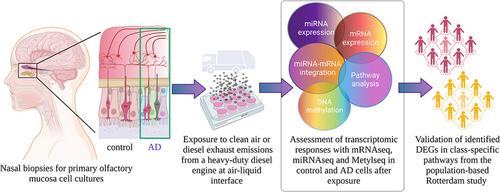
We exposed olfactory mucosa (OM) cells of healthy individuals and AD patients to diesel emissions (DE). Cytotoxicity of exposure was assessed, mRNA, miRNA expression, and DNA methylation analyses were performed. The discovered altered pathways were validated using data from the human population-based Rotterdam Study.
RESULTS
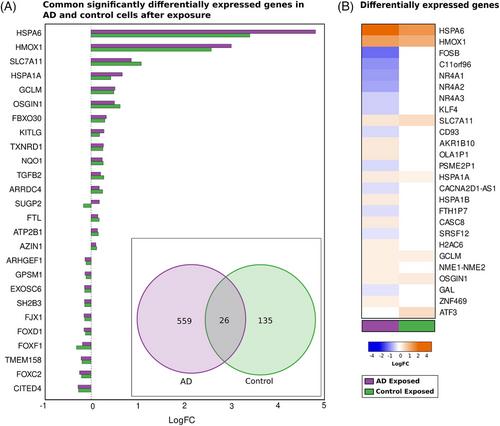
DE exposure resulted in an almost four-fold higher response in AD OM cells, indicating increased susceptibility to DE effects. Methylation analysis detected different DNA methylation patterns, revealing new exposure targets. Findings were validated by analyzing data from the Rotterdam Study cohort and demonstrated a key role of nuclear factor erythroid 2–related factor 2 signaling in responses to air pollutants.
DISCUSSION
This study identifies air pollution exposure biomarkers and pinpoints key pathways activated by exposure. The data suggest that AD individuals may face heightened risks due to impaired cellular defenses.
Highlights
Healthy and AD olfactory cells respond differently to DE exposure.
AD cells are highly susceptible to DE exposure.
The NRF2 oxidative stress response is highly activated upon air pollution exposure.
DE-exposed AD cells activate the unfolded protein response pathway.
Key findings are also confirmed in a population-based study.
期刊介绍:
Alzheimer's & Dementia is a peer-reviewed journal that aims to bridge knowledge gaps in dementia research by covering the entire spectrum, from basic science to clinical trials to social and behavioral investigations. It provides a platform for rapid communication of new findings and ideas, optimal translation of research into practical applications, increasing knowledge across diverse disciplines for early detection, diagnosis, and intervention, and identifying promising new research directions. In July 2008, Alzheimer's & Dementia was accepted for indexing by MEDLINE, recognizing its scientific merit and contribution to Alzheimer's research.




 京公网安备 11010802042870号
京ICP备2023020795号-1
京公网安备 11010802042870号
京ICP备2023020795号-1

 分享
分享
 求助内容:
求助内容: 应助结果提醒方式:
 扫码关注我们
