Activation of somatostatin neurons in the medial amygdala reverses long-term aggression and social deficits associated to early-life stress in male mice
Aroa Mañas-Ojeda, José Hidalgo-Cortés, Clara García-Mompó, Mohamed Aly Zahran, Isis Gil-Miravet, Francisco E. Olucha-Bordonau, Ramón Guirado, Esther Castillo-Gómez
{"title":"Activation of somatostatin neurons in the medial amygdala reverses long-term aggression and social deficits associated to early-life stress in male mice","authors":"Aroa Mañas-Ojeda, José Hidalgo-Cortés, Clara García-Mompó, Mohamed Aly Zahran, Isis Gil-Miravet, Francisco E. Olucha-Bordonau, Ramón Guirado, Esther Castillo-Gómez","doi":"10.1038/s41380-024-02829-6","DOIUrl":null,"url":null,"abstract":"Early postnatal development is a critical period for the configuration of neural networks that support social and affective-like behaviors. In this sense, children raised in stressful environments are at high risk to develop maladaptive behaviors immediately or later in life, including anti-social and aggressive behaviors. However, the neurobiological bases of such phenomena remain poorly understood. Here we showed that, at long-term, maternal separation with early weaning (MSEW) decreased the density of somatostatin-expressing (SST+) neurons in the basolateral amygdala (BLA) of females and males, while their activity was only reduced in the medial amygdala (MeA) of males. Interestingly, only MSEW males exhibited long-term behavioral effects, including reduced sociability and social novelty preference in the 3-chamber test (3CH), decreased social interest in the resident-intruder test (RI), and increased aggressivity in both the RI and the tube dominance test (TT). To test whether the manipulation of MeASST+ neurons was sufficient to reverse these negative behavioral outcomes, we expressed the chemogenetic excitatory receptor hM3Dq in MSEW adult males. We found that the activation of MeASST+ neurons ameliorated social interest in the RI test and reduced aggression traits in the TT and RI assays. Altogether, our results highlight a role for MeASST+ neurons in the regulation of aggressivity and social interest and point to the loss of activity of these neurons as a plausible etiological mechanism linking early life stress to these maladaptive behaviors in later life.","PeriodicalId":19008,"journal":{"name":"Molecular Psychiatry","volume":"30 5","pages":"2168-2182"},"PeriodicalIF":10.4000,"publicationDate":"2024-11-23","publicationTypes":"Journal Article","fieldsOfStudy":null,"isOpenAccess":false,"openAccessPdf":"https://www.nature.comhttps://www.nature.com/articles/s41380-024-02829-6.pdf","citationCount":"0","resultStr":null,"platform":"Semanticscholar","paperid":null,"PeriodicalName":"Molecular Psychiatry","FirstCategoryId":"3","ListUrlMain":"https://www.nature.com/articles/s41380-024-02829-6","RegionNum":1,"RegionCategory":"医学","ArticlePicture":[],"TitleCN":null,"AbstractTextCN":null,"PMCID":null,"EPubDate":"","PubModel":"","JCR":"Q1","JCRName":"BIOCHEMISTRY & MOLECULAR BIOLOGY","Score":null,"Total":0}
引用次数: 0
Abstract
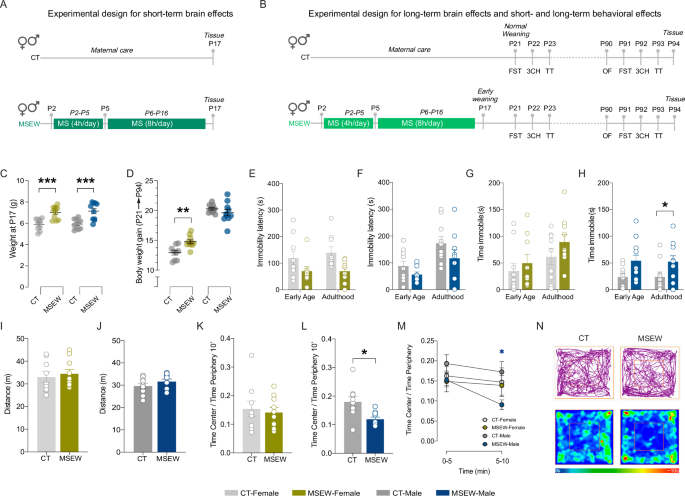
Early postnatal development is a critical period for the configuration of neural networks that support social and affective-like behaviors. In this sense, children raised in stressful environments are at high risk to develop maladaptive behaviors immediately or later in life, including anti-social and aggressive behaviors. However, the neurobiological bases of such phenomena remain poorly understood. Here we showed that, at long-term, maternal separation with early weaning (MSEW) decreased the density of somatostatin-expressing (SST+) neurons in the basolateral amygdala (BLA) of females and males, while their activity was only reduced in the medial amygdala (MeA) of males. Interestingly, only MSEW males exhibited long-term behavioral effects, including reduced sociability and social novelty preference in the 3-chamber test (3CH), decreased social interest in the resident-intruder test (RI), and increased aggressivity in both the RI and the tube dominance test (TT). To test whether the manipulation of MeASST+ neurons was sufficient to reverse these negative behavioral outcomes, we expressed the chemogenetic excitatory receptor hM3Dq in MSEW adult males. We found that the activation of MeASST+ neurons ameliorated social interest in the RI test and reduced aggression traits in the TT and RI assays. Altogether, our results highlight a role for MeASST+ neurons in the regulation of aggressivity and social interest and point to the loss of activity of these neurons as a plausible etiological mechanism linking early life stress to these maladaptive behaviors in later life.
期刊介绍:
Molecular Psychiatry focuses on publishing research that aims to uncover the biological mechanisms behind psychiatric disorders and their treatment. The journal emphasizes studies that bridge pre-clinical and clinical research, covering cellular, molecular, integrative, clinical, imaging, and psychopharmacology levels.





 京公网安备 11010802042870号
京ICP备2023020795号-1
京公网安备 11010802042870号
京ICP备2023020795号-1

 分享
分享
 求助内容:
求助内容: 应助结果提醒方式:
 扫码关注我们
