Xinwan Zhao , Minjun Lei , Guangbo Liu , Zhiliang Jin , Noritatsu Tsubaki
{"title":"Graphdiyne (CnH2n−2) based copper(i) bromide dual S-scheme heterojunction with AX2O8 type compounds induced electron directional migration","authors":"Xinwan Zhao , Minjun Lei , Guangbo Liu , Zhiliang Jin , Noritatsu Tsubaki","doi":"10.1039/d4cy01031k","DOIUrl":null,"url":null,"abstract":"<div><div>A fundamental strategy for enhancing the performance of photocatalytic water-splitting catalysts is to facilitate the efficient migration of photogenerated charge carriers to establish a heterojunction. In this study, we replace copper foil with CuBr as the catalytic substrate to synthesize a CuBr/graphdiyne composite that exhibits improved hydrogen evolution performance and construct a ZrMo<sub>2</sub>O<sub>8</sub>/CuBr/graphdiyne dual S-scheme heterojunction in conjunction with AX<sub>2</sub>O<sub>8</sub>-type compounds. Demonstrated <em>via in situ</em> XPS, charge separation in ZrMo<sub>2</sub>O<sub>8</sub>, graphdiyne and CuBr can be augmented by constructing dual S-scheme heterojunction to enhance the photocatalytic hydrogen evolution capability. The band structure is confirmed using ultraviolet-visible (UV-vis) spectroscopy and density functional theory (DFT) calculations. Experimental results indicate that the hydrogen evolution rate of the ZrMo<sub>2</sub>O<sub>8</sub>/CuBr/graphdiyne composite catalyst is five times greater than that of ZrMo<sub>2</sub>O<sub>8</sub> alone, three times greater than that of CuBr, and 20 times greater than that of graphdiyne. This work investigates and expands potential synthesis methods for graphdiyne materials within photocatalysis while elucidating mechanisms promoting efficient charge separation. Furthermore, it provides novel perspectives and strategies for enhancing the hydrogen evolution efficiency of ternary photocatalysts through the development of S-scheme heterojunctions.</div></div>","PeriodicalId":66,"journal":{"name":"Catalysis Science & Technology","volume":"14 23","pages":"Pages 6854-6868"},"PeriodicalIF":4.2000,"publicationDate":"2024-10-17","publicationTypes":"Journal Article","fieldsOfStudy":null,"isOpenAccess":false,"openAccessPdf":"","citationCount":"0","resultStr":null,"platform":"Semanticscholar","paperid":null,"PeriodicalName":"Catalysis Science & Technology","FirstCategoryId":"92","ListUrlMain":"https://www.sciencedirect.com/org/science/article/pii/S204447532400580X","RegionNum":3,"RegionCategory":"化学","ArticlePicture":[],"TitleCN":null,"AbstractTextCN":null,"PMCID":null,"EPubDate":"","PubModel":"","JCR":"Q2","JCRName":"CHEMISTRY, PHYSICAL","Score":null,"Total":0}
引用次数: 0
Abstract
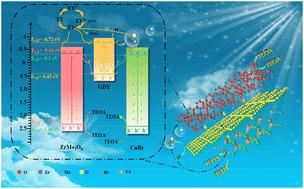
A fundamental strategy for enhancing the performance of photocatalytic water-splitting catalysts is to facilitate the efficient migration of photogenerated charge carriers to establish a heterojunction. In this study, we replace copper foil with CuBr as the catalytic substrate to synthesize a CuBr/graphdiyne composite that exhibits improved hydrogen evolution performance and construct a ZrMo2O8/CuBr/graphdiyne dual S-scheme heterojunction in conjunction with AX2O8-type compounds. Demonstrated via in situ XPS, charge separation in ZrMo2O8, graphdiyne and CuBr can be augmented by constructing dual S-scheme heterojunction to enhance the photocatalytic hydrogen evolution capability. The band structure is confirmed using ultraviolet-visible (UV-vis) spectroscopy and density functional theory (DFT) calculations. Experimental results indicate that the hydrogen evolution rate of the ZrMo2O8/CuBr/graphdiyne composite catalyst is five times greater than that of ZrMo2O8 alone, three times greater than that of CuBr, and 20 times greater than that of graphdiyne. This work investigates and expands potential synthesis methods for graphdiyne materials within photocatalysis while elucidating mechanisms promoting efficient charge separation. Furthermore, it provides novel perspectives and strategies for enhancing the hydrogen evolution efficiency of ternary photocatalysts through the development of S-scheme heterojunctions.
期刊介绍:
A multidisciplinary journal focusing on cutting edge research across all fundamental science and technological aspects of catalysis.
Editor-in-chief: Bert Weckhuysen
Impact factor: 5.0
Time to first decision (peer reviewed only): 31 days



 京公网安备 11010802042870号
京ICP备2023020795号-1
京公网安备 11010802042870号
京ICP备2023020795号-1

 分享
分享
 求助内容:
求助内容: 应助结果提醒方式:
 扫码关注我们
