Jeong Suk Lee , Clinton Manianglung , Hye In Jeon , Young Soo Ko
{"title":"Influence of MIL-53 on the catalytic performance of metallocene in propylene polymerization","authors":"Jeong Suk Lee , Clinton Manianglung , Hye In Jeon , Young Soo Ko","doi":"10.1016/j.mcat.2024.114719","DOIUrl":null,"url":null,"abstract":"<div><div>In this study, we investigate the application of metal-organic frameworks (MOFs) as a support for metallocene catalysts in the polymerization of propylene. MOFs such as MIL-53 and other conventional supports, SBA-15 and SiO<sub>2</sub>, were employed to immobilize the Me<sub>2</sub>Si(2-Me-4-PhInd)<sub>2</sub>ZrCl<sub>2</sub> catalyst activated with methylaluminoxane (MAO). The effects of the physicochemical properties of these supports on catalytic performance and polymer properties were investigated. MIL-53, characterized by its channel structure, facilitated higher molecular weight polypropylene production and exhibited double the catalytic activity of SBA-15 and SiO<sub>2</sub> supports. The MIL-53/MAO/Me<sub>2</sub>Si(2-Me-4-PhInd)<sub>2</sub>ZrCl<sub>2</sub> catalyst also demonstrated higher comonomer incorporation and lower polymer melting points. The higher activity, elevated molecular weight, and increased reactivity towards 1-hexene of the MIL-53/MAO/Me<sub>2</sub>Si(2-Me-4-PhInd)<sub>2</sub>ZrCl<sub>2</sub> catalyst are attributed to the electronic and steric effects of MIL-53. This study underscores the significant role of MOF structure in influencing polymerization behavior and highlights the potential of MOF-supported catalysts for tailored polymer properties.</div></div>","PeriodicalId":393,"journal":{"name":"Molecular Catalysis","volume":"571 ","pages":"Article 114719"},"PeriodicalIF":4.9000,"publicationDate":"2025-01-15","publicationTypes":"Journal Article","fieldsOfStudy":null,"isOpenAccess":false,"openAccessPdf":"","citationCount":"0","resultStr":null,"platform":"Semanticscholar","paperid":null,"PeriodicalName":"Molecular Catalysis","FirstCategoryId":"92","ListUrlMain":"https://www.sciencedirect.com/science/article/pii/S2468823124009015","RegionNum":2,"RegionCategory":"化学","ArticlePicture":[],"TitleCN":null,"AbstractTextCN":null,"PMCID":null,"EPubDate":"2024/11/23 0:00:00","PubModel":"Epub","JCR":"Q2","JCRName":"CHEMISTRY, PHYSICAL","Score":null,"Total":0}
引用次数: 0
Abstract
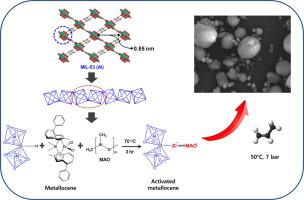
In this study, we investigate the application of metal-organic frameworks (MOFs) as a support for metallocene catalysts in the polymerization of propylene. MOFs such as MIL-53 and other conventional supports, SBA-15 and SiO2, were employed to immobilize the Me2Si(2-Me-4-PhInd)2ZrCl2 catalyst activated with methylaluminoxane (MAO). The effects of the physicochemical properties of these supports on catalytic performance and polymer properties were investigated. MIL-53, characterized by its channel structure, facilitated higher molecular weight polypropylene production and exhibited double the catalytic activity of SBA-15 and SiO2 supports. The MIL-53/MAO/Me2Si(2-Me-4-PhInd)2ZrCl2 catalyst also demonstrated higher comonomer incorporation and lower polymer melting points. The higher activity, elevated molecular weight, and increased reactivity towards 1-hexene of the MIL-53/MAO/Me2Si(2-Me-4-PhInd)2ZrCl2 catalyst are attributed to the electronic and steric effects of MIL-53. This study underscores the significant role of MOF structure in influencing polymerization behavior and highlights the potential of MOF-supported catalysts for tailored polymer properties.
期刊介绍:
Molecular Catalysis publishes full papers that are original, rigorous, and scholarly contributions examining the molecular and atomic aspects of catalytic activation and reaction mechanisms. The fields covered are:
Heterogeneous catalysis including immobilized molecular catalysts
Homogeneous catalysis including organocatalysis, organometallic catalysis and biocatalysis
Photo- and electrochemistry
Theoretical aspects of catalysis analyzed by computational methods



 京公网安备 11010802042870号
京ICP备2023020795号-1
京公网安备 11010802042870号
京ICP备2023020795号-1

 分享
分享
 求助内容:
求助内容: 应助结果提醒方式:
 扫码关注我们
