{"title":"Toward Communication Optimization for Future Underwater Networking: A Survey of Reinforcement Learning-Based Approaches","authors":"Ziyuan Wang;Jun Du;Xiangwang Hou;Jingjing Wang;Chunxiao Jiang;Xiao-Ping Zhang;Yong Ren","doi":"10.1109/COMST.2024.3505850","DOIUrl":null,"url":null,"abstract":"As an essential part of the 6G sea-land-air integrated network, underwater networking has attracted increasing attention and has been widely studied. The key for improving its performance is the communication optimization based on data rate, throughput, latency, reliability, spectrum utilization, and other factors impacting on the quality of service (QoS). However, the poor underwater communication environment makes it difficult to improve the communication quality of underwater networking and brings many challenges to the design of optimization schemes. In the face of complex and unknown dynamic underwater environment, the optimization schemes need to have a higher level of adaptability and intelligence, so as to carry out autonomous decision-making and multi-objective optimization under different conditions. To meet the above challenges and needs, reinforcement learning (RL) is widely used to obtain the optimal strategy for underwater communication. Nevertheless, there is still a lack of comprehensive reviews on using RL to optimize underwater communication networking. Therefore, this survey comprehensively investigates the application of RL in underwater networking to guide the optimization of underwater communication in the future and bridge this gap. Specifically, we provide an overview of RL usage processes and tools and detail its various applications in underwater communication networking, including spectrum resource allocation and development, throughput improvement and delay reduction, reliability improvement, energy saving, and energy efficiency optimization, data sensing and processing, and intelligent cluster networking. Based on the review, we further analyze the open challenges and research directions of RL-enabled underwater communication networking in the future.","PeriodicalId":55029,"journal":{"name":"IEEE Communications Surveys and Tutorials","volume":"27 5","pages":"2765-2793"},"PeriodicalIF":34.4000,"publicationDate":"2024-11-25","publicationTypes":"Journal Article","fieldsOfStudy":null,"isOpenAccess":false,"openAccessPdf":"","citationCount":"0","resultStr":null,"platform":"Semanticscholar","paperid":null,"PeriodicalName":"IEEE Communications Surveys and Tutorials","FirstCategoryId":"94","ListUrlMain":"https://ieeexplore.ieee.org/document/10766420/","RegionNum":1,"RegionCategory":"计算机科学","ArticlePicture":[],"TitleCN":null,"AbstractTextCN":null,"PMCID":null,"EPubDate":"","PubModel":"","JCR":"Q1","JCRName":"COMPUTER SCIENCE, INFORMATION SYSTEMS","Score":null,"Total":0}
引用次数: 0
Abstract
As an essential part of the 6G sea-land-air integrated network, underwater networking has attracted increasing attention and has been widely studied. The key for improving its performance is the communication optimization based on data rate, throughput, latency, reliability, spectrum utilization, and other factors impacting on the quality of service (QoS). However, the poor underwater communication environment makes it difficult to improve the communication quality of underwater networking and brings many challenges to the design of optimization schemes. In the face of complex and unknown dynamic underwater environment, the optimization schemes need to have a higher level of adaptability and intelligence, so as to carry out autonomous decision-making and multi-objective optimization under different conditions. To meet the above challenges and needs, reinforcement learning (RL) is widely used to obtain the optimal strategy for underwater communication. Nevertheless, there is still a lack of comprehensive reviews on using RL to optimize underwater communication networking. Therefore, this survey comprehensively investigates the application of RL in underwater networking to guide the optimization of underwater communication in the future and bridge this gap. Specifically, we provide an overview of RL usage processes and tools and detail its various applications in underwater communication networking, including spectrum resource allocation and development, throughput improvement and delay reduction, reliability improvement, energy saving, and energy efficiency optimization, data sensing and processing, and intelligent cluster networking. Based on the review, we further analyze the open challenges and research directions of RL-enabled underwater communication networking in the future.
水下组网作为6G海陆空一体化网络的重要组成部分,越来越受到人们的重视,并得到了广泛的研究。提高其性能的关键是根据影响QoS (quality of service)的数据速率、吞吐量、延迟、可靠性、频谱利用率等因素进行通信优化。然而,恶劣的水下通信环境给水下组网通信质量的提高带来了困难,也给优化方案的设计带来了诸多挑战。面对复杂未知的动态水下环境,优化方案需要具有更高水平的适应性和智能性,才能在不同条件下进行自主决策和多目标优化。为了应对上述挑战和需求,强化学习(RL)被广泛用于获得水下通信的最优策略。然而,关于利用RL优化水下通信网络的研究仍缺乏全面的综述。因此,本调查将全面研究RL在水下组网中的应用,以指导未来水下通信的优化,弥补这一空白。具体而言,我们概述了RL的使用流程和工具,并详细介绍了RL在水下通信网络中的各种应用,包括频谱资源分配和开发、吞吐量提高和延迟降低、可靠性提高、节能和能效优化、数据感知和处理以及智能集群网络。在此基础上,进一步分析了rl水下通信网络未来面临的挑战和研究方向。
期刊介绍:
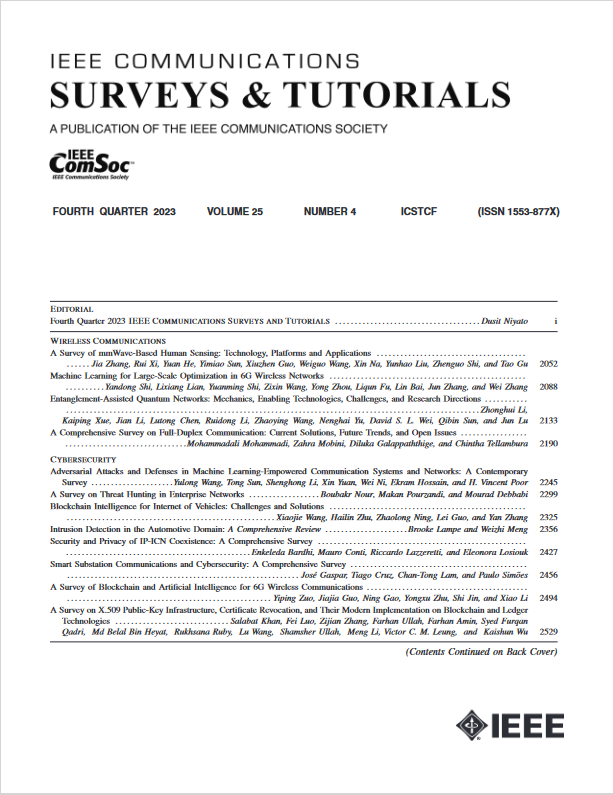
IEEE Communications Surveys & Tutorials is an online journal published by the IEEE Communications Society for tutorials and surveys covering all aspects of the communications field. Telecommunications technology is progressing at a rapid pace, and the IEEE Communications Society is committed to providing researchers and other professionals the information and tools to stay abreast. IEEE Communications Surveys and Tutorials focuses on integrating and adding understanding to the existing literature on communications, putting results in context. Whether searching for in-depth information about a familiar area or an introduction into a new area, IEEE Communications Surveys & Tutorials aims to be the premier source of peer-reviewed, comprehensive tutorials and surveys, and pointers to further sources. IEEE Communications Surveys & Tutorials publishes only articles exclusively written for IEEE Communications Surveys & Tutorials and go through a rigorous review process before their publication in the quarterly issues.
A tutorial article in the IEEE Communications Surveys & Tutorials should be designed to help the reader to become familiar with and learn something specific about a chosen topic. In contrast, the term survey, as applied here, is defined to mean a survey of the literature. A survey article in IEEE Communications Surveys & Tutorials should provide a comprehensive review of developments in a selected area, covering its development from its inception to its current state and beyond, and illustrating its development through liberal citations from the literature. Both tutorials and surveys should be tutorial in nature and should be written in a style comprehensible to readers outside the specialty of the article.



 京公网安备 11010802042870号
京ICP备2023020795号-1
京公网安备 11010802042870号
京ICP备2023020795号-1

 分享
分享
 求助内容:
求助内容: 应助结果提醒方式:
 扫码关注我们
