{"title":"Survey on Large Language Model-Enhanced Reinforcement Learning: Concept, Taxonomy, and Methods","authors":"Yuji Cao;Huan Zhao;Yuheng Cheng;Ting Shu;Yue Chen;Guolong Liu;Gaoqi Liang;Junhua Zhao;Jinyue Yan;Yun Li","doi":"10.1109/TNNLS.2024.3497992","DOIUrl":null,"url":null,"abstract":"With extensive pretrained knowledge and high-level general capabilities, large language models (LLMs) emerge as a promising avenue to augment reinforcement learning (RL) in aspects, such as multitask learning, sample efficiency, and high-level task planning. In this survey, we provide a comprehensive review of the existing literature in LLM-enhanced RL and summarize its characteristics compared with conventional RL methods, aiming to clarify the research scope and directions for future studies. Utilizing the classical agent-environment interaction paradigm, we propose a structured taxonomy to systematically categorize LLMs’ functionalities in RL, including four roles: information processor, reward designer, decision-maker, and generator. For each role, we summarize the methodologies, analyze the specific RL challenges that are mitigated and provide insights into future directions. Finally, the comparative analysis of each role, potential applications, prospective opportunities, and challenges of the LLM-enhanced RL are discussed. By proposing this taxonomy, we aim to provide a framework for researchers to effectively leverage LLMs in the RL field, potentially accelerating RL applications in complex applications, such as robotics, autonomous driving, and energy systems.","PeriodicalId":13303,"journal":{"name":"IEEE transactions on neural networks and learning systems","volume":"36 6","pages":"9737-9757"},"PeriodicalIF":8.9000,"publicationDate":"2024-11-25","publicationTypes":"Journal Article","fieldsOfStudy":null,"isOpenAccess":false,"openAccessPdf":"","citationCount":"0","resultStr":null,"platform":"Semanticscholar","paperid":null,"PeriodicalName":"IEEE transactions on neural networks and learning systems","FirstCategoryId":"94","ListUrlMain":"https://ieeexplore.ieee.org/document/10766898/","RegionNum":1,"RegionCategory":"计算机科学","ArticlePicture":[],"TitleCN":null,"AbstractTextCN":null,"PMCID":null,"EPubDate":"","PubModel":"","JCR":"Q1","JCRName":"COMPUTER SCIENCE, ARTIFICIAL INTELLIGENCE","Score":null,"Total":0}
引用次数: 0
Abstract
With extensive pretrained knowledge and high-level general capabilities, large language models (LLMs) emerge as a promising avenue to augment reinforcement learning (RL) in aspects, such as multitask learning, sample efficiency, and high-level task planning. In this survey, we provide a comprehensive review of the existing literature in LLM-enhanced RL and summarize its characteristics compared with conventional RL methods, aiming to clarify the research scope and directions for future studies. Utilizing the classical agent-environment interaction paradigm, we propose a structured taxonomy to systematically categorize LLMs’ functionalities in RL, including four roles: information processor, reward designer, decision-maker, and generator. For each role, we summarize the methodologies, analyze the specific RL challenges that are mitigated and provide insights into future directions. Finally, the comparative analysis of each role, potential applications, prospective opportunities, and challenges of the LLM-enhanced RL are discussed. By proposing this taxonomy, we aim to provide a framework for researchers to effectively leverage LLMs in the RL field, potentially accelerating RL applications in complex applications, such as robotics, autonomous driving, and energy systems.
期刊介绍:
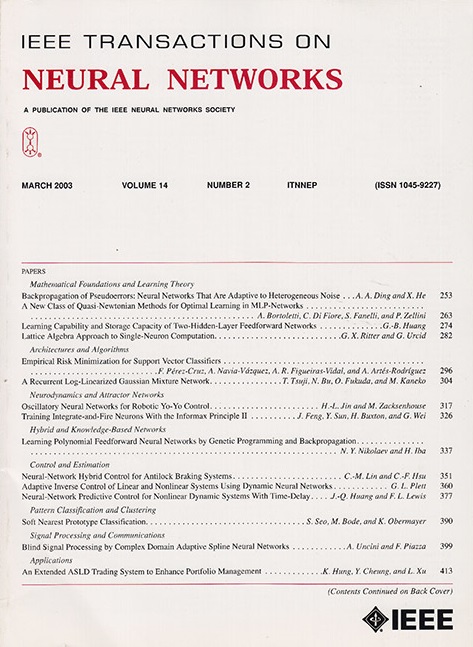
The focus of IEEE Transactions on Neural Networks and Learning Systems is to present scholarly articles discussing the theory, design, and applications of neural networks as well as other learning systems. The journal primarily highlights technical and scientific research in this domain.



 京公网安备 11010802042870号
京ICP备2023020795号-1
京公网安备 11010802042870号
京ICP备2023020795号-1

 分享
分享
 求助内容:
求助内容: 应助结果提醒方式:
 扫码关注我们
