Jéssica Cristina de Almeida, Thais Aparecida Rodrigues, Thais Mota de Souza, Douglas M. S. Del Duque, Tânia Regina Giraldi and Vagner R. de Mendonça
{"title":"Thermal oxidation synthesis of MoS2/MoO3 composites for cationic dye adsorption†","authors":"Jéssica Cristina de Almeida, Thais Aparecida Rodrigues, Thais Mota de Souza, Douglas M. S. Del Duque, Tânia Regina Giraldi and Vagner R. de Mendonça","doi":"10.1039/D4NJ03363A","DOIUrl":null,"url":null,"abstract":"<p >This study investigates the influence of synthesis parameters on the preparation of MoS<small><sub>2</sub></small>/MoO<small><sub>3</sub></small> composites and their adsorption performance for methylene blue (MB) dye removal. The research gap is based on searching for easily obtainable materials with high adsorption capacity. A 2<small><sup><em>k</em></sup></small> factorial design with a central point was employed to optimize the synthesis conditions, focusing on calcination temperature and time. The synthesized materials were characterized, revealing the MoS<small><sub>2</sub></small>/MoO<small><sub>3</sub></small> composition at the calcination temperature of 300 °C, with varying calcination times. In particular, the sample treated at 300 °C for 23 minutes (S-300/23) demonstrated the highest maximum adsorption capacity, reaching 505.1 mg g<small><sup>−1</sup></small>. The adsorption isotherm and kinetics were also evaluated, fitting with Langmuir and pseudo-first-order models, indicating monolayer adsorption and physisorption as the dominant mechanism, respectively. This study highlights the potential of MoS<small><sub>2</sub></small>/MoO<small><sub>3</sub></small> composites as efficient adsorbents for MB dye removal. The optimized synthesis conditions enable the production of this composite adsorbent in a single step under mild conditions. This efficiency and ease of production highlight its potential for further investigation.</p>","PeriodicalId":95,"journal":{"name":"New Journal of Chemistry","volume":" 46","pages":" 19638-19649"},"PeriodicalIF":2.5000,"publicationDate":"2024-11-07","publicationTypes":"Journal Article","fieldsOfStudy":null,"isOpenAccess":false,"openAccessPdf":"","citationCount":"0","resultStr":null,"platform":"Semanticscholar","paperid":null,"PeriodicalName":"New Journal of Chemistry","FirstCategoryId":"92","ListUrlMain":"https://pubs.rsc.org/en/content/articlelanding/2024/nj/d4nj03363a","RegionNum":3,"RegionCategory":"化学","ArticlePicture":[],"TitleCN":null,"AbstractTextCN":null,"PMCID":null,"EPubDate":"","PubModel":"","JCR":"Q2","JCRName":"CHEMISTRY, MULTIDISCIPLINARY","Score":null,"Total":0}
引用次数: 0
Abstract
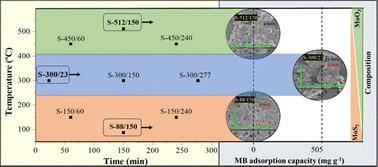
This study investigates the influence of synthesis parameters on the preparation of MoS2/MoO3 composites and their adsorption performance for methylene blue (MB) dye removal. The research gap is based on searching for easily obtainable materials with high adsorption capacity. A 2k factorial design with a central point was employed to optimize the synthesis conditions, focusing on calcination temperature and time. The synthesized materials were characterized, revealing the MoS2/MoO3 composition at the calcination temperature of 300 °C, with varying calcination times. In particular, the sample treated at 300 °C for 23 minutes (S-300/23) demonstrated the highest maximum adsorption capacity, reaching 505.1 mg g−1. The adsorption isotherm and kinetics were also evaluated, fitting with Langmuir and pseudo-first-order models, indicating monolayer adsorption and physisorption as the dominant mechanism, respectively. This study highlights the potential of MoS2/MoO3 composites as efficient adsorbents for MB dye removal. The optimized synthesis conditions enable the production of this composite adsorbent in a single step under mild conditions. This efficiency and ease of production highlight its potential for further investigation.



 京公网安备 11010802042870号
京ICP备2023020795号-1
京公网安备 11010802042870号
京ICP备2023020795号-1

 分享
分享
 求助内容:
求助内容: 应助结果提醒方式:
 扫码关注我们
