Sara Bertuzzi, Marta G. Lete, Antonio Franconetti, Tammo Diercks, Sandra Delgado, Iker Oyenarte, Maria J. Moure, Reyes Nuñez-Franco, Pablo Valverde, Maria Pia Lenza, Klaudia Sobczak, Gonzalo Jiménez-Osés, James C. Paulson, Ana Ardá, June Ereño-Orbea, Jesús Jiménez-Barbero
{"title":"Exploring Glycan-Lectin Interactions in Natural-Like Environments: A View Using NMR Experiments Inside Cell and on Cell Surface","authors":"Sara Bertuzzi, Marta G. Lete, Antonio Franconetti, Tammo Diercks, Sandra Delgado, Iker Oyenarte, Maria J. Moure, Reyes Nuñez-Franco, Pablo Valverde, Maria Pia Lenza, Klaudia Sobczak, Gonzalo Jiménez-Osés, James C. Paulson, Ana Ardá, June Ereño-Orbea, Jesús Jiménez-Barbero","doi":"10.1002/chem.202403102","DOIUrl":null,"url":null,"abstract":"<p>Glycan-mediated molecular recognition events are essential for life. NMR is widely used to monitor glycan binding to lectins in solution using isolated glycans and lectins. In this context, we herein explore diverse NMR methodologies, from both the receptor and ligand perspectives, to monitor glycan-lectin interactions under experimental conditions mimicking the native milieu inside cells and on cell surface. For the NMR experiments inside cells, galectin-7 is employed as model, since most galectins are soluble and carry out their functions in the cellular micro-environment. Using <i>Danio Rerio</i> oocytes, the <sup>1</sup>H-<sup>15</sup>N HMQC NMR spectrum of a folded galectin has been observed inside cell for the first time, using a glycomimetic ligand (TDG) to overcoming the natural tendency of galectins to bind to numerous galactose-containing receptors within cells. Alternatively, most lectins, other than galectins, are displayed on the cell surface, providing a multivalent presentation to bind their glycan partners in <i>cis</i> (at the same cell) or in <i>trans</i> (on other cells). In this case, ligand-based STD-NMR experiments have been successfully applied to account for the interactions of natural glycans and glycomimetics with Siglec-10. These methodologies provide the proof-of-concept to open the door to the NMR analysis of the recognition of glycans in native-like settings.</p>","PeriodicalId":144,"journal":{"name":"Chemistry - A European Journal","volume":"31 10","pages":""},"PeriodicalIF":3.7000,"publicationDate":"2024-11-26","publicationTypes":"Journal Article","fieldsOfStudy":null,"isOpenAccess":false,"openAccessPdf":"https://onlinelibrary.wiley.com/doi/epdf/10.1002/chem.202403102","citationCount":"0","resultStr":null,"platform":"Semanticscholar","paperid":null,"PeriodicalName":"Chemistry - A European Journal","FirstCategoryId":"92","ListUrlMain":"https://chemistry-europe.onlinelibrary.wiley.com/doi/10.1002/chem.202403102","RegionNum":2,"RegionCategory":"化学","ArticlePicture":[],"TitleCN":null,"AbstractTextCN":null,"PMCID":null,"EPubDate":"","PubModel":"","JCR":"Q2","JCRName":"CHEMISTRY, MULTIDISCIPLINARY","Score":null,"Total":0}
引用次数: 0
Abstract
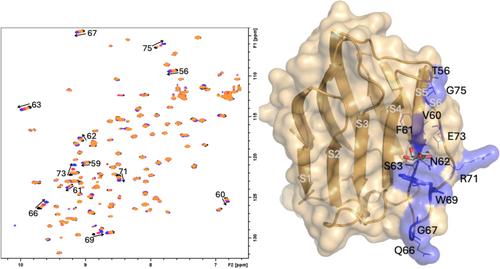
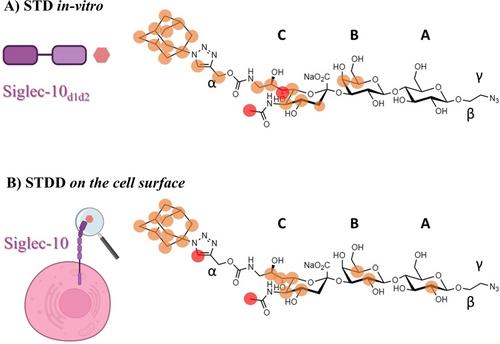
Glycan-mediated molecular recognition events are essential for life. NMR is widely used to monitor glycan binding to lectins in solution using isolated glycans and lectins. In this context, we herein explore diverse NMR methodologies, from both the receptor and ligand perspectives, to monitor glycan-lectin interactions under experimental conditions mimicking the native milieu inside cells and on cell surface. For the NMR experiments inside cells, galectin-7 is employed as model, since most galectins are soluble and carry out their functions in the cellular micro-environment. Using Danio Rerio oocytes, the 1H-15N HMQC NMR spectrum of a folded galectin has been observed inside cell for the first time, using a glycomimetic ligand (TDG) to overcoming the natural tendency of galectins to bind to numerous galactose-containing receptors within cells. Alternatively, most lectins, other than galectins, are displayed on the cell surface, providing a multivalent presentation to bind their glycan partners in cis (at the same cell) or in trans (on other cells). In this case, ligand-based STD-NMR experiments have been successfully applied to account for the interactions of natural glycans and glycomimetics with Siglec-10. These methodologies provide the proof-of-concept to open the door to the NMR analysis of the recognition of glycans in native-like settings.
期刊介绍:
Chemistry—A European Journal is a truly international journal with top quality contributions (2018 ISI Impact Factor: 5.16). It publishes a wide range of outstanding Reviews, Minireviews, Concepts, Full Papers, and Communications from all areas of chemistry and related fields.
Based in Europe Chemistry—A European Journal provides an excellent platform for increasing the visibility of European chemistry as well as for featuring the best research from authors from around the world.
All manuscripts are peer-reviewed, and electronic processing ensures accurate reproduction of text and data, plus short publication times.
The Concepts section provides nonspecialist readers with a useful conceptual guide to unfamiliar areas and experts with new angles on familiar problems.
Chemistry—A European Journal is published on behalf of ChemPubSoc Europe, a group of 16 national chemical societies from within Europe, and supported by the Asian Chemical Editorial Societies. The ChemPubSoc Europe family comprises: Angewandte Chemie, Chemistry—A European Journal, European Journal of Organic Chemistry, European Journal of Inorganic Chemistry, ChemPhysChem, ChemBioChem, ChemMedChem, ChemCatChem, ChemSusChem, ChemPlusChem, ChemElectroChem, and ChemistryOpen.




 京公网安备 11010802042870号
京ICP备2023020795号-1
京公网安备 11010802042870号
京ICP备2023020795号-1

 分享
分享
 求助内容:
求助内容: 应助结果提醒方式:
 扫码关注我们
