Yue Wang, Minna Zhang, Manuel Delgado-Baquerizo, Guangyin Li, Jinting Cai, Xiaobin Pan, Yao Wang, Yingli Xiao, Ling Wang
{"title":"Long-term grazing effects on soil-borne pathogens are driven by temperature","authors":"Yue Wang, Minna Zhang, Manuel Delgado-Baquerizo, Guangyin Li, Jinting Cai, Xiaobin Pan, Yao Wang, Yingli Xiao, Ling Wang","doi":"10.1038/s42003-024-07280-5","DOIUrl":null,"url":null,"abstract":"Soils support a highly diverse community of plant pathogens, which are highly responsive to global change. Climate and livestock grazing are the main global changes in grasslands, yet, how long-term grazing alone, and in interaction with climate, influence the distribution of soil-borne plant pathogens remain virtually unknown. Here, we present the first long-term regional-scale experimental investigation on the impacts of livestock grazing on soil-borne fungal plant pathogens and their association with plant community across 10 experimental sites spanning a climate gradient in the steppe in Northern China. Our results showed that long-term grazing effects on the diversity and proportion of soil-borne fungal plant pathogens are strongly controlled by temperature, with grazing increasing pathogen richness and proportions largely in cooler grasslands. We further show that long-term grazing supported stronger connections between soil-borne fungal pathogens and plant communities. Our work demonstrates that climate controls the effects of grazing on plant pathogens, which is critical to understand and manage grasslands in a changing world. Long-term effects of grazing on soil-borne fungal plant pathogens are strongly controlled by temperature, posing greater potential threats to plant pathogen infections in cooler grasslands.","PeriodicalId":10552,"journal":{"name":"Communications Biology","volume":" ","pages":"1-7"},"PeriodicalIF":5.1000,"publicationDate":"2024-11-26","publicationTypes":"Journal Article","fieldsOfStudy":null,"isOpenAccess":false,"openAccessPdf":"https://www.ncbi.nlm.nih.gov/pmc/articles/PMC11589589/pdf/","citationCount":"0","resultStr":null,"platform":"Semanticscholar","paperid":null,"PeriodicalName":"Communications Biology","FirstCategoryId":"99","ListUrlMain":"https://www.nature.com/articles/s42003-024-07280-5","RegionNum":1,"RegionCategory":"生物学","ArticlePicture":[],"TitleCN":null,"AbstractTextCN":null,"PMCID":null,"EPubDate":"","PubModel":"","JCR":"Q1","JCRName":"BIOLOGY","Score":null,"Total":0}
引用次数: 0
Abstract
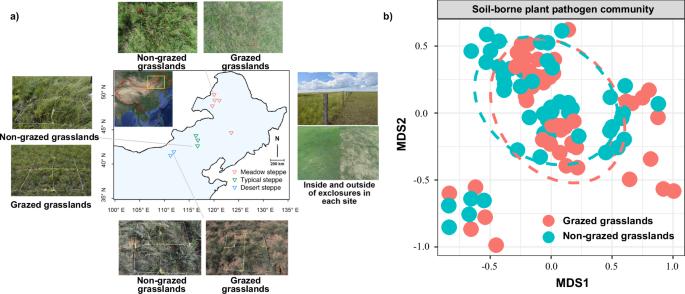
Soils support a highly diverse community of plant pathogens, which are highly responsive to global change. Climate and livestock grazing are the main global changes in grasslands, yet, how long-term grazing alone, and in interaction with climate, influence the distribution of soil-borne plant pathogens remain virtually unknown. Here, we present the first long-term regional-scale experimental investigation on the impacts of livestock grazing on soil-borne fungal plant pathogens and their association with plant community across 10 experimental sites spanning a climate gradient in the steppe in Northern China. Our results showed that long-term grazing effects on the diversity and proportion of soil-borne fungal plant pathogens are strongly controlled by temperature, with grazing increasing pathogen richness and proportions largely in cooler grasslands. We further show that long-term grazing supported stronger connections between soil-borne fungal pathogens and plant communities. Our work demonstrates that climate controls the effects of grazing on plant pathogens, which is critical to understand and manage grasslands in a changing world. Long-term effects of grazing on soil-borne fungal plant pathogens are strongly controlled by temperature, posing greater potential threats to plant pathogen infections in cooler grasslands.
期刊介绍:
Communications Biology is an open access journal from Nature Research publishing high-quality research, reviews and commentary in all areas of the biological sciences. Research papers published by the journal represent significant advances bringing new biological insight to a specialized area of research.



 京公网安备 11010802042870号
京ICP备2023020795号-1
京公网安备 11010802042870号
京ICP备2023020795号-1

 分享
分享
 求助内容:
求助内容: 应助结果提醒方式:
 扫码关注我们
