{"title":"Spatial sensing as a strategy for public goods regulation by gut microbes.","authors":"I Hashem, A Zhang, J Van Impe","doi":"10.1093/ismejo/wrae233","DOIUrl":null,"url":null,"abstract":"<p><p>The gut microbiota has evolved in a complex, spatially structured environment, where microbial interactions are shaped by host-secreted molecules. We propose the spatial sensing (SS) hypothesis, which posits that gut microbes regulate costly cooperative traits, such as public goods, based on their proximity to the epithelial layer. First, we explore the evolutionary dynamics and selective pressures that could drive the emergence of SS. We then outline the spatial organization of the gut microbiota, emphasizing diffusion gradients of host-secreted molecules that may serve as positional cues. Depending on the cost-benefit ratio of secreting public goods near the epithelium, we propose two SS regulatory strategies: SS Type I, where production is suppressed in high-cost, low-benefit conditions, and SS Type II, where production is upregulated in nutrient-rich regions where benefits outweigh costs. We evaluate these strategies using an individual-based model simulating microbial competition in the gut environment. Our results show that SS regulation enhances microbial fitness by modulating investment in costly traits according to spatially varying costs and benefits, outperforming constitutive production. Our findings highlight that SS is both beneficial and evolutionarily feasible, as host-secreted molecules create spatial gradients that microbes can exploit for regulatory purposes. By incorporating spatial positioning as an additional regulatory cue, SS could complement quorum sensing (QS) and competition sensing (CS), fine-tuning the expression of costly traits when and where they are most beneficial within the gut environment. This perspective offers new insights into host-microbiota interactions and could inform strategies for modulating gut microbiomes in health and disease.</p>","PeriodicalId":50271,"journal":{"name":"ISME Journal","volume":" ","pages":""},"PeriodicalIF":10.0000,"publicationDate":"2025-01-02","publicationTypes":"Journal Article","fieldsOfStudy":null,"isOpenAccess":false,"openAccessPdf":"https://www.ncbi.nlm.nih.gov/pmc/articles/PMC12551461/pdf/","citationCount":"0","resultStr":null,"platform":"Semanticscholar","paperid":null,"PeriodicalName":"ISME Journal","FirstCategoryId":"93","ListUrlMain":"https://doi.org/10.1093/ismejo/wrae233","RegionNum":1,"RegionCategory":"环境科学与生态学","ArticlePicture":[],"TitleCN":null,"AbstractTextCN":null,"PMCID":null,"EPubDate":"","PubModel":"","JCR":"Q1","JCRName":"ECOLOGY","Score":null,"Total":0}
引用次数: 0
Abstract
The gut microbiota has evolved in a complex, spatially structured environment, where microbial interactions are shaped by host-secreted molecules. We propose the spatial sensing (SS) hypothesis, which posits that gut microbes regulate costly cooperative traits, such as public goods, based on their proximity to the epithelial layer. First, we explore the evolutionary dynamics and selective pressures that could drive the emergence of SS. We then outline the spatial organization of the gut microbiota, emphasizing diffusion gradients of host-secreted molecules that may serve as positional cues. Depending on the cost-benefit ratio of secreting public goods near the epithelium, we propose two SS regulatory strategies: SS Type I, where production is suppressed in high-cost, low-benefit conditions, and SS Type II, where production is upregulated in nutrient-rich regions where benefits outweigh costs. We evaluate these strategies using an individual-based model simulating microbial competition in the gut environment. Our results show that SS regulation enhances microbial fitness by modulating investment in costly traits according to spatially varying costs and benefits, outperforming constitutive production. Our findings highlight that SS is both beneficial and evolutionarily feasible, as host-secreted molecules create spatial gradients that microbes can exploit for regulatory purposes. By incorporating spatial positioning as an additional regulatory cue, SS could complement quorum sensing (QS) and competition sensing (CS), fine-tuning the expression of costly traits when and where they are most beneficial within the gut environment. This perspective offers new insights into host-microbiota interactions and could inform strategies for modulating gut microbiomes in health and disease.
期刊介绍:
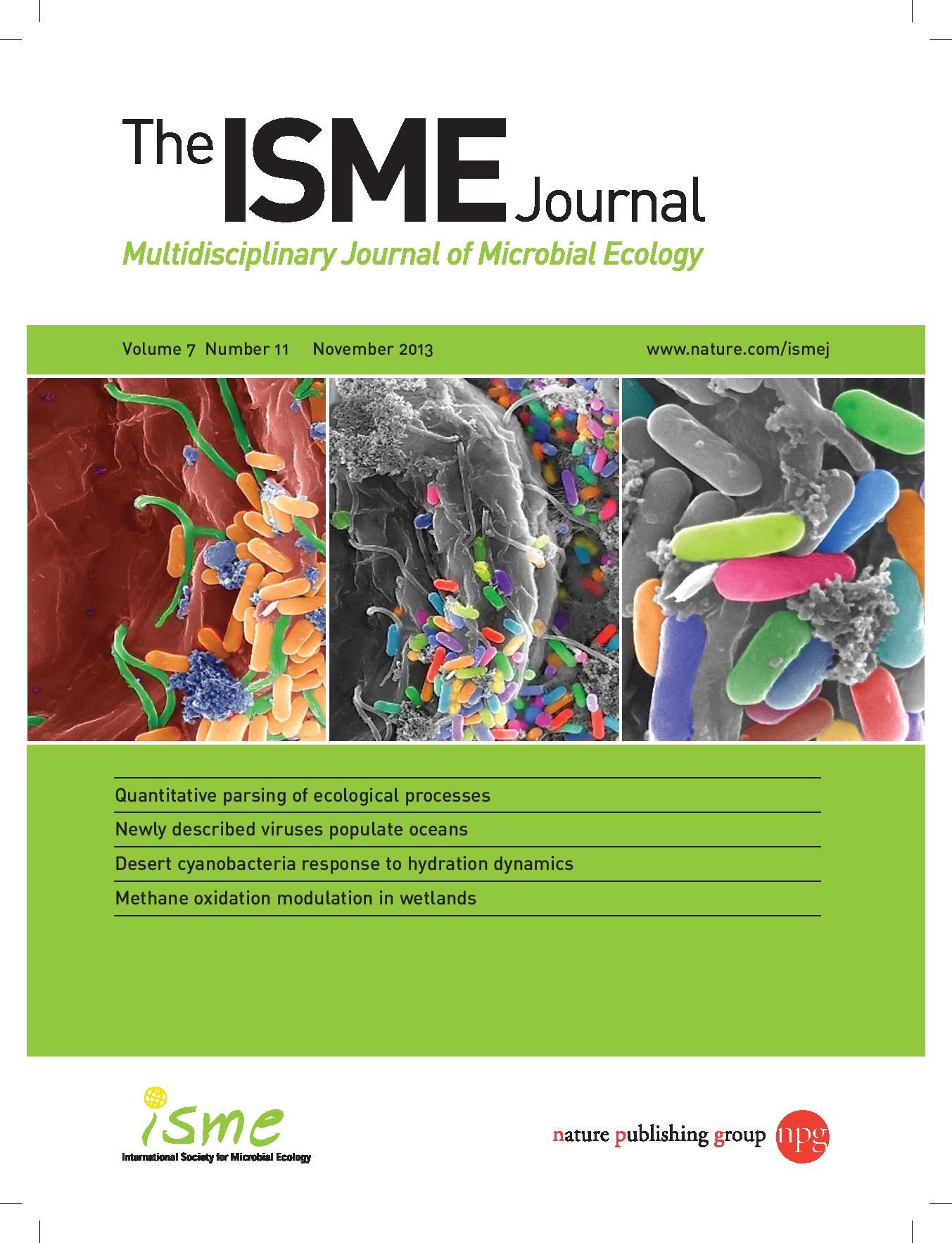
The ISME Journal covers the diverse and integrated areas of microbial ecology. We encourage contributions that represent major advances for the study of microbial ecosystems, communities, and interactions of microorganisms in the environment. Articles in The ISME Journal describe pioneering discoveries of wide appeal that enhance our understanding of functional and mechanistic relationships among microorganisms, their communities, and their habitats.





 京公网安备 11010802042870号
京ICP备2023020795号-1
京公网安备 11010802042870号
京ICP备2023020795号-1

 分享
分享
 求助内容:
求助内容: 应助结果提醒方式:
 扫码关注我们
