Todd J. Marzec;Brandon M. Grainger;Ravisekhar Raju;Paul R. Ohodnicki
{"title":"Analytical Models for Solid and Litz Wire AC Winding Loss in Toroidal Inductors","authors":"Todd J. Marzec;Brandon M. Grainger;Ravisekhar Raju;Paul R. Ohodnicki","doi":"10.1109/TTE.2024.3506698","DOIUrl":null,"url":null,"abstract":"Inductors are energy storage devices that serve as key components in power conversion technology. The advent of wide bandgap (WBG) semiconductor devices, and the promise of ultra-WBG, has led to high-frequency operation of switching converters at higher voltage and current levels. In the kHz–MHz range, additional sources of loss in magnetic components interfacing with these WBG semiconductors are introduced due to high-frequency electromagnetic phenomena. A finite element analysis (FEA) can capture these effects to a high degree of accuracy but requires extensive computation resources precluding application in robust optimization and design schemes. There exist several analytical models for winding loss in literature that can evaluate multiple designs with minimal computation cost. In this work, popular models are reviewed, investigated, and expanded on in context of various toroidal winding geometries. The goal of this work is to analyze well-known winding loss models and demonstrate accuracies at high frequency as they pertain to toroidal inductors while maintaining low computation cost required for integration into optimization and design schemes. Furthermore, Litz wire’s role in high-frequency magnetics is discussed and a novel approach to predicting the winding loss for Litz wire toroidal inductors is laid out and benchmarked against another preexisting model.","PeriodicalId":56269,"journal":{"name":"IEEE Transactions on Transportation Electrification","volume":"11 1","pages":"5134-5145"},"PeriodicalIF":8.3000,"publicationDate":"2024-11-26","publicationTypes":"Journal Article","fieldsOfStudy":null,"isOpenAccess":false,"openAccessPdf":"","citationCount":"0","resultStr":null,"platform":"Semanticscholar","paperid":null,"PeriodicalName":"IEEE Transactions on Transportation Electrification","FirstCategoryId":"5","ListUrlMain":"https://ieeexplore.ieee.org/document/10767735/","RegionNum":1,"RegionCategory":"工程技术","ArticlePicture":[],"TitleCN":null,"AbstractTextCN":null,"PMCID":null,"EPubDate":"","PubModel":"","JCR":"Q1","JCRName":"ENGINEERING, ELECTRICAL & ELECTRONIC","Score":null,"Total":0}
引用次数: 0
Abstract
Inductors are energy storage devices that serve as key components in power conversion technology. The advent of wide bandgap (WBG) semiconductor devices, and the promise of ultra-WBG, has led to high-frequency operation of switching converters at higher voltage and current levels. In the kHz–MHz range, additional sources of loss in magnetic components interfacing with these WBG semiconductors are introduced due to high-frequency electromagnetic phenomena. A finite element analysis (FEA) can capture these effects to a high degree of accuracy but requires extensive computation resources precluding application in robust optimization and design schemes. There exist several analytical models for winding loss in literature that can evaluate multiple designs with minimal computation cost. In this work, popular models are reviewed, investigated, and expanded on in context of various toroidal winding geometries. The goal of this work is to analyze well-known winding loss models and demonstrate accuracies at high frequency as they pertain to toroidal inductors while maintaining low computation cost required for integration into optimization and design schemes. Furthermore, Litz wire’s role in high-frequency magnetics is discussed and a novel approach to predicting the winding loss for Litz wire toroidal inductors is laid out and benchmarked against another preexisting model.
期刊介绍:
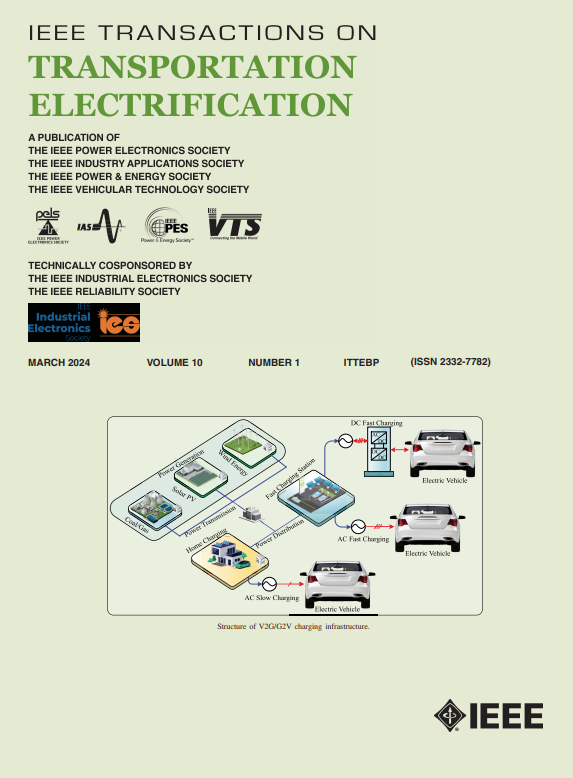
IEEE Transactions on Transportation Electrification is focused on components, sub-systems, systems, standards, and grid interface technologies related to power and energy conversion, propulsion, and actuation for all types of electrified vehicles including on-road, off-road, off-highway, and rail vehicles, airplanes, and ships.



 京公网安备 11010802042870号
京ICP备2023020795号-1
京公网安备 11010802042870号
京ICP备2023020795号-1

 分享
分享
 求助内容:
求助内容: 应助结果提醒方式:
 扫码关注我们
