Jochen S. Utikal, Sebastian A. Wohlfeil, Christiane Bauer-Auch, Tilo Vogel, Anna-Lena Koy, Philipp Morakis
{"title":"Prognosis of primary cutaneous angiosarcoma versus radiation-induced angiosarcoma: A cohort study","authors":"Jochen S. Utikal, Sebastian A. Wohlfeil, Christiane Bauer-Auch, Tilo Vogel, Anna-Lena Koy, Philipp Morakis","doi":"10.1111/jdv.20444","DOIUrl":null,"url":null,"abstract":"<p>Angiosarcomas are malignant soft-tissue tumours of vascular or lymphatic endothelial cell origin.<span><sup>1</sup></span> Two subtypes of cutaneous angiosarcomas (cAS) are defined: primary and secondary cAS associated with radiotherapy or lymphedema. Primary cAS predominantly occurs in elderly men on sun-damaged skin, especially the scalp. Secondary cAS affects women with history of breast cancer and is caused by radiotherapy or lymphedema. The latency for secondary cAS is about 4–8 years. The pathogenesis of cAS remains elusive, but genetic mutations predispose to its development.<span><sup>2</sup></span> Treatment comprises surgery with safety margins and is followed by adjuvant radiotherapy to prevent local recurrence.<span><sup>3</sup></span> The prognosis of cAS is poor, especially in large tumours with a horizontal size >5 cm.<span><sup>4</sup></span> In case of inoperability or metastasis of cAS, systemic treatment is inevitable. Pegylated liposomal doxorubicin or paclitaxel are recommended first-line.<span><sup>3</sup></span> Second-line treatment with trabectidin<span><sup>5</sup></span> or pazopanib<span><sup>6</sup></span> can be applied. Therapies also include anti-angiogenic agents, such as bevacizumab,<span><sup>7</sup></span> or immune checkpoint inhibition.<span><sup>8</sup></span></p><p>As there is a debate ongoing if the aetiology of cAS, primary versus secondary, impacts on the survival of patients,<span><sup>9, 10</sup></span> our multicentre retrospective study aimed to compare real-world data on these two subtypes of cAS.</p><p>All patients gave written informed consent to be registered in the Baden-Württemberg Cancer Registry. Cases with diagnosis of cAS between 2008 and 2023 were extracted from the registry. Data cut was on 1 February 2024. The ICD-10 diagnoses C44, C50 and C49 (only with histologic reports ‘cutis’) were screened for the histology 9120/3 (haemangiosarcoma). Only cases of secondary cAS with available information about breast cancer therapy were included. Statistical analyses were performed with R (version 4.2.1) and tidyverse, survival or survminer packages. Kaplan–Meier survival curves were compared by log-rank tests. Besides, descriptive statistics were performed with Mann–Whitney <i>U</i> or chi-squared tests.</p><p>Primary cAS (<i>n</i> = 60) affected both genders, whereas secondary cAS (<i>n</i> = 71) was exclusively detected in women after radiotherapy of breast cancer. Patients with secondary cAS were younger compared to primary cAS (<i>p</i> = 0.041) (Table 1). Primary cAS was mainly located at the head and neck (83%), while secondary cAS occurred at the thorax (<i>p</i> = 0.001). The median latency period between diagnosis of breast cancer and secondary cAS was 8.0 years. Therapy tended to be initiated earlier in secondary cAS as compared to primary cAS (<i>p</i> = 0.073). Primary cAS was often treated by surgery (19 cases, 63%) (Table 1). In some cases, this was followed by postoperative radiotherapy (eight cases, 27%) or other combinations. Radiotherapy was applied alone (six cases, 20%) or with systemic treatment (three cases, 10%). Systemic first-line treatment was initiated in two patients (7%). In secondary AS, surgery was performed in 34 cases (87%), with subsequent radiotherapy in nine cases (23%) and postoperative systemic treatment in one patient (3%). Four patients (10%) received systemic treatment alone. None were treated with radiotherapy alone.</p><p>Interestingly, female patients with secondary cAS show an increased OS in comparison with patients with primary cAS (<i>p</i> = 0.013) (Figure 1a). To correlate if this is influenced by the gender of primary cAS cases, these have been stratified according to their gender and compared to secondary cAS patients. Patients with secondary cAS perform significantly better as compared to both male and female patients with primary cAS (<i>p</i> = 0.040) (Figure 1b).</p><p>Altogether, patients with secondary cAS were slightly younger. Besides, secondary cAS was mostly treated by surgery and postoperative radiotherapy, while patients with primary cAS needed systemic treatment more frequently. This resulted in a survival benefit for patients with secondary cAS as compared to primary cAS.</p><p>None.</p><p>JSU is on the advisory board or has received honoraria and travel support from Amgen, Bristol Myers Squibb, GSK, Immunocore, LeoPharma, Merck Sharp and Dohme, Novartis, Pierre Fabre, Rheacell, Roche and Sanofi outside the submitted work. SAW received honoraria from Bristol Myers Squibb, Novartis and Sun Pharma outside the submitted work. All other authors declare no conflicts of interest.</p><p>Written informed consent for participation in the Baden-Württemberg Cancer Registry was obtained from all patients.</p><p>The patients in this manuscript have given written informed consent to publication of their case details.</p>","PeriodicalId":17351,"journal":{"name":"Journal of the European Academy of Dermatology and Venereology","volume":"39 8","pages":"e678-e681"},"PeriodicalIF":8.0000,"publicationDate":"2024-11-26","publicationTypes":"Journal Article","fieldsOfStudy":null,"isOpenAccess":false,"openAccessPdf":"https://onlinelibrary.wiley.com/doi/epdf/10.1111/jdv.20444","citationCount":"0","resultStr":null,"platform":"Semanticscholar","paperid":null,"PeriodicalName":"Journal of the European Academy of Dermatology and Venereology","FirstCategoryId":"3","ListUrlMain":"https://onlinelibrary.wiley.com/doi/10.1111/jdv.20444","RegionNum":2,"RegionCategory":"医学","ArticlePicture":[],"TitleCN":null,"AbstractTextCN":null,"PMCID":null,"EPubDate":"","PubModel":"","JCR":"Q1","JCRName":"DERMATOLOGY","Score":null,"Total":0}
引用次数: 0
Abstract
Angiosarcomas are malignant soft-tissue tumours of vascular or lymphatic endothelial cell origin.1 Two subtypes of cutaneous angiosarcomas (cAS) are defined: primary and secondary cAS associated with radiotherapy or lymphedema. Primary cAS predominantly occurs in elderly men on sun-damaged skin, especially the scalp. Secondary cAS affects women with history of breast cancer and is caused by radiotherapy or lymphedema. The latency for secondary cAS is about 4–8 years. The pathogenesis of cAS remains elusive, but genetic mutations predispose to its development.2 Treatment comprises surgery with safety margins and is followed by adjuvant radiotherapy to prevent local recurrence.3 The prognosis of cAS is poor, especially in large tumours with a horizontal size >5 cm.4 In case of inoperability or metastasis of cAS, systemic treatment is inevitable. Pegylated liposomal doxorubicin or paclitaxel are recommended first-line.3 Second-line treatment with trabectidin5 or pazopanib6 can be applied. Therapies also include anti-angiogenic agents, such as bevacizumab,7 or immune checkpoint inhibition.8
As there is a debate ongoing if the aetiology of cAS, primary versus secondary, impacts on the survival of patients,9, 10 our multicentre retrospective study aimed to compare real-world data on these two subtypes of cAS.
All patients gave written informed consent to be registered in the Baden-Württemberg Cancer Registry. Cases with diagnosis of cAS between 2008 and 2023 were extracted from the registry. Data cut was on 1 February 2024. The ICD-10 diagnoses C44, C50 and C49 (only with histologic reports ‘cutis’) were screened for the histology 9120/3 (haemangiosarcoma). Only cases of secondary cAS with available information about breast cancer therapy were included. Statistical analyses were performed with R (version 4.2.1) and tidyverse, survival or survminer packages. Kaplan–Meier survival curves were compared by log-rank tests. Besides, descriptive statistics were performed with Mann–Whitney U or chi-squared tests.
Primary cAS (n = 60) affected both genders, whereas secondary cAS (n = 71) was exclusively detected in women after radiotherapy of breast cancer. Patients with secondary cAS were younger compared to primary cAS (p = 0.041) (Table 1). Primary cAS was mainly located at the head and neck (83%), while secondary cAS occurred at the thorax (p = 0.001). The median latency period between diagnosis of breast cancer and secondary cAS was 8.0 years. Therapy tended to be initiated earlier in secondary cAS as compared to primary cAS (p = 0.073). Primary cAS was often treated by surgery (19 cases, 63%) (Table 1). In some cases, this was followed by postoperative radiotherapy (eight cases, 27%) or other combinations. Radiotherapy was applied alone (six cases, 20%) or with systemic treatment (three cases, 10%). Systemic first-line treatment was initiated in two patients (7%). In secondary AS, surgery was performed in 34 cases (87%), with subsequent radiotherapy in nine cases (23%) and postoperative systemic treatment in one patient (3%). Four patients (10%) received systemic treatment alone. None were treated with radiotherapy alone.
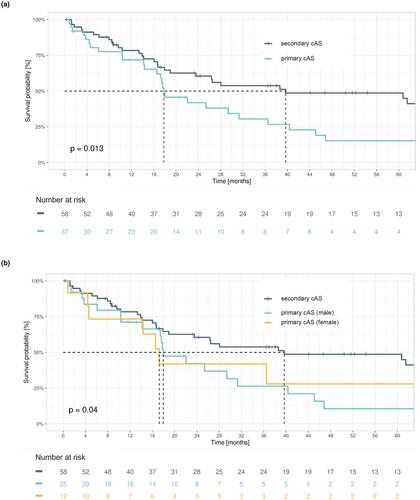
Interestingly, female patients with secondary cAS show an increased OS in comparison with patients with primary cAS (p = 0.013) (Figure 1a). To correlate if this is influenced by the gender of primary cAS cases, these have been stratified according to their gender and compared to secondary cAS patients. Patients with secondary cAS perform significantly better as compared to both male and female patients with primary cAS (p = 0.040) (Figure 1b).
Altogether, patients with secondary cAS were slightly younger. Besides, secondary cAS was mostly treated by surgery and postoperative radiotherapy, while patients with primary cAS needed systemic treatment more frequently. This resulted in a survival benefit for patients with secondary cAS as compared to primary cAS.
None.
JSU is on the advisory board or has received honoraria and travel support from Amgen, Bristol Myers Squibb, GSK, Immunocore, LeoPharma, Merck Sharp and Dohme, Novartis, Pierre Fabre, Rheacell, Roche and Sanofi outside the submitted work. SAW received honoraria from Bristol Myers Squibb, Novartis and Sun Pharma outside the submitted work. All other authors declare no conflicts of interest.
Written informed consent for participation in the Baden-Württemberg Cancer Registry was obtained from all patients.
The patients in this manuscript have given written informed consent to publication of their case details.
期刊介绍:
The Journal of the European Academy of Dermatology and Venereology (JEADV) is a publication that focuses on dermatology and venereology. It covers various topics within these fields, including both clinical and basic science subjects. The journal publishes articles in different formats, such as editorials, review articles, practice articles, original papers, short reports, letters to the editor, features, and announcements from the European Academy of Dermatology and Venereology (EADV).
The journal covers a wide range of keywords, including allergy, cancer, clinical medicine, cytokines, dermatology, drug reactions, hair disease, laser therapy, nail disease, oncology, skin cancer, skin disease, therapeutics, tumors, virus infections, and venereology.
The JEADV is indexed and abstracted by various databases and resources, including Abstracts on Hygiene & Communicable Diseases, Academic Search, AgBiotech News & Information, Botanical Pesticides, CAB Abstracts®, Embase, Global Health, InfoTrac, Ingenta Select, MEDLINE/PubMed, Science Citation Index Expanded, and others.



 京公网安备 11010802042870号
京ICP备2023020795号-1
京公网安备 11010802042870号
京ICP备2023020795号-1

 分享
分享
 求助内容:
求助内容: 应助结果提醒方式:
 扫码关注我们
