Isabella Trautwein, Daniel Behme, Philip Kunkel, Jasper Gerdes, Klaus Mohnike
{"title":"Anatomical Characteristics of Cervicomedullary Compression on MRI Scans in Children with Achondroplasia.","authors":"Isabella Trautwein, Daniel Behme, Philip Kunkel, Jasper Gerdes, Klaus Mohnike","doi":"10.3390/jimaging10110291","DOIUrl":null,"url":null,"abstract":"<p><p>This retrospective study assessed anatomical characteristics of cervicomedullary compression in children with achondroplasia. Twelve anatomical parameters were analyzed (foramen magnum diameter and area; myelon area; clivus length; tentorium and occipital angles; brainstem volume outside the posterior fossa; and posterior fossa, cerebellum, supratentorial ventricular system, intracranial cerebrospinal fluid, and fourth ventricle volumes) from sagittal and transversal T1- and T2-weighted magnetic resonance imaging (MRI) scans from 37 children with achondroplasia aged ≤ 4 years (median [range] 0.8 [0.1-3.6] years) and compared with scans from 37 children without achondroplasia (median age 1.5 [0-3.9] years). Mann-Whitney U testing was used for between-group comparisons. Foramen magnum diameter and area were significantly smaller in children with achondroplasia compared with the reference group (mean 10.0 vs. 16.1 mm [<i>p</i> < 0.001] and 109.0 vs. 160.8 mm<sup>2</sup> [<i>p</i> = 0.005], respectively). The tentorial angle was also steeper in children with achondroplasia (mean 47.6 vs. 38.1 degrees; <i>p</i> < 0.001), while the clivus was significantly shorter (mean 23.5 vs. 30.3 mm; <i>p</i> < 0.001). Significant differences were also observed in myelon area, occipital angle, fourth ventricle, intracranial cerebrospinal fluid and supratentorial ventricular volumes, and the volume of brainstem protruding beyond the posterior fossa (all <i>p</i> < 0.05). MRI analysis of brain structures may provide a standardized value to indicate decompression surgery in children with achondroplasia.</p>","PeriodicalId":37035,"journal":{"name":"Journal of Imaging","volume":"10 11","pages":""},"PeriodicalIF":3.8000,"publicationDate":"2024-11-14","publicationTypes":"Journal Article","fieldsOfStudy":null,"isOpenAccess":false,"openAccessPdf":"https://www.ncbi.nlm.nih.gov/pmc/articles/PMC11595703/pdf/","citationCount":"0","resultStr":null,"platform":"Semanticscholar","paperid":null,"PeriodicalName":"Journal of Imaging","FirstCategoryId":"1085","ListUrlMain":"https://doi.org/10.3390/jimaging10110291","RegionNum":0,"RegionCategory":null,"ArticlePicture":[],"TitleCN":null,"AbstractTextCN":null,"PMCID":null,"EPubDate":"","PubModel":"","JCR":"Q3","JCRName":"IMAGING SCIENCE & PHOTOGRAPHIC TECHNOLOGY","Score":null,"Total":0}
引用次数: 0
Abstract
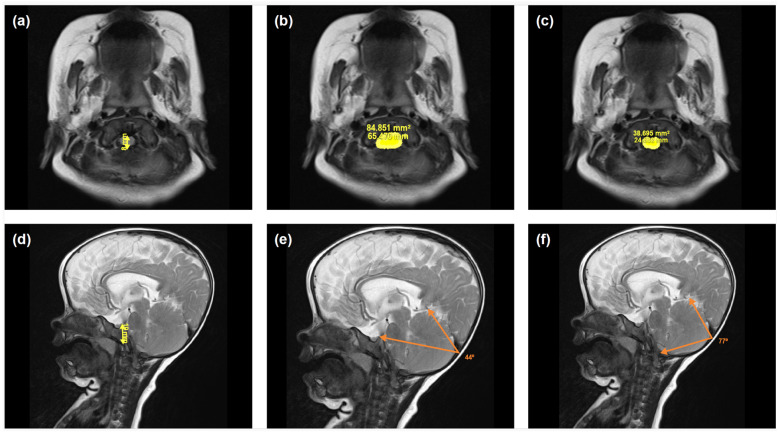
This retrospective study assessed anatomical characteristics of cervicomedullary compression in children with achondroplasia. Twelve anatomical parameters were analyzed (foramen magnum diameter and area; myelon area; clivus length; tentorium and occipital angles; brainstem volume outside the posterior fossa; and posterior fossa, cerebellum, supratentorial ventricular system, intracranial cerebrospinal fluid, and fourth ventricle volumes) from sagittal and transversal T1- and T2-weighted magnetic resonance imaging (MRI) scans from 37 children with achondroplasia aged ≤ 4 years (median [range] 0.8 [0.1-3.6] years) and compared with scans from 37 children without achondroplasia (median age 1.5 [0-3.9] years). Mann-Whitney U testing was used for between-group comparisons. Foramen magnum diameter and area were significantly smaller in children with achondroplasia compared with the reference group (mean 10.0 vs. 16.1 mm [p < 0.001] and 109.0 vs. 160.8 mm2 [p = 0.005], respectively). The tentorial angle was also steeper in children with achondroplasia (mean 47.6 vs. 38.1 degrees; p < 0.001), while the clivus was significantly shorter (mean 23.5 vs. 30.3 mm; p < 0.001). Significant differences were also observed in myelon area, occipital angle, fourth ventricle, intracranial cerebrospinal fluid and supratentorial ventricular volumes, and the volume of brainstem protruding beyond the posterior fossa (all p < 0.05). MRI analysis of brain structures may provide a standardized value to indicate decompression surgery in children with achondroplasia.







 京公网安备 11010802042870号
京ICP备2023020795号-1
京公网安备 11010802042870号
京ICP备2023020795号-1

 分享
分享
 求助内容:
求助内容: 应助结果提醒方式:
 扫码关注我们
