Qing-Hua Zou, Wen-Hao Yang, Ling-Kun Wu, Lu-Lu Jiang, Shuai-Hua Wang, Lang Liu, Ren-Fu Li, Heng-Yun Ye and Jian-Rong Li
{"title":"Ionothermal synthesis of a stable three-dimensional [Cu4I4] cluster scintillator with near-unity quantum efficiency and weak thermal quenching†","authors":"Qing-Hua Zou, Wen-Hao Yang, Ling-Kun Wu, Lu-Lu Jiang, Shuai-Hua Wang, Lang Liu, Ren-Fu Li, Heng-Yun Ye and Jian-Rong Li","doi":"10.1039/D4QI02590C","DOIUrl":null,"url":null,"abstract":"<p >A facile and environmentally friendly ionothermal synthesis was employed to prepare a highly luminescent hybrid scintillator, Cu<small><sub>4</sub></small>I<small><sub>4</sub></small>(C<small><sub>6</sub></small>H<small><sub>14</sub></small>N<small><sub>2</sub></small>)<small><sub>2</sub></small> (<strong>1</strong>, (C<small><sub>6</sub></small>H<small><sub>14</sub></small>N<small><sub>2</sub></small>)<small><sub>2</sub></small> = 1,4-dimethylpiperazine). <strong>1</strong> features a 3-D structure of (Cu<small><sub>4</sub></small>I<small><sub>4</sub></small>) cubane clusters connected by 1,4-dimethylpiperazine. The optical properties of <strong>1</strong> under UV light and X-ray excitation were investigated. The results revealed that its excellent electronic transport properties enable a near-100% quantum yield. Moreover, its luminescence intensity at 110 °C can still maintain 90% of its room temperature value. After being placed in air for 100 days, the luminescence intensity retains 88.34% of its initial one. The compound demonstrates a strong X-ray response, achieving an effective light yield of 48 538 photons per MeV and a detection limit of 30.68 <em>n</em>Gy<small><sub>air</sub></small> s<small><sup>−1</sup></small>, far below the medical diagnostic dose of 5.5 μGy<small><sub>air</sub></small> s<small><sup>−1</sup></small>. The successful development of this compound provides inspiration for green, non-toxic, and efficient detection applications.</p>","PeriodicalId":79,"journal":{"name":"Inorganic Chemistry Frontiers","volume":" 2","pages":" 692-700"},"PeriodicalIF":6.4000,"publicationDate":"2024-11-28","publicationTypes":"Journal Article","fieldsOfStudy":null,"isOpenAccess":false,"openAccessPdf":"","citationCount":"0","resultStr":null,"platform":"Semanticscholar","paperid":null,"PeriodicalName":"Inorganic Chemistry Frontiers","FirstCategoryId":"92","ListUrlMain":"https://pubs.rsc.org/en/content/articlelanding/2025/qi/d4qi02590c","RegionNum":1,"RegionCategory":"化学","ArticlePicture":[],"TitleCN":null,"AbstractTextCN":null,"PMCID":null,"EPubDate":"","PubModel":"","JCR":"Q1","JCRName":"CHEMISTRY, INORGANIC & NUCLEAR","Score":null,"Total":0}
引用次数: 0
Abstract
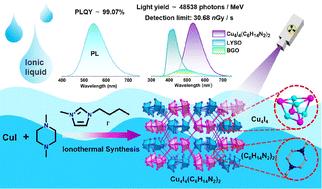
A facile and environmentally friendly ionothermal synthesis was employed to prepare a highly luminescent hybrid scintillator, Cu4I4(C6H14N2)2 (1, (C6H14N2)2 = 1,4-dimethylpiperazine). 1 features a 3-D structure of (Cu4I4) cubane clusters connected by 1,4-dimethylpiperazine. The optical properties of 1 under UV light and X-ray excitation were investigated. The results revealed that its excellent electronic transport properties enable a near-100% quantum yield. Moreover, its luminescence intensity at 110 °C can still maintain 90% of its room temperature value. After being placed in air for 100 days, the luminescence intensity retains 88.34% of its initial one. The compound demonstrates a strong X-ray response, achieving an effective light yield of 48 538 photons per MeV and a detection limit of 30.68 nGyair s−1, far below the medical diagnostic dose of 5.5 μGyair s−1. The successful development of this compound provides inspiration for green, non-toxic, and efficient detection applications.



 京公网安备 11010802042870号
京ICP备2023020795号-1
京公网安备 11010802042870号
京ICP备2023020795号-1

 分享
分享
 求助内容:
求助内容: 应助结果提醒方式:
 扫码关注我们
