Chang Su, Juan Tian, Xueqing He, Xiaona Chang, Guang Wang, Jia Liu
{"title":"Novel Insights into Causal Effects of Lipid and Lipid-Lowering Targets with Autoimmune Thyroid Disease: A Mendelian Randomization Study.","authors":"Chang Su, Juan Tian, Xueqing He, Xiaona Chang, Guang Wang, Jia Liu","doi":"10.2147/ITT.S487319","DOIUrl":null,"url":null,"abstract":"<p><strong>Background: </strong>Dyslipidemia has been implicated in the pathogenesis of several diseases, including thyroid dysfunction and immune disorders. However, whether circulating lipids and long-term use of lipid-lowering drugs influence the development of autoimmune thyroid disease (AITD) remains unclear. This study aims to evaluate the effects of lipid-lowering drugs on AITD and explore their potential mechanisms.</p><p><strong>Methods: </strong>Two-sample and two-step Mendelian randomization (MR) studies were performed to assess the causal relationships between circulating lipids (LDL-C, TC, TG, and ApoB) and seven lipid-lowering drug targets (<i>ApoB, CETP, HMGCR, LDLR, NPC1L1, PCSK9</i>, and <i>PPARα</i>) with AITD. Mediation analyses were conducted to explore potential mediating factors.</p><p><strong>Results: </strong>There was no clear causality between circulating lipids (ApoB, LDL-C, TC, and TG) and AITD (<i>p</i> > 0.05). <i>ApoB</i> inhibition is related to a reduced risk of autoimmune thyroiditis (AT) (OR = 0.462, <i>p</i>= 0.046), while <i>PCSK9</i> inhibition is related to reduced Graves' disease (GD) risk (OR = 0. 551, <i>p</i> = 0.033). Moreover, <i>PCSK9</i> inhibition (OR = 0.735, <i>p</i> = 0.003), <i>LDLR</i> inhibition (OR = 0.779, <i>p</i> = 0.027), and <i>NPC1L1</i> inhibition (OR = 0.599, <i>p</i> = 0.016) reduced the risk of autoimmune hypothyroidism (AIH). Mediation analysis showed that <i>NPC1L1</i> inhibition and <i>PCSK9</i> inhibition exerted effects on AIH through IL-4 and FGF-19 levels. And the effect of <i>PCSK9</i> inhibition on GD through TNF-β levels.</p><p><strong>Conclusion: </strong>There was no clear causality between circulating lipids (ApoB, LDL-C, TC, and TG) and AITD. Lipid-lowering drug target gene inhibitors reduced the AITD risk by modulating inflammatory factors.</p>","PeriodicalId":30986,"journal":{"name":"ImmunoTargets and Therapy","volume":"13 ","pages":"631-641"},"PeriodicalIF":4.4000,"publicationDate":"2024-11-23","publicationTypes":"Journal Article","fieldsOfStudy":null,"isOpenAccess":false,"openAccessPdf":"https://www.ncbi.nlm.nih.gov/pmc/articles/PMC11600951/pdf/","citationCount":"0","resultStr":null,"platform":"Semanticscholar","paperid":null,"PeriodicalName":"ImmunoTargets and Therapy","FirstCategoryId":"1085","ListUrlMain":"https://doi.org/10.2147/ITT.S487319","RegionNum":0,"RegionCategory":null,"ArticlePicture":[],"TitleCN":null,"AbstractTextCN":null,"PMCID":null,"EPubDate":"2024/1/1 0:00:00","PubModel":"eCollection","JCR":"Q1","JCRName":"IMMUNOLOGY","Score":null,"Total":0}
引用次数: 0
Abstract
Background: Dyslipidemia has been implicated in the pathogenesis of several diseases, including thyroid dysfunction and immune disorders. However, whether circulating lipids and long-term use of lipid-lowering drugs influence the development of autoimmune thyroid disease (AITD) remains unclear. This study aims to evaluate the effects of lipid-lowering drugs on AITD and explore their potential mechanisms.
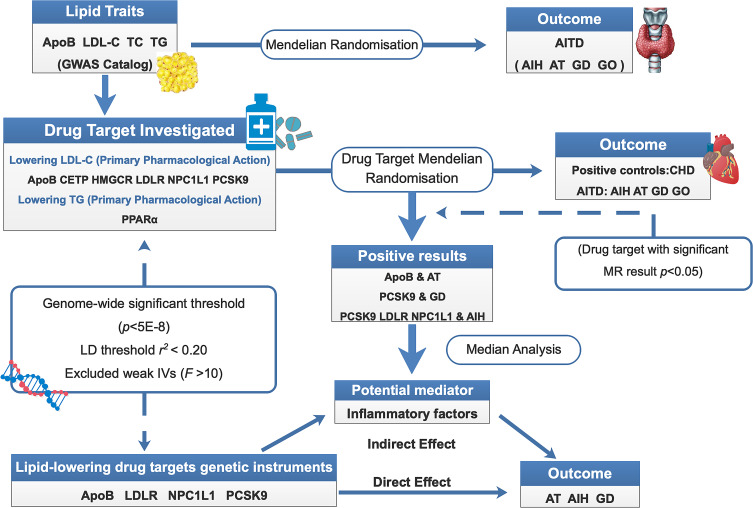
Methods: Two-sample and two-step Mendelian randomization (MR) studies were performed to assess the causal relationships between circulating lipids (LDL-C, TC, TG, and ApoB) and seven lipid-lowering drug targets (ApoB, CETP, HMGCR, LDLR, NPC1L1, PCSK9, and PPARα) with AITD. Mediation analyses were conducted to explore potential mediating factors.
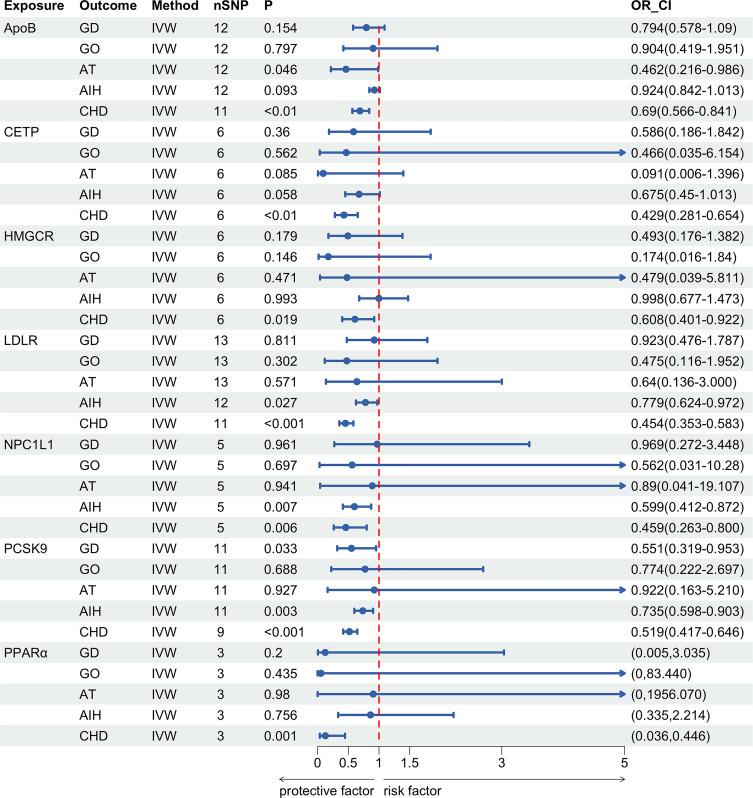
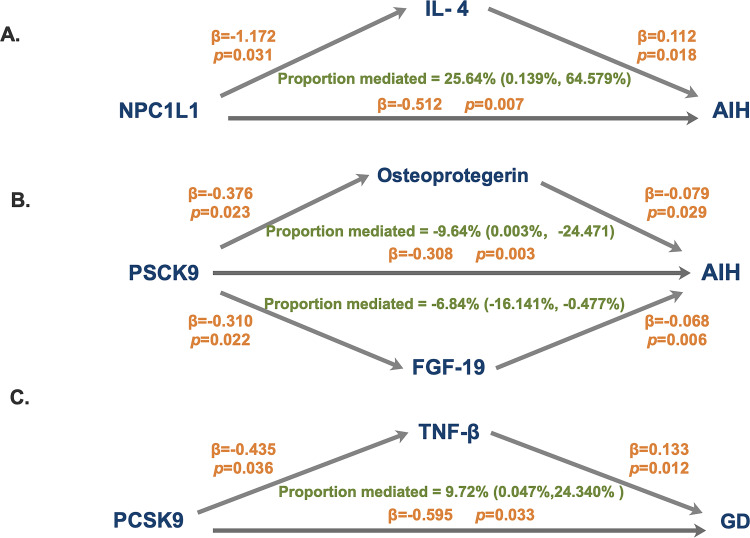
Results: There was no clear causality between circulating lipids (ApoB, LDL-C, TC, and TG) and AITD (p > 0.05). ApoB inhibition is related to a reduced risk of autoimmune thyroiditis (AT) (OR = 0.462, p= 0.046), while PCSK9 inhibition is related to reduced Graves' disease (GD) risk (OR = 0. 551, p = 0.033). Moreover, PCSK9 inhibition (OR = 0.735, p = 0.003), LDLR inhibition (OR = 0.779, p = 0.027), and NPC1L1 inhibition (OR = 0.599, p = 0.016) reduced the risk of autoimmune hypothyroidism (AIH). Mediation analysis showed that NPC1L1 inhibition and PCSK9 inhibition exerted effects on AIH through IL-4 and FGF-19 levels. And the effect of PCSK9 inhibition on GD through TNF-β levels.
Conclusion: There was no clear causality between circulating lipids (ApoB, LDL-C, TC, and TG) and AITD. Lipid-lowering drug target gene inhibitors reduced the AITD risk by modulating inflammatory factors.
期刊介绍:
Immuno Targets and Therapy is an international, peer-reviewed open access journal focusing on the immunological basis of diseases, potential targets for immune based therapy and treatment protocols employed to improve patient management. Basic immunology and physiology of the immune system in health, and disease will be also covered.In addition, the journal will focus on the impact of management programs and new therapeutic agents and protocols on patient perspectives such as quality of life, adherence and satisfaction.



 京公网安备 11010802042870号
京ICP备2023020795号-1
京公网安备 11010802042870号
京ICP备2023020795号-1

 分享
分享
 求助内容:
求助内容: 应助结果提醒方式:
 扫码关注我们
