Chen Zhang , Dongsheng Chen , Yixin Luo , Yiming Yuan , Ying Wang , Zuobao Yang
{"title":"Engineering functional groups of ZnMn2O4/GO composite nanofibers for efficient and stable supercapacitors","authors":"Chen Zhang , Dongsheng Chen , Yixin Luo , Yiming Yuan , Ying Wang , Zuobao Yang","doi":"10.1016/j.surfin.2024.105517","DOIUrl":null,"url":null,"abstract":"<div><div>Spinel ZnMn<sub>2</sub>O<sub>4</sub> (ZMO) is a promising supercapacitor materials due to its high theoretical capacity, non-toxic, and more environmental benefits. However, traditional ZMO suffers from poor conductivity and instability, limiting its performance. To address these issues, we incorporated graphene oxide (GO) into ZMO, forming mesoporous ZMO/GO nanofibers (NFs) with a large specific surface area via electrospinning and further annealing. GO doping introduces oxygen-containing functional groups that add active sites for ion adsorption and increase electrode conductivity, as confirmed by COMSOL simulations, showing a rise in maximum current density from 6976 A m<sup>−2</sup> to 15705 A m<sup>−2</sup>. The NF structure also prevents GO aggregation, enhancing ion transport and stabilizing ZMO. Consequently, the ZMO/GO3 electrode achieves a high specific capacitance (1489.5 F g<sup>−1</sup> at 1 A g<sup>−1</sup> with 0.3 wt% GO) and excellent electrochemical performance. The asymmetric supercapacitor (ZMO/GO3//AC) with activated carbon achieves an energy density of 22.04 Wh kg<sup>−1</sup> at 799.84 W kg<sup>−1</sup> and retains 91.3 % capacitance after 5000 cycles at 5 A g<sup>−1</sup>, capable of powering an LED. This approach underscores ZMO's potential for high-power supercapacitor applications.</div></div>","PeriodicalId":22081,"journal":{"name":"Surfaces and Interfaces","volume":"56 ","pages":"Article 105517"},"PeriodicalIF":6.3000,"publicationDate":"2025-01-01","publicationTypes":"Journal Article","fieldsOfStudy":null,"isOpenAccess":false,"openAccessPdf":"","citationCount":"0","resultStr":null,"platform":"Semanticscholar","paperid":null,"PeriodicalName":"Surfaces and Interfaces","FirstCategoryId":"88","ListUrlMain":"https://www.sciencedirect.com/science/article/pii/S2468023024016729","RegionNum":2,"RegionCategory":"材料科学","ArticlePicture":[],"TitleCN":null,"AbstractTextCN":null,"PMCID":null,"EPubDate":"2024/11/26 0:00:00","PubModel":"Epub","JCR":"Q2","JCRName":"CHEMISTRY, PHYSICAL","Score":null,"Total":0}
引用次数: 0
Abstract
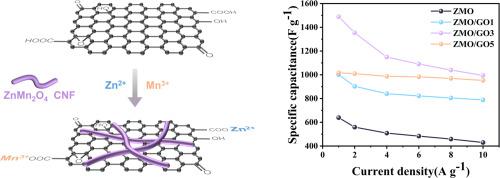
Spinel ZnMn2O4 (ZMO) is a promising supercapacitor materials due to its high theoretical capacity, non-toxic, and more environmental benefits. However, traditional ZMO suffers from poor conductivity and instability, limiting its performance. To address these issues, we incorporated graphene oxide (GO) into ZMO, forming mesoporous ZMO/GO nanofibers (NFs) with a large specific surface area via electrospinning and further annealing. GO doping introduces oxygen-containing functional groups that add active sites for ion adsorption and increase electrode conductivity, as confirmed by COMSOL simulations, showing a rise in maximum current density from 6976 A m−2 to 15705 A m−2. The NF structure also prevents GO aggregation, enhancing ion transport and stabilizing ZMO. Consequently, the ZMO/GO3 electrode achieves a high specific capacitance (1489.5 F g−1 at 1 A g−1 with 0.3 wt% GO) and excellent electrochemical performance. The asymmetric supercapacitor (ZMO/GO3//AC) with activated carbon achieves an energy density of 22.04 Wh kg−1 at 799.84 W kg−1 and retains 91.3 % capacitance after 5000 cycles at 5 A g−1, capable of powering an LED. This approach underscores ZMO's potential for high-power supercapacitor applications.
尖晶石ZnMn2O4 (ZMO)具有理论容量高、无毒、环保等优点,是一种很有前途的超级电容器材料。然而,传统的ZMO具有导电性差和不稳定性,限制了其性能。为了解决这些问题,我们将氧化石墨烯(GO)掺入ZMO中,通过静电纺丝和进一步退火形成具有大比表面积的ZMO/GO介孔纳米纤维(NFs)。COMSOL模拟证实,氧化石墨烯掺杂引入了含氧官能团,增加了离子吸附的活性位点,提高了电极的导电性,显示出最大电流密度从6976 a m−2增加到15705 a m−2。NF结构还能阻止氧化石墨烯的聚集,增强离子传递,稳定ZMO。因此,ZMO/GO3电极具有较高的比电容(当氧化石墨烯含量为0.3 wt%时,比电容为1489.5 F g−1)和优异的电化学性能。采用活性炭制备的非对称超级电容器(ZMO/GO3//AC)在799.84 W kg - 1下的能量密度为22.04 Wh kg - 1,在5a g - 1下循环5000次后仍保持91.3%的电容,能够为LED供电。这种方法强调了ZMO在高功率超级电容器应用方面的潜力。
期刊介绍:
The aim of the journal is to provide a respectful outlet for ''sound science'' papers in all research areas on surfaces and interfaces. We define sound science papers as papers that describe new and well-executed research, but that do not necessarily provide brand new insights or are merely a description of research results.
Surfaces and Interfaces publishes research papers in all fields of surface science which may not always find the right home on first submission to our Elsevier sister journals (Applied Surface, Surface and Coatings Technology, Thin Solid Films)




 京公网安备 11010802042870号
京ICP备2023020795号-1
京公网安备 11010802042870号
京ICP备2023020795号-1

 分享
分享
 求助内容:
求助内容: 应助结果提醒方式:
 扫码关注我们
