Guotan Liu , Weihong Gao , Zhihao Huang , Bin Sun , Yunxiang Tong , Guosheng Huang , Yudong Fu
{"title":"Hydrogen behavior in Ti surface nitridation: Hydrogen as an active component catalyzes the nitridation reaction","authors":"Guotan Liu , Weihong Gao , Zhihao Huang , Bin Sun , Yunxiang Tong , Guosheng Huang , Yudong Fu","doi":"10.1016/j.surfin.2024.105512","DOIUrl":null,"url":null,"abstract":"<div><div>Typically, H<sub>2</sub> is introduced into the nitriding atmosphere to enhance the efficiency of metal surface nitridation. However, the role of hydrogen as an active species in catalyzing the reaction is still uncertain. Here, we present the nitridation mechanism of pure titanium(Ti) surface (hexagonal, α phase) with and without H atoms(H) based on first-principles calculations of surface nitrogen adsorption, dissociation and penetration. First, the adsorption characteristics of N atoms(N) and N<sub>2</sub> molecules(N<sub>2</sub>) and the system energy indicate that FCC and HCP are favorable adsorption sites. In contrast, the adsorption stability of N on H-containing surfaces shows higher trend. Second, the minimum energy path (MEP) study results based on the climb image nudged elastic band (CI-NEB) method show that H increases the efficiency of dissociation and penetration processes. A linear relationship exists between hydrogen concentration and the N penetration energy barrier. In addition, electronic structure calculations theoretically support H regulation of surface nitridation efficiency. The nearby H reduces the energy barrier for the dissociation of N<sub>2</sub> and the penetration of N by enhancing the interaction between N and surrounding Ti. This study provides theoretical support and new insights into the microscopic mechanism of H regulating the nitridation reaction of the Ti surface.</div></div>","PeriodicalId":22081,"journal":{"name":"Surfaces and Interfaces","volume":"56 ","pages":"Article 105512"},"PeriodicalIF":6.3000,"publicationDate":"2025-01-01","publicationTypes":"Journal Article","fieldsOfStudy":null,"isOpenAccess":false,"openAccessPdf":"","citationCount":"0","resultStr":null,"platform":"Semanticscholar","paperid":null,"PeriodicalName":"Surfaces and Interfaces","FirstCategoryId":"88","ListUrlMain":"https://www.sciencedirect.com/science/article/pii/S2468023024016675","RegionNum":2,"RegionCategory":"材料科学","ArticlePicture":[],"TitleCN":null,"AbstractTextCN":null,"PMCID":null,"EPubDate":"2024/11/26 0:00:00","PubModel":"Epub","JCR":"Q2","JCRName":"CHEMISTRY, PHYSICAL","Score":null,"Total":0}
引用次数: 0
Abstract
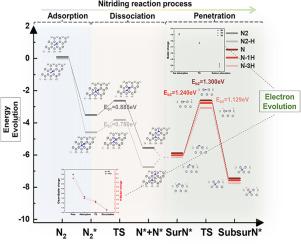
Typically, H2 is introduced into the nitriding atmosphere to enhance the efficiency of metal surface nitridation. However, the role of hydrogen as an active species in catalyzing the reaction is still uncertain. Here, we present the nitridation mechanism of pure titanium(Ti) surface (hexagonal, α phase) with and without H atoms(H) based on first-principles calculations of surface nitrogen adsorption, dissociation and penetration. First, the adsorption characteristics of N atoms(N) and N2 molecules(N2) and the system energy indicate that FCC and HCP are favorable adsorption sites. In contrast, the adsorption stability of N on H-containing surfaces shows higher trend. Second, the minimum energy path (MEP) study results based on the climb image nudged elastic band (CI-NEB) method show that H increases the efficiency of dissociation and penetration processes. A linear relationship exists between hydrogen concentration and the N penetration energy barrier. In addition, electronic structure calculations theoretically support H regulation of surface nitridation efficiency. The nearby H reduces the energy barrier for the dissociation of N2 and the penetration of N by enhancing the interaction between N and surrounding Ti. This study provides theoretical support and new insights into the microscopic mechanism of H regulating the nitridation reaction of the Ti surface.
期刊介绍:
The aim of the journal is to provide a respectful outlet for ''sound science'' papers in all research areas on surfaces and interfaces. We define sound science papers as papers that describe new and well-executed research, but that do not necessarily provide brand new insights or are merely a description of research results.
Surfaces and Interfaces publishes research papers in all fields of surface science which may not always find the right home on first submission to our Elsevier sister journals (Applied Surface, Surface and Coatings Technology, Thin Solid Films)




 京公网安备 11010802042870号
京ICP备2023020795号-1
京公网安备 11010802042870号
京ICP备2023020795号-1

 分享
分享
 求助内容:
求助内容: 应助结果提醒方式:
 扫码关注我们
