Adaptation for Staphylococcus aureus to hosts via insertion mutation in the accessory gene regulator agrC gene: decreased virulence and enhanced persistence capacity.
Jiawei Chen, Yun Wu, Ying Zhu, Li Zhang, Yingchun Xu, Yali Liu
{"title":"Adaptation for <i>Staphylococcus aureus</i> to hosts via insertion mutation in the accessory gene regulator <i>agrC</i> gene: decreased virulence and enhanced persistence capacity.","authors":"Jiawei Chen, Yun Wu, Ying Zhu, Li Zhang, Yingchun Xu, Yali Liu","doi":"10.1128/spectrum.01497-24","DOIUrl":null,"url":null,"abstract":"<p><p><i>Staphylococcus aureus</i> is an important human pathogen due to its vast array of virulence factors regulated by multiple regulatory mechanisms, including the accessory gene regulator. In this study, two <i>S</i>. <i>aureus</i> strains were simultaneously isolated from the blood of a febrile patient, belonging to the same clone, designated as 23H with a complete hemolytic phenotype, and 23B, exhibiting an incomplete hemolytic phenotype. The genomic comparison between strains 23B and 23H revealed that 23B had a single adenine base insertion at position 923 in the <i>agrC</i> gene, leading to a functional loss of the encoded AgrC. Experimental findings showed that strain 23B had decreased hemolytic activity, lower cytotoxicity against human alveolar epithelial A549 cells and in the <i>Galleria mellonella</i> model, and a reduced ability to survive intracellularly after infecting macrophages, in comparison to 23H. Conversely, 23B exhibited enhanced biofilm formation, greater adherence to A549 cells, and increased persistence in the face of vancomycin and daptomycin treatment. Transcriptomic analysis revealed that 23B upregulated surface protein-encoding genes while simultaneously reducing the expression levels of virulence factors, highlighting the intricate regulatory adjustments facilitating its persistence and reducing pathogenic potential. ATP assay results indicated that 23B maintained elevated ATP levels during the exponential phase yet exhibited reduced levels in the stationary phase when compared with 23H. Our findings suggested that the mutation in the <i>agrC</i> gene of <i>S. aureus</i> results in diminished virulence but markedly enhances persistence. This mutated strain warrants clinical attention because it may lead to treatment failures and persist in patients.</p><p><strong>Importance: </strong>In clinical antimicrobial therapy, bacterial strains often develop resistance to antimicrobial agents. Additionally, mutations in their gene regulatory networks can increase their persistence, especially in immunocompromised patients. This study identified an insertion mutation in the accessory gene regulator, <i>agrC</i> gene, carried by a <i>Staphylococcus aureus</i> strain isolated from the blood of a febrile patient, leading to the functional loss of AgrC. Further research revealed that despite the reduced virulence of the mutated strain, it significantly bolstered the capacity to adapt and endure within the host during prolonged infections. This was evidenced by increased adhesion and biofilm formation capabilities, development of antimicrobial tolerance, and decreased ATP levels linked to persistence. Therefore, monitoring these mutations in <i>S. aureus</i> is crucial clinically, as they can complicate treatment strategies.</p>","PeriodicalId":18670,"journal":{"name":"Microbiology spectrum","volume":" ","pages":"e0149724"},"PeriodicalIF":3.8000,"publicationDate":"2025-01-07","publicationTypes":"Journal Article","fieldsOfStudy":null,"isOpenAccess":false,"openAccessPdf":"https://www.ncbi.nlm.nih.gov/pmc/articles/PMC11705864/pdf/","citationCount":"0","resultStr":null,"platform":"Semanticscholar","paperid":null,"PeriodicalName":"Microbiology spectrum","FirstCategoryId":"99","ListUrlMain":"https://doi.org/10.1128/spectrum.01497-24","RegionNum":2,"RegionCategory":"生物学","ArticlePicture":[],"TitleCN":null,"AbstractTextCN":null,"PMCID":null,"EPubDate":"2024/11/29 0:00:00","PubModel":"Epub","JCR":"Q2","JCRName":"MICROBIOLOGY","Score":null,"Total":0}
引用次数: 0
Abstract
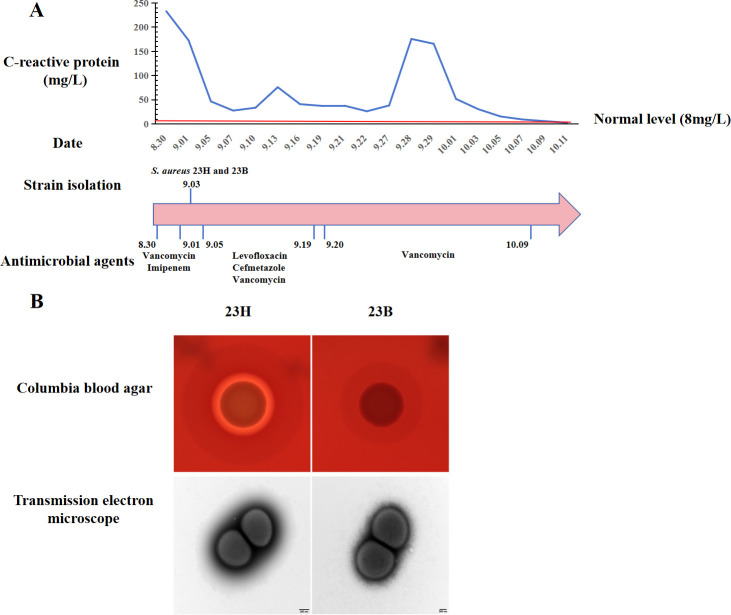
Staphylococcus aureus is an important human pathogen due to its vast array of virulence factors regulated by multiple regulatory mechanisms, including the accessory gene regulator. In this study, two S. aureus strains were simultaneously isolated from the blood of a febrile patient, belonging to the same clone, designated as 23H with a complete hemolytic phenotype, and 23B, exhibiting an incomplete hemolytic phenotype. The genomic comparison between strains 23B and 23H revealed that 23B had a single adenine base insertion at position 923 in the agrC gene, leading to a functional loss of the encoded AgrC. Experimental findings showed that strain 23B had decreased hemolytic activity, lower cytotoxicity against human alveolar epithelial A549 cells and in the Galleria mellonella model, and a reduced ability to survive intracellularly after infecting macrophages, in comparison to 23H. Conversely, 23B exhibited enhanced biofilm formation, greater adherence to A549 cells, and increased persistence in the face of vancomycin and daptomycin treatment. Transcriptomic analysis revealed that 23B upregulated surface protein-encoding genes while simultaneously reducing the expression levels of virulence factors, highlighting the intricate regulatory adjustments facilitating its persistence and reducing pathogenic potential. ATP assay results indicated that 23B maintained elevated ATP levels during the exponential phase yet exhibited reduced levels in the stationary phase when compared with 23H. Our findings suggested that the mutation in the agrC gene of S. aureus results in diminished virulence but markedly enhances persistence. This mutated strain warrants clinical attention because it may lead to treatment failures and persist in patients.
Importance: In clinical antimicrobial therapy, bacterial strains often develop resistance to antimicrobial agents. Additionally, mutations in their gene regulatory networks can increase their persistence, especially in immunocompromised patients. This study identified an insertion mutation in the accessory gene regulator, agrC gene, carried by a Staphylococcus aureus strain isolated from the blood of a febrile patient, leading to the functional loss of AgrC. Further research revealed that despite the reduced virulence of the mutated strain, it significantly bolstered the capacity to adapt and endure within the host during prolonged infections. This was evidenced by increased adhesion and biofilm formation capabilities, development of antimicrobial tolerance, and decreased ATP levels linked to persistence. Therefore, monitoring these mutations in S. aureus is crucial clinically, as they can complicate treatment strategies.
期刊介绍:
Microbiology Spectrum publishes commissioned review articles on topics in microbiology representing ten content areas: Archaea; Food Microbiology; Bacterial Genetics, Cell Biology, and Physiology; Clinical Microbiology; Environmental Microbiology and Ecology; Eukaryotic Microbes; Genomics, Computational, and Synthetic Microbiology; Immunology; Pathogenesis; and Virology. Reviews are interrelated, with each review linking to other related content. A large board of Microbiology Spectrum editors aids in the development of topics for potential reviews and in the identification of an editor, or editors, who shepherd each collection.






 京公网安备 11010802042870号
京ICP备2023020795号-1
京公网安备 11010802042870号
京ICP备2023020795号-1

 分享
分享
 求助内容:
求助内容: 应助结果提醒方式:
 扫码关注我们
