{"title":"Spectrum Sharing and Interference Management for 6G LEO Satellite-Terrestrial Network Integration","authors":"Navid Heydarishahreza;Tao Han;Nirwan Ansari","doi":"10.1109/COMST.2024.3507019","DOIUrl":null,"url":null,"abstract":"The rapid emergence of satellite systems introduces unprecedented interference challenges to both existing satellite networks and Terrestrial Networks (TNs), necessitating innovative strategies to efficiently manage spectrum resources amid heightened competition. Traditional interference management methods fail to address the unique challenges facing satellite systems. These challenges include higher propagation delays caused by the high altitude of Low Earth Orbit (LEO) satellites, increased Doppler shifts due to their high speeds, atmospheric attenuations affecting LEO satellite-TN links, and limited processing capacity in satellite systems. This article provides a comprehensive exploration of interference in LEO satellite-Integrated Terrestrial Networks (LITNets), encompassing various types of interference, including Inter-Beam Interference (IBI), which occurs between different beams of the same satellites; Inter-Satellite Interference (ISI), which arises between different satellites; and LEO satellite-Terrestrial infrastructure Interference (LTI). Moreover, it outlines strategies for interference management and reviews current mitigation methods. Finally, the article concludes by discussing the research challenges and proposing future directions for enhancing spectrum efficiency and interference management in LITNets.","PeriodicalId":55029,"journal":{"name":"IEEE Communications Surveys and Tutorials","volume":"27 5","pages":"2794-2825"},"PeriodicalIF":34.4000,"publicationDate":"2024-11-27","publicationTypes":"Journal Article","fieldsOfStudy":null,"isOpenAccess":false,"openAccessPdf":"","citationCount":"0","resultStr":null,"platform":"Semanticscholar","paperid":null,"PeriodicalName":"IEEE Communications Surveys and Tutorials","FirstCategoryId":"94","ListUrlMain":"https://ieeexplore.ieee.org/document/10769081/","RegionNum":1,"RegionCategory":"计算机科学","ArticlePicture":[],"TitleCN":null,"AbstractTextCN":null,"PMCID":null,"EPubDate":"","PubModel":"","JCR":"Q1","JCRName":"COMPUTER SCIENCE, INFORMATION SYSTEMS","Score":null,"Total":0}
引用次数: 0
Abstract
The rapid emergence of satellite systems introduces unprecedented interference challenges to both existing satellite networks and Terrestrial Networks (TNs), necessitating innovative strategies to efficiently manage spectrum resources amid heightened competition. Traditional interference management methods fail to address the unique challenges facing satellite systems. These challenges include higher propagation delays caused by the high altitude of Low Earth Orbit (LEO) satellites, increased Doppler shifts due to their high speeds, atmospheric attenuations affecting LEO satellite-TN links, and limited processing capacity in satellite systems. This article provides a comprehensive exploration of interference in LEO satellite-Integrated Terrestrial Networks (LITNets), encompassing various types of interference, including Inter-Beam Interference (IBI), which occurs between different beams of the same satellites; Inter-Satellite Interference (ISI), which arises between different satellites; and LEO satellite-Terrestrial infrastructure Interference (LTI). Moreover, it outlines strategies for interference management and reviews current mitigation methods. Finally, the article concludes by discussing the research challenges and proposing future directions for enhancing spectrum efficiency and interference management in LITNets.
期刊介绍:
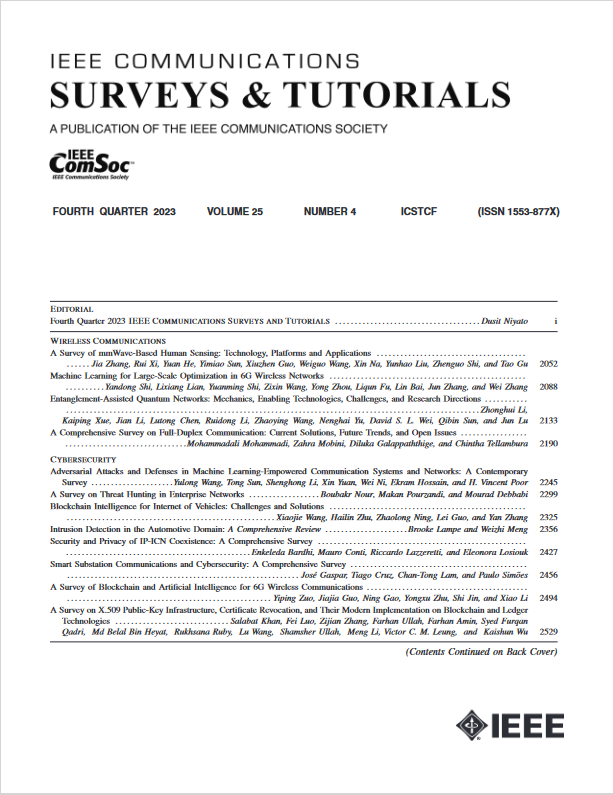
IEEE Communications Surveys & Tutorials is an online journal published by the IEEE Communications Society for tutorials and surveys covering all aspects of the communications field. Telecommunications technology is progressing at a rapid pace, and the IEEE Communications Society is committed to providing researchers and other professionals the information and tools to stay abreast. IEEE Communications Surveys and Tutorials focuses on integrating and adding understanding to the existing literature on communications, putting results in context. Whether searching for in-depth information about a familiar area or an introduction into a new area, IEEE Communications Surveys & Tutorials aims to be the premier source of peer-reviewed, comprehensive tutorials and surveys, and pointers to further sources. IEEE Communications Surveys & Tutorials publishes only articles exclusively written for IEEE Communications Surveys & Tutorials and go through a rigorous review process before their publication in the quarterly issues.
A tutorial article in the IEEE Communications Surveys & Tutorials should be designed to help the reader to become familiar with and learn something specific about a chosen topic. In contrast, the term survey, as applied here, is defined to mean a survey of the literature. A survey article in IEEE Communications Surveys & Tutorials should provide a comprehensive review of developments in a selected area, covering its development from its inception to its current state and beyond, and illustrating its development through liberal citations from the literature. Both tutorials and surveys should be tutorial in nature and should be written in a style comprehensible to readers outside the specialty of the article.



 京公网安备 11010802042870号
京ICP备2023020795号-1
京公网安备 11010802042870号
京ICP备2023020795号-1

 分享
分享
 求助内容:
求助内容: 应助结果提醒方式:
 扫码关注我们
