Yunfei Zuo, Pei Li, Wen-Jin Wang, Changhuo Xu, Shuting Xu, Herman H. Y. Sung, Jianwei Sun, Guorui Jin, Weiping Wang, Ryan T. K. Kwok, Jacky W. Y. Lam, Ben Zhong Tang
{"title":"Tumor Site-Specific In Vivo Theranostics Enabled by Microenvironment-Dependent Chemical Transformation and Self-Amplifying Effect","authors":"Yunfei Zuo, Pei Li, Wen-Jin Wang, Changhuo Xu, Shuting Xu, Herman H. Y. Sung, Jianwei Sun, Guorui Jin, Weiping Wang, Ryan T. K. Kwok, Jacky W. Y. Lam, Ben Zhong Tang","doi":"10.1002/advs.202409506","DOIUrl":null,"url":null,"abstract":"<p>Precise tumor diagnosis and treatment remain complex challenges. While numerous fluorescent probes have been developed for tumor-specific imaging and therapy, few exhibit effective function in vivo. Herein, a probe called TQ-H<sub>2</sub> is designed that can realize robust theranostic effects both in vitro and in vivo. In vitro, TQ-H<sub>2</sub> specifically targets the lysosome and reacts with hydroxyl radical (·OH) to generate TQ-HA, which lights up the cells. TQ-HA generates reactive oxygen species (ROS) under light irradiation, enabling the simultaneous induction and monitoring of apoptosis and ferroptosis in tumor cells. Remarkably, TQ-HA also acts as a self-amplifier, autocatalytically activating TQ-H<sub>2</sub> by generating ·OH under light exposure. This self-amplification aligns with the tumor microenvironment, where TQ-H<sub>2</sub> undergoes chemical transformation, distinguishing tumors from healthy tissue via near-infrared (NIR) fluorescence imaging. Furthermore, ROS generated by TQ-HA effectively kills tumor cells and inhibits tumor growth without harming normal cells. This study offers a promising strategy for targeted tumor theranostics using self-amplifying microenvironment-responsive fluorescent probes.</p>","PeriodicalId":117,"journal":{"name":"Advanced Science","volume":"12 4","pages":""},"PeriodicalIF":14.1000,"publicationDate":"2024-11-29","publicationTypes":"Journal Article","fieldsOfStudy":null,"isOpenAccess":false,"openAccessPdf":"https://onlinelibrary.wiley.com/doi/epdf/10.1002/advs.202409506","citationCount":"0","resultStr":null,"platform":"Semanticscholar","paperid":null,"PeriodicalName":"Advanced Science","FirstCategoryId":"88","ListUrlMain":"https://advanced.onlinelibrary.wiley.com/doi/10.1002/advs.202409506","RegionNum":1,"RegionCategory":"材料科学","ArticlePicture":[],"TitleCN":null,"AbstractTextCN":null,"PMCID":null,"EPubDate":"","PubModel":"","JCR":"Q1","JCRName":"CHEMISTRY, MULTIDISCIPLINARY","Score":null,"Total":0}
引用次数: 0
Abstract
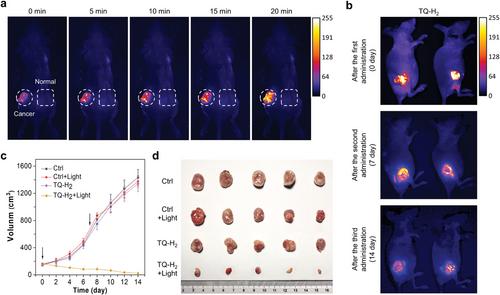
Precise tumor diagnosis and treatment remain complex challenges. While numerous fluorescent probes have been developed for tumor-specific imaging and therapy, few exhibit effective function in vivo. Herein, a probe called TQ-H2 is designed that can realize robust theranostic effects both in vitro and in vivo. In vitro, TQ-H2 specifically targets the lysosome and reacts with hydroxyl radical (·OH) to generate TQ-HA, which lights up the cells. TQ-HA generates reactive oxygen species (ROS) under light irradiation, enabling the simultaneous induction and monitoring of apoptosis and ferroptosis in tumor cells. Remarkably, TQ-HA also acts as a self-amplifier, autocatalytically activating TQ-H2 by generating ·OH under light exposure. This self-amplification aligns with the tumor microenvironment, where TQ-H2 undergoes chemical transformation, distinguishing tumors from healthy tissue via near-infrared (NIR) fluorescence imaging. Furthermore, ROS generated by TQ-HA effectively kills tumor cells and inhibits tumor growth without harming normal cells. This study offers a promising strategy for targeted tumor theranostics using self-amplifying microenvironment-responsive fluorescent probes.
期刊介绍:
Advanced Science is a prestigious open access journal that focuses on interdisciplinary research in materials science, physics, chemistry, medical and life sciences, and engineering. The journal aims to promote cutting-edge research by employing a rigorous and impartial review process. It is committed to presenting research articles with the highest quality production standards, ensuring maximum accessibility of top scientific findings. With its vibrant and innovative publication platform, Advanced Science seeks to revolutionize the dissemination and organization of scientific knowledge.





 京公网安备 11010802042870号
京ICP备2023020795号-1
京公网安备 11010802042870号
京ICP备2023020795号-1

 分享
分享
 求助内容:
求助内容: 应助结果提醒方式:
 扫码关注我们
