Comparison of efficacy and safety of neoadjuvant immunochemotherapy in young and elderly patients with IIA-IIIB non-small-cell lung cancer in real-world practice.
Jiacong Liu, Xuhua Huang, Yuhong Yang, Wang Lv, Yiqing Wang, Pinghui Xia, Jian Hu
{"title":"Comparison of efficacy and safety of neoadjuvant immunochemotherapy in young and elderly patients with IIA-IIIB non-small-cell lung cancer in real-world practice.","authors":"Jiacong Liu, Xuhua Huang, Yuhong Yang, Wang Lv, Yiqing Wang, Pinghui Xia, Jian Hu","doi":"10.1186/s12890-024-03417-8","DOIUrl":null,"url":null,"abstract":"<p><strong>Objective: </strong>There is currently no consensus over whether neoadjuvant immunochemotherapy is more effective in young patients than in elderly patients with IIA-IIIB non-small-cell lung cancer (NSCLC). In this study, we compare the efficacy and safety of neoadjuvant immunochemotherapy in young and elderly patients with IIA-IIIB NSCLC.</p><p><strong>Methods: </strong>This retrospective study consecutively included IIA-IIIB NSCLC patients who received 2-4 cycles preoperative immunochemotherapy at the Department of Thoracic Surgery, the First Affiliated Hospital, Zhejiang University School of Medicine from 2019 to 2022. The 1:1 propensity score match analysis was conducted to balance the confounding factors between the young patient group (< 65 years old) and elderly patient group (≥ 65 years old). The follow-up period would not end until at least 1 year after surgery or patient's decision to abandon treatment. The primary endpoint was pathological response, while the secondary endpoints were objective response rate (ORR), adverse events (AEs), disease-free survival (DFS) and overall survival (OS).</p><p><strong>Results: </strong>A total of 179 patients were included in our study: <65 years group (71 patients) and ≥ 65 years group (108 patients). After a 1:1 propensity score matching,132 patients (66 pairs) were analyzed to compare the efficacy and safety between the two groups. The ORR in the young patient group and elderly patient group was 72.7% and 71.2% (P = 1.000), respectively. The incidence of grade 3-4 AEs in the elderly patient group was similar to the young patient group (13.6% vs. 16.7%, P = 0.627). About 62.1% (41/66) in the young patient group and 54.5% (36/66) in the elderly patient group eventually underwent surgery. The rate of major pathological response (MPR) in the young patient group and elderly patient group was 68.3% and 55.6% (P = 0.903), respectively. The rate of pathological complete response (pCR) in the young patient group was significantly higher than that in the elderly patient group (46.3% vs. 22.2%, P = 0.027). The median DFS in the young patient group was not reached and 32.2 months in the elderly patient group (P = 0.071). The 1-year DFS rate, 2-year DFS rate and 3-year DFS rate in the young patient group were 90.2%, 85.4% and 80.5%, with that in the elderly patient group 86.1%, 69.4% and 66.7%. The median OS in the young patient group was 42.4 months and not reached in the elderly patient group (P = 0.067). The 1-year OS rate, 2-year OS rate and 3-year OS rate in the young patient group were 97.6%, 90.2% and 90.2%, with that in the elderly patient group 88.9%, 80.6% and 72.2%.</p><p><strong>Conclusions: </strong>For IIA-IIIB NSCLC, neoadjuvant immunochemotherapy in young patients can produce a higher percentage of patients with a pCR than in elderly patients. However, the survival benefits and incidence of AEs are similar in young and elderly patients.</p>","PeriodicalId":9148,"journal":{"name":"BMC Pulmonary Medicine","volume":"24 1","pages":"592"},"PeriodicalIF":2.8000,"publicationDate":"2024-11-29","publicationTypes":"Journal Article","fieldsOfStudy":null,"isOpenAccess":false,"openAccessPdf":"https://www.ncbi.nlm.nih.gov/pmc/articles/PMC11606034/pdf/","citationCount":"0","resultStr":null,"platform":"Semanticscholar","paperid":null,"PeriodicalName":"BMC Pulmonary Medicine","FirstCategoryId":"3","ListUrlMain":"https://doi.org/10.1186/s12890-024-03417-8","RegionNum":3,"RegionCategory":"医学","ArticlePicture":[],"TitleCN":null,"AbstractTextCN":null,"PMCID":null,"EPubDate":"","PubModel":"","JCR":"Q2","JCRName":"RESPIRATORY SYSTEM","Score":null,"Total":0}
引用次数: 0
Abstract
Objective: There is currently no consensus over whether neoadjuvant immunochemotherapy is more effective in young patients than in elderly patients with IIA-IIIB non-small-cell lung cancer (NSCLC). In this study, we compare the efficacy and safety of neoadjuvant immunochemotherapy in young and elderly patients with IIA-IIIB NSCLC.
Methods: This retrospective study consecutively included IIA-IIIB NSCLC patients who received 2-4 cycles preoperative immunochemotherapy at the Department of Thoracic Surgery, the First Affiliated Hospital, Zhejiang University School of Medicine from 2019 to 2022. The 1:1 propensity score match analysis was conducted to balance the confounding factors between the young patient group (< 65 years old) and elderly patient group (≥ 65 years old). The follow-up period would not end until at least 1 year after surgery or patient's decision to abandon treatment. The primary endpoint was pathological response, while the secondary endpoints were objective response rate (ORR), adverse events (AEs), disease-free survival (DFS) and overall survival (OS).
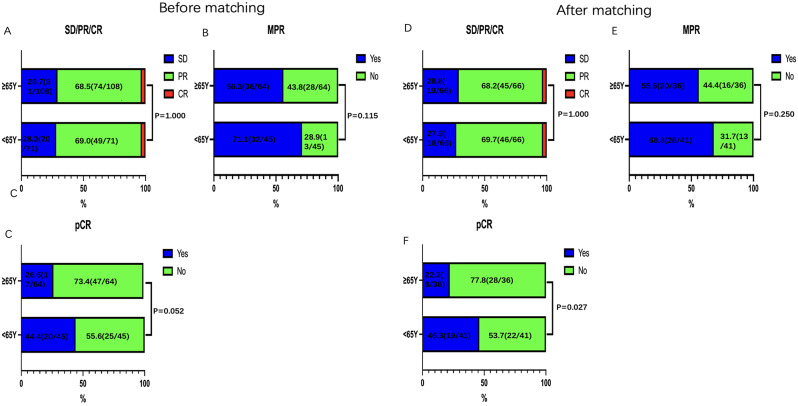
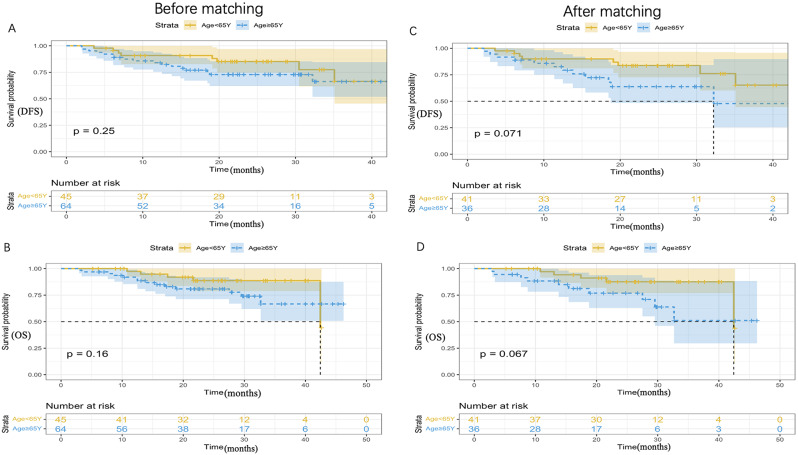
Results: A total of 179 patients were included in our study: <65 years group (71 patients) and ≥ 65 years group (108 patients). After a 1:1 propensity score matching,132 patients (66 pairs) were analyzed to compare the efficacy and safety between the two groups. The ORR in the young patient group and elderly patient group was 72.7% and 71.2% (P = 1.000), respectively. The incidence of grade 3-4 AEs in the elderly patient group was similar to the young patient group (13.6% vs. 16.7%, P = 0.627). About 62.1% (41/66) in the young patient group and 54.5% (36/66) in the elderly patient group eventually underwent surgery. The rate of major pathological response (MPR) in the young patient group and elderly patient group was 68.3% and 55.6% (P = 0.903), respectively. The rate of pathological complete response (pCR) in the young patient group was significantly higher than that in the elderly patient group (46.3% vs. 22.2%, P = 0.027). The median DFS in the young patient group was not reached and 32.2 months in the elderly patient group (P = 0.071). The 1-year DFS rate, 2-year DFS rate and 3-year DFS rate in the young patient group were 90.2%, 85.4% and 80.5%, with that in the elderly patient group 86.1%, 69.4% and 66.7%. The median OS in the young patient group was 42.4 months and not reached in the elderly patient group (P = 0.067). The 1-year OS rate, 2-year OS rate and 3-year OS rate in the young patient group were 97.6%, 90.2% and 90.2%, with that in the elderly patient group 88.9%, 80.6% and 72.2%.
Conclusions: For IIA-IIIB NSCLC, neoadjuvant immunochemotherapy in young patients can produce a higher percentage of patients with a pCR than in elderly patients. However, the survival benefits and incidence of AEs are similar in young and elderly patients.
期刊介绍:
BMC Pulmonary Medicine is an open access, peer-reviewed journal that considers articles on all aspects of the prevention, diagnosis and management of pulmonary and associated disorders, as well as related molecular genetics, pathophysiology, and epidemiology.




 京公网安备 11010802042870号
京ICP备2023020795号-1
京公网安备 11010802042870号
京ICP备2023020795号-1

 分享
分享
 求助内容:
求助内容: 应助结果提醒方式:
 扫码关注我们
