Xue Wang , Zhu-Jun Zhong , Peng-Fei Chen , Chao-Fan Deng , Xiao-Mei Chen , Gui-Zhong Xin , Dan Tang
{"title":"Integrating metabolomics and network pharmacology to investigate Da-Chai-Hu Decoction prevents kidney injury in diabetic mice","authors":"Xue Wang , Zhu-Jun Zhong , Peng-Fei Chen , Chao-Fan Deng , Xiao-Mei Chen , Gui-Zhong Xin , Dan Tang","doi":"10.1016/j.jep.2024.119158","DOIUrl":null,"url":null,"abstract":"<div><h3>Ethnopharmacological relevance</h3><div>The current treatment for diabetic nephropathy (DN) is inadequate, and there is an urgent need for an effective and minimally adverse alternative therapy. Da-Chai-Hu Decoction (DCHD) is a time-honored herbal remedy from Chinese medicine, boasting a legacy spanning more than 1800 years. Clinical observations suggest that it may provide therapeutic benefits for individuals with type 2 diabetes mellitus (T2DM). Nonetheless, the specific advantages of DCHD in relation to DN and the mechanisms through which it operates are still not well understood.</div></div><div><h3>Aim of the study</h3><div>This research aims to investigate whether DCHD can avert renal damage in mice with T2DM and to elucidate the mechanisms by which DCHD combats DN through the integration of metabolomics and network pharmacology.</div></div><div><h3>Materials and methods</h3><div>The beneficial effects of DCHD on DN was initially evaluated using a renal injury model in T2DM mice. Subsequently, untargeted metabolomics analysis was utilized to investigate the potential mechanisms of DCHD against DN. Additionally, UPLC-HR MS/MS was employed to identify the chemical components in DCHD and the absorption components in DCHD-treated plasma. Network pharmacology and our newly proposed function-guided and network-based complementary methodology (FNICM) was utilized to predict the potential pathway of DCHD intervention in DN. Finally, the core pathway was validated through Western blotting analysis and ELISA.</div></div><div><h3>Results</h3><div>A total of 260 chemical components were detected in DCHD, and 41 absorption components were found in DCHD-treated plasma by UPLC-HR MS/MS for the first time. Additionally, In vivo experiments revealed that DCHD exerts the ability to regulate the disorder in glucose/lipid metabolism and improves kidney dysfunction. Furthermore, a comprehensive analysis utilizing non-targeted urine metabolomics and the FNICM method identified a total of 33 differential metabolites, which were categorized as core metabolites. Lastly, combined FNICM, network pharmacology and experimental pharmacology studies suggest that DCHD may regulate the AGEs/RAGE/AKT pathways in combating DN.</div></div><div><h3>Conclusions</h3><div>The results indicate that DCHD treats DN through the inhibition of the AGEs/RAGE/AKT pathway and by regulating metabolic profiles.</div></div>","PeriodicalId":15761,"journal":{"name":"Journal of ethnopharmacology","volume":"340 ","pages":"Article 119158"},"PeriodicalIF":5.4000,"publicationDate":"2025-01-31","publicationTypes":"Journal Article","fieldsOfStudy":null,"isOpenAccess":false,"openAccessPdf":"","citationCount":"0","resultStr":null,"platform":"Semanticscholar","paperid":null,"PeriodicalName":"Journal of ethnopharmacology","FirstCategoryId":"3","ListUrlMain":"https://www.sciencedirect.com/science/article/pii/S0378874124014570","RegionNum":2,"RegionCategory":"医学","ArticlePicture":[],"TitleCN":null,"AbstractTextCN":null,"PMCID":null,"EPubDate":"2024/11/27 0:00:00","PubModel":"Epub","JCR":"Q1","JCRName":"CHEMISTRY, MEDICINAL","Score":null,"Total":0}
引用次数: 0
Abstract
Ethnopharmacological relevance
The current treatment for diabetic nephropathy (DN) is inadequate, and there is an urgent need for an effective and minimally adverse alternative therapy. Da-Chai-Hu Decoction (DCHD) is a time-honored herbal remedy from Chinese medicine, boasting a legacy spanning more than 1800 years. Clinical observations suggest that it may provide therapeutic benefits for individuals with type 2 diabetes mellitus (T2DM). Nonetheless, the specific advantages of DCHD in relation to DN and the mechanisms through which it operates are still not well understood.
Aim of the study
This research aims to investigate whether DCHD can avert renal damage in mice with T2DM and to elucidate the mechanisms by which DCHD combats DN through the integration of metabolomics and network pharmacology.
Materials and methods
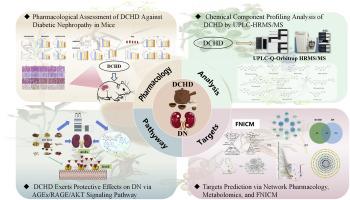
The beneficial effects of DCHD on DN was initially evaluated using a renal injury model in T2DM mice. Subsequently, untargeted metabolomics analysis was utilized to investigate the potential mechanisms of DCHD against DN. Additionally, UPLC-HR MS/MS was employed to identify the chemical components in DCHD and the absorption components in DCHD-treated plasma. Network pharmacology and our newly proposed function-guided and network-based complementary methodology (FNICM) was utilized to predict the potential pathway of DCHD intervention in DN. Finally, the core pathway was validated through Western blotting analysis and ELISA.
Results
A total of 260 chemical components were detected in DCHD, and 41 absorption components were found in DCHD-treated plasma by UPLC-HR MS/MS for the first time. Additionally, In vivo experiments revealed that DCHD exerts the ability to regulate the disorder in glucose/lipid metabolism and improves kidney dysfunction. Furthermore, a comprehensive analysis utilizing non-targeted urine metabolomics and the FNICM method identified a total of 33 differential metabolites, which were categorized as core metabolites. Lastly, combined FNICM, network pharmacology and experimental pharmacology studies suggest that DCHD may regulate the AGEs/RAGE/AKT pathways in combating DN.
Conclusions
The results indicate that DCHD treats DN through the inhibition of the AGEs/RAGE/AKT pathway and by regulating metabolic profiles.
期刊介绍:
The Journal of Ethnopharmacology is dedicated to the exchange of information and understandings about people''s use of plants, fungi, animals, microorganisms and minerals and their biological and pharmacological effects based on the principles established through international conventions. Early people confronted with illness and disease, discovered a wealth of useful therapeutic agents in the plant and animal kingdoms. The empirical knowledge of these medicinal substances and their toxic potential was passed on by oral tradition and sometimes recorded in herbals and other texts on materia medica. Many valuable drugs of today (e.g., atropine, ephedrine, tubocurarine, digoxin, reserpine) came into use through the study of indigenous remedies. Chemists continue to use plant-derived drugs (e.g., morphine, taxol, physostigmine, quinidine, emetine) as prototypes in their attempts to develop more effective and less toxic medicinals.




 京公网安备 11010802042870号
京ICP备2023020795号-1
京公网安备 11010802042870号
京ICP备2023020795号-1

 分享
分享
 求助内容:
求助内容: 应助结果提醒方式:
 扫码关注我们
