Hai-Yu Duan, Xiu-Yuan Li, Lei Hou, Si-Ru Liu, Xiang-Yu Liu and Ping Wang
{"title":"Efficient inverse CO2/C2H2 separation driven by difference in rare thermodynamic affinities in a porous MOF†","authors":"Hai-Yu Duan, Xiu-Yuan Li, Lei Hou, Si-Ru Liu, Xiang-Yu Liu and Ping Wang","doi":"10.1039/D4QI02531H","DOIUrl":null,"url":null,"abstract":"<p >Separating C<small><sub>2</sub></small>H<small><sub>2</sub></small> from CO<small><sub>2</sub></small> is crucial in the petrochemicals industry but extremely difficult, owing to their very close molecular sizes and similar physical characteristics. Herein, a new porous MOF with 1D rhombus channels featuring plentiful open metal sites was built. The activated framework presents a high CO<small><sub>2</sub></small> uptake of 83.1 cm<small><sup>3</sup></small> cm<small><sup>−3</sup></small> at 298 K under 100 kPa and uncommon inverse selectivity for the CO<small><sub>2</sub></small>/C<small><sub>2</sub></small>H<small><sub>2</sub></small> mixtures. What's more, the MOF can directly yield high-purity C<small><sub>2</sub></small>H<small><sub>2</sub></small> (≥99.9%) from CO<small><sub>2</sub></small>/C<small><sub>2</sub></small>H<small><sub>2</sub></small> mixtures (v/v = 50/50 and 10/90) under ambient conditions through a single breakthrough separation process, which significantly increased the separation efficiency and reduced energy consumption. The GCMC simulations revealed that highly efficient inverse CO<small><sub>2</sub></small>/C<small><sub>2</sub></small>H<small><sub>2</sub></small> separation performance arose from the higher thermodynamic affinities for CO<small><sub>2</sub></small> than C<small><sub>2</sub></small>H<small><sub>2</sub></small>.</p>","PeriodicalId":79,"journal":{"name":"Inorganic Chemistry Frontiers","volume":" 2","pages":" 723-729"},"PeriodicalIF":6.4000,"publicationDate":"2024-11-30","publicationTypes":"Journal Article","fieldsOfStudy":null,"isOpenAccess":false,"openAccessPdf":"","citationCount":"0","resultStr":null,"platform":"Semanticscholar","paperid":null,"PeriodicalName":"Inorganic Chemistry Frontiers","FirstCategoryId":"92","ListUrlMain":"https://pubs.rsc.org/en/content/articlelanding/2025/qi/d4qi02531h","RegionNum":1,"RegionCategory":"化学","ArticlePicture":[],"TitleCN":null,"AbstractTextCN":null,"PMCID":null,"EPubDate":"","PubModel":"","JCR":"Q1","JCRName":"CHEMISTRY, INORGANIC & NUCLEAR","Score":null,"Total":0}
引用次数: 0
Abstract
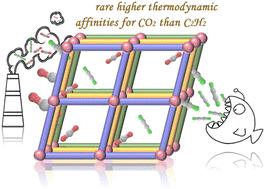
Separating C2H2 from CO2 is crucial in the petrochemicals industry but extremely difficult, owing to their very close molecular sizes and similar physical characteristics. Herein, a new porous MOF with 1D rhombus channels featuring plentiful open metal sites was built. The activated framework presents a high CO2 uptake of 83.1 cm3 cm−3 at 298 K under 100 kPa and uncommon inverse selectivity for the CO2/C2H2 mixtures. What's more, the MOF can directly yield high-purity C2H2 (≥99.9%) from CO2/C2H2 mixtures (v/v = 50/50 and 10/90) under ambient conditions through a single breakthrough separation process, which significantly increased the separation efficiency and reduced energy consumption. The GCMC simulations revealed that highly efficient inverse CO2/C2H2 separation performance arose from the higher thermodynamic affinities for CO2 than C2H2.




 京公网安备 11010802042870号
京ICP备2023020795号-1
京公网安备 11010802042870号
京ICP备2023020795号-1

 分享
分享
 求助内容:
求助内容: 应助结果提醒方式:
 扫码关注我们
