Hanna Huber, Valentina Cantoni, Daniele Altomare, Lana Grötschel, Laia Montoliu-Gaya, Francisco Meda, Hlin Kvartsberg, Ilenia Libri, Maria Sofia Cotelli, Henrik Zetterberg, Kaj Blennow, Barbara Borroni, Nicholas J. Ashton
{"title":"The detection of GRN mutation carriers by progranulin blood protein levels from finger-stick collection","authors":"Hanna Huber, Valentina Cantoni, Daniele Altomare, Lana Grötschel, Laia Montoliu-Gaya, Francisco Meda, Hlin Kvartsberg, Ilenia Libri, Maria Sofia Cotelli, Henrik Zetterberg, Kaj Blennow, Barbara Borroni, Nicholas J. Ashton","doi":"10.1002/alz.14259","DOIUrl":null,"url":null,"abstract":"<div>\n \n \n <section>\n \n <h3> INTRODUCTION</h3>\n \n <p>Heterozygous mutations in the progranulin gene (<i>GRN</i>) leading to decreased progranulin levels are one of the most frequent causes of inherited frontotemporal dementia (FTD). We evaluated progranulin levels in dried blood spots from capillary finger-stick collection (DBS<sup>capillary</sup>).</p>\n </section>\n \n <section>\n \n <h3> METHODS</h3>\n \n <p>Paired venous Ethylenediaminetetraacetic acid (EDTA) plasma and DBS<sup>capillary</sup> samples were collected from each participant with or without pathogenic <i>GRN</i> mutations.</p>\n </section>\n \n <section>\n \n <h3> RESULTS</h3>\n \n <p>DBS<sup>capillary</sup> progranulin levels in <i>GRN</i> mutation carriers (mean [SD] age, 55 [13] years; <i>n</i> = 16) were reduced compared to non-mutation carriers (64 [11] years; <i>n</i> = 44) (2.38 ng/mL [1.0] vs 4.37 [0.68] ng/mL; <i>U</i> = 42; <i>p </i>< 0.0001, ROC AUC = 0.94 [95% CI: 0.83 to 1.00]) and highly associated with venous plasma levels (<i>R</i> = 0.819; <i>p </i>< 0.001).</p>\n </section>\n \n <section>\n \n <h3> DISCUSSION</h3>\n \n <p>Progranulin levels can be accurately determined from finger-stick blood samples. This can enable regular and remote monitoring of this protein in FTD therapeutic trials and potentially serve as a first-level screening test for GRN mutations.</p>\n </section>\n \n <section>\n \n <h3> Highlights</h3>\n \n <div>\n <ul>\n \n <li>Progranulin levels measured using capillary dried blood spots were significantly reduced in <i>GRN</i> mutation carriers compared to non-mutation carriers.</li>\n \n <li>Progranulin levels measured using capillary dried blood spots strongly correlated with levels from venous EDTA plasma.</li>\n \n <li>DBS<sup>capillary</sup> progranulin levels were able to identify <i>GRN</i> mutation carriers with high accuracy.</li>\n \n <li>DBS<sup>capillary</sup> might allow repeated measurements of progranulin levels in a remote and unsupervised setting, circumventing the restrictions of traditional venous blood collection.</li>\n \n <li>DBS<sup>capillary</sup> might be used to assess the biological efficacy of disease-modifying therapies in clinical trials aiming to increase baseline progranulin levels or as a first-level screening for <i>GRN</i> mutations in primary settings.</li>\n </ul>\n </div>\n </section>\n </div>","PeriodicalId":7471,"journal":{"name":"Alzheimer's & Dementia","volume":"21 1","pages":""},"PeriodicalIF":11.1000,"publicationDate":"2024-11-30","publicationTypes":"Journal Article","fieldsOfStudy":null,"isOpenAccess":false,"openAccessPdf":"https://onlinelibrary.wiley.com/doi/epdf/10.1002/alz.14259","citationCount":"0","resultStr":null,"platform":"Semanticscholar","paperid":null,"PeriodicalName":"Alzheimer's & Dementia","FirstCategoryId":"3","ListUrlMain":"https://alz-journals.onlinelibrary.wiley.com/doi/10.1002/alz.14259","RegionNum":1,"RegionCategory":"医学","ArticlePicture":[],"TitleCN":null,"AbstractTextCN":null,"PMCID":null,"EPubDate":"","PubModel":"","JCR":"Q1","JCRName":"CLINICAL NEUROLOGY","Score":null,"Total":0}
引用次数: 0
Abstract
INTRODUCTION
Heterozygous mutations in the progranulin gene (GRN) leading to decreased progranulin levels are one of the most frequent causes of inherited frontotemporal dementia (FTD). We evaluated progranulin levels in dried blood spots from capillary finger-stick collection (DBScapillary).
METHODS
Paired venous Ethylenediaminetetraacetic acid (EDTA) plasma and DBScapillary samples were collected from each participant with or without pathogenic GRN mutations.
RESULTS
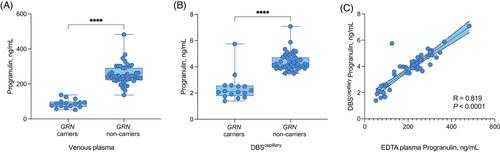
DBScapillary progranulin levels in GRN mutation carriers (mean [SD] age, 55 [13] years; n = 16) were reduced compared to non-mutation carriers (64 [11] years; n = 44) (2.38 ng/mL [1.0] vs 4.37 [0.68] ng/mL; U = 42; p < 0.0001, ROC AUC = 0.94 [95% CI: 0.83 to 1.00]) and highly associated with venous plasma levels (R = 0.819; p < 0.001).
DISCUSSION
Progranulin levels can be accurately determined from finger-stick blood samples. This can enable regular and remote monitoring of this protein in FTD therapeutic trials and potentially serve as a first-level screening test for GRN mutations.
Highlights
Progranulin levels measured using capillary dried blood spots were significantly reduced in GRN mutation carriers compared to non-mutation carriers.
Progranulin levels measured using capillary dried blood spots strongly correlated with levels from venous EDTA plasma.
DBScapillary progranulin levels were able to identify GRN mutation carriers with high accuracy.
DBScapillary might allow repeated measurements of progranulin levels in a remote and unsupervised setting, circumventing the restrictions of traditional venous blood collection.
DBScapillary might be used to assess the biological efficacy of disease-modifying therapies in clinical trials aiming to increase baseline progranulin levels or as a first-level screening for GRN mutations in primary settings.
期刊介绍:
Alzheimer's & Dementia is a peer-reviewed journal that aims to bridge knowledge gaps in dementia research by covering the entire spectrum, from basic science to clinical trials to social and behavioral investigations. It provides a platform for rapid communication of new findings and ideas, optimal translation of research into practical applications, increasing knowledge across diverse disciplines for early detection, diagnosis, and intervention, and identifying promising new research directions. In July 2008, Alzheimer's & Dementia was accepted for indexing by MEDLINE, recognizing its scientific merit and contribution to Alzheimer's research.





 京公网安备 11010802042870号
京ICP备2023020795号-1
京公网安备 11010802042870号
京ICP备2023020795号-1

 分享
分享
 求助内容:
求助内容: 应助结果提醒方式:
 扫码关注我们
