Liya Li, Zhanpeng He, Zhi Gao, Xinmin Zhang, Shengzhi Zhu, Yicheng Ge
{"title":"Phase transition and magnetocaloric effect of LaFe11.5Si1.5Cx compounds: experiments and density functional theory calculations","authors":"Liya Li, Zhanpeng He, Zhi Gao, Xinmin Zhang, Shengzhi Zhu, Yicheng Ge","doi":"10.1016/j.jallcom.2024.177909","DOIUrl":null,"url":null,"abstract":"The itinerant-electron metamagnetic (IEM) transition is a crucial phenomenon in first-order transition magnetocaloric materials. However, most magnetocaloric materials experience a transition from first to second order, weakening their IEM transition and magnetocaloric effect. This study uses experiments and density functional theory (DFT) calculations to elucidate phase transition and magnetocaloric effect in C-doped La(Fe,Si)<sub>13</sub> compounds. The LaFe<sub>11.5</sub>Si<sub>1.5</sub>C<sub>x</sub> alloys exhibit a cubic NaZn<sub>13</sub>-type 1:13 primary phase. The critical phase transition from first order to second order occurs at <em>x</em> = 0.14. As <em>x</em> increases from 0 to 0.6, the maximum magnetic entropy change (<span><span style=\"\"><math><msubsup is=\"true\"><mrow is=\"true\"><mi is=\"true\" mathvariant=\"normal\">Δ</mi><mi is=\"true\">S</mi></mrow><mrow is=\"true\"><mi is=\"true\" mathvariant=\"normal\">M</mi></mrow><mrow is=\"true\"><mi is=\"true\">max</mi></mrow></msubsup></math></span><span style=\"font-size: 90%; display: inline-block;\" tabindex=\"0\"></span><script type=\"math/mml\"><math><msubsup is=\"true\"><mrow is=\"true\"><mi mathvariant=\"normal\" is=\"true\">Δ</mi><mi is=\"true\">S</mi></mrow><mrow is=\"true\"><mi mathvariant=\"normal\" is=\"true\">M</mi></mrow><mrow is=\"true\"><mi is=\"true\">max</mi></mrow></msubsup></math></script></span>) decreases from 19.6 to 4.5<!-- --> <!-- -->J∙kg<sup>-1</sup>∙K<sup>-1</sup> at <span><span style=\"\"><math><msub is=\"true\"><mrow is=\"true\"><mi is=\"true\">μ</mi></mrow><mrow is=\"true\"><mn is=\"true\">0</mn></mrow></msub><mo is=\"true\">∆</mo><mi is=\"true\">H</mi><mo is=\"true\" linebreak=\"goodbreak\" linebreakstyle=\"after\">=</mo><mn is=\"true\">2</mn><mi is=\"true\" mathvariant=\"italic\">T</mi></math></span><span style=\"font-size: 90%; display: inline-block;\" tabindex=\"0\"></span><script type=\"math/mml\"><math><msub is=\"true\"><mrow is=\"true\"><mi is=\"true\">μ</mi></mrow><mrow is=\"true\"><mn is=\"true\">0</mn></mrow></msub><mo is=\"true\">∆</mo><mi is=\"true\">H</mi><mo linebreak=\"goodbreak\" linebreakstyle=\"after\" is=\"true\">=</mo><mn is=\"true\">2</mn><mi mathvariant=\"italic\" is=\"true\">T</mi></math></script></span>, while the Curie temperature (<em>T</em><sub><em>c</em></sub>) rises from 193 to 251<!-- --> <!-- -->K. DFT calculations reveal that interstitial C-24d atom reduces the magnetic moment of 4 adjacent Fe-96i atoms, contracts the B1, B2 and B3 intra-icosahedron Fe-Fe bonds, but elongates the B4 and B5 inter-icosahedron bonds. Furthermore, the phase transition from first order to second order is attributed to the formation of Fe-C covalent bonds and localization of Fe 3d electrons, due to the strong electronic hybridization of the C 2p and Fe 3d states. C-doping weakens the IEM transition by shifting the minimum in the minority density of states (DOS) channels from the Fermi level to lower energies. This study offers valuable insights into the phase transition and IEM transition behaviors and paves the way for designing high performance magnetocaloric alloys.","PeriodicalId":344,"journal":{"name":"Journal of Alloys and Compounds","volume":"16 1","pages":""},"PeriodicalIF":6.3000,"publicationDate":"2024-12-02","publicationTypes":"Journal Article","fieldsOfStudy":null,"isOpenAccess":false,"openAccessPdf":"","citationCount":"0","resultStr":null,"platform":"Semanticscholar","paperid":null,"PeriodicalName":"Journal of Alloys and Compounds","FirstCategoryId":"88","ListUrlMain":"https://doi.org/10.1016/j.jallcom.2024.177909","RegionNum":2,"RegionCategory":"材料科学","ArticlePicture":[],"TitleCN":null,"AbstractTextCN":null,"PMCID":null,"EPubDate":"","PubModel":"","JCR":"Q2","JCRName":"CHEMISTRY, PHYSICAL","Score":null,"Total":0}
引用次数: 0
Abstract
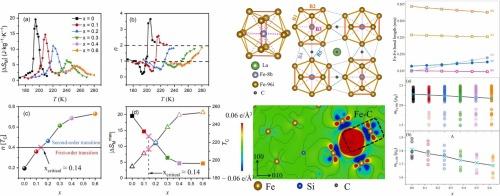
The itinerant-electron metamagnetic (IEM) transition is a crucial phenomenon in first-order transition magnetocaloric materials. However, most magnetocaloric materials experience a transition from first to second order, weakening their IEM transition and magnetocaloric effect. This study uses experiments and density functional theory (DFT) calculations to elucidate phase transition and magnetocaloric effect in C-doped La(Fe,Si)13 compounds. The LaFe11.5Si1.5Cx alloys exhibit a cubic NaZn13-type 1:13 primary phase. The critical phase transition from first order to second order occurs at x = 0.14. As x increases from 0 to 0.6, the maximum magnetic entropy change () decreases from 19.6 to 4.5 J∙kg-1∙K-1 at , while the Curie temperature (Tc) rises from 193 to 251 K. DFT calculations reveal that interstitial C-24d atom reduces the magnetic moment of 4 adjacent Fe-96i atoms, contracts the B1, B2 and B3 intra-icosahedron Fe-Fe bonds, but elongates the B4 and B5 inter-icosahedron bonds. Furthermore, the phase transition from first order to second order is attributed to the formation of Fe-C covalent bonds and localization of Fe 3d electrons, due to the strong electronic hybridization of the C 2p and Fe 3d states. C-doping weakens the IEM transition by shifting the minimum in the minority density of states (DOS) channels from the Fermi level to lower energies. This study offers valuable insights into the phase transition and IEM transition behaviors and paves the way for designing high performance magnetocaloric alloys.
期刊介绍:
The Journal of Alloys and Compounds is intended to serve as an international medium for the publication of work on solid materials comprising compounds as well as alloys. Its great strength lies in the diversity of discipline which it encompasses, drawing together results from materials science, solid-state chemistry and physics.



 京公网安备 11010802042870号
京ICP备2023020795号-1
京公网安备 11010802042870号
京ICP备2023020795号-1

 分享
分享
 求助内容:
求助内容: 应助结果提醒方式:
 扫码关注我们
